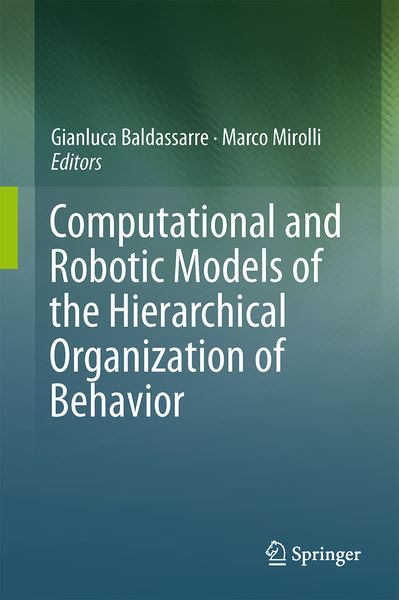
Computational and Robotic Models of the Hierarchical Organization of Behavior
-
- Hardcover ausgewählt
- Taschenbuch
- eBook
-
Sprache:Englisch
99,99 €
inkl. gesetzl. MwSt.,
Beschreibung
Produktdetails
Einband
Gebundene Ausgabe
Erscheinungsdatum
02.12.2013
Abbildungen
VI, 358 p. 116 illus., 73 illus. in color.
Herausgeber
Gianluca Baldassarre + weitereVerlag
Springer BerlinSeitenzahl
358
Maße (L/B/H)
24,1/16/2,6 cm
Gewicht
711 g
Auflage
2013
Sprache
Englisch
ISBN
978-3-642-39874-2
Current robots and other artificial systems are typically able to accomplish only one single task. Overcoming this limitation requires the development of control architectures and learning algorithms that can support the acquisition and deployment of several different skills, which in turn seems to require a modular and hierarchical organization. In this way, different modules can acquire different skills without catastrophic interference, and higher-level components of the system can solve complex tasks by exploiting the skills encapsulated in the lower-level modules. While machine learning and robotics recognize the fundamental importance of the hierarchical organization of behavior for building robots that scale up to solve complex tasks, research in psychology and neuroscience shows increasing evidence that modularity and hierarchy are pivotal organization principles of behavior and of the brain. They might even lead to the cumulative acquisition of an ever-increasing number of skills, which seems to be a characteristic of mammals, and humans in particular.
This book is a comprehensive overview of the state of the art on the modeling of the hierarchical organization of behavior in animals, and on its exploitation in robot controllers. The book perspective is highly interdisciplinary, featuring models belonging to all relevant areas, including machine learning, robotics, neural networks, and computational modeling in psychology and neuroscience. The book chapters review the authors' most recent contributions to the investigation of hierarchical behavior, and highlight the open questions and most promising research directions. As the contributing authors are among the pioneers carrying out fundamental work on this topic, the book covers the most important and topical issues in the field from a computationally informed, theoretically oriented perspective. The book will be of benefit to academic and industrial researchers and graduate students in related disciplines.
Noch keine Bewertungen vorhanden
Verfassen Sie die erste Bewertung zu diesem Artikel
Helfen Sie anderen Kundinnen und Kunden durch Ihre Meinung.
Kurze Frage zu unserer Seite
Vielen Dank für Ihr Feedback
Wir nutzen Ihr Feedback, um unsere Produktseiten zu verbessern. Bitte haben Sie Verständnis, dass wir Ihnen keine Rückmeldung geben können. Falls Sie Kontakt mit uns aufnehmen möchten, können Sie sich aber gerne an unseren Kund*innenservice wenden.
zum Kundenservice