
KI-Beratung Beta

Gutscheinbedingungen

**Gültig bis 30.11.2026 auf Spielzeug, Schreibwaren, Filme, Geschenke & Trends, Musik, tolino eReader & Zubehör, Hörbücher und Hörbuch-Downloads, nicht preisgebundene Bücher und Kalender online auf thalia.at und in der Thalia App. Einzelne Artikel können ausgeschlossen sein. Aufgrund der Buchpreisbindung sind deutschsprachige Bücher und eBooks ausgenommen. Zusätzlich ausgenommen sind Abos & Flatrates, Games, Geschenkkarten/-boxen, Shelfies, Software, Zeitschriften sowie einzelne Artikel von tonies®. Pro Einkauf einmal einlösbar. Nur gültig mit im Onlineshop hinterlegter Bonuscard. Click & Collect nur bei Onlinevorabzahlung möglich. Keine Barauszahlung. Nicht kombinierbar mit anderen Aktionen und Gutscheinen. Gutschein wird auf max. 500€ Bestellwert angerechnet. Nicht gültig für Versandkosten und Services.

  • Produktbild: The Challenge of Non-Territorial Autonomy
  • Produktbild: The Challenge of Non-Territorial Autonomy
Band 13

The Challenge of Non-Territorial Autonomy Theory and Practice

79,60 €

inkl. gesetzl. MwSt., Versandkostenfrei


Beschreibung

This book explores and evaluates non-territorial autonomy (NTA), an important modality of ethnic and religious diversity management. Whereas multicultural liberal democracies sincerely champion equality and individual human rights, they often have considerable difficulty in accommodating culturally diverse...

Beschreibung

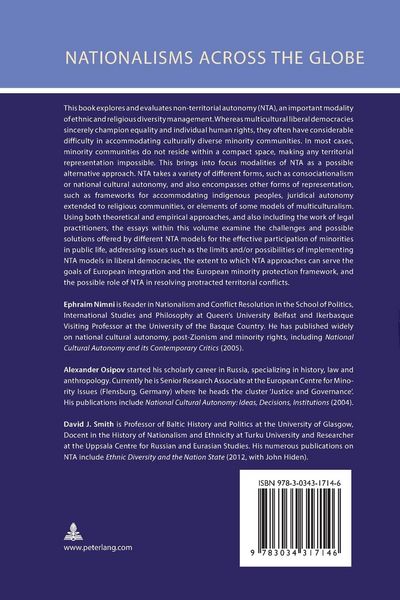
This book explores and evaluates non-territorial autonomy (NTA), an important modality of ethnic and religious diversity management. Whereas multicultural liberal democracies sincerely champion equality and individual human rights, they often have considerable difficulty in accommodating culturally diverse minority communities. In most cases, minority communities do not reside within a compact space, making any territorial representation impossible. This brings into focus modalities of NTA as a possible alternative approach. NTA takes a variety of different forms, such as consociationalism or national cultural autonomy, and also encompasses other forms of representation, such as frameworks for accommodating indigenous peoples, juridical autonomy extended to religious communities, or elements of some models of multiculturalism. Using both theoretical and empirical approaches, and also including the work of legal practitioners, the essays within this volume examine the challenges and possible solutions offered by different NTA models for the effective participation of minorities in public life, addressing issues such as the limits and/or possibilities of implementing NTA models in liberal democracies, the extent to which NTA approaches can serve the goals of European integration and the European minority protection framework, and the possible role of NTA in resolving protracted territorial conflicts.

Portrait

Ephraim Nimni is Reader in Nationalism and Conflict Resolution in the School of Politics, International Studies and Philosophy at Queen’s University Belfast and Ikerbasque Visiting Professor at the University of the Basque Country. He has published widely on national cultural autonomy, post-Zionism and minority rights, including National Cultural Autonomy and its Contemporary Critics (2005). Alexander Osipov started his scholarly career in Russia, specializing in history, law and anthropology. Currently he is Senior Research Associate at the European Centre for Minority Issues (Flensburg, Germany) where he heads the cluster ‘Justice and Governance’. His publications include National Cultural Autonomy: Ideas, Decisions, Institutions (2004). David J. Smith is Professor of Baltic History and Politics at the University of Glasgow, Docent in the History of Nationalism and Ethnicity at Turku University and Researcher at the Uppsala Centre for Russian and Eurasian Studies. His numerous publications on NTA include Ethnic Diversity and the Nation State (2012, with John Hiden).

Produktdetails

Einband

Taschenbuch

Erscheinungsdatum

27.08.2013

Herausgeber Ephraim Nimni + weitere
Verlag Peter Lang Group AG, International Academic Publishers

Produktdetails

Einband

Taschenbuch

Erscheinungsdatum

27.08.2013

Herausgeber
Verlag Peter Lang Group AG, International Academic Publishers
Seitenzahl

258

Maße (L/B/H)

22,5/15/1,6 cm

Gewicht

410 g

Auflage

1

Sprache

Englisch

ISBN

978-3-0343-1714-6

EU-Ansprechpartner

Kolibri 360 GmbH
Ettore-Bugatti-Straße 6-14
51149 Köln
DE
produktsicherheit@kolibri360.de

Herstelleradresse

Peter Lang
Avenue du Théâtre 7
1005 Lausanne
CH
orders@peterlang.com

Noch keine Bewertungen vorhanden

Verfassen Sie die erste Bewertung zu diesem Artikel

Helfen Sie anderen Kundinnen und Kunden durch Ihre Meinung.

Kundinnen und Kunden meinen

Bewertungen (0)

  • Produktbild: The Challenge of Non-Territorial Autonomy
  • Produktbild: The Challenge of Non-Territorial Autonomy
  • Contents: Rt Hon. Charles Clarke: Preface: Using the Ideas of ‘Non-Territorial Autonomy’ to Avoid Violent Conflict and Meet the Modern Challenges of Nationalism – Ephraim Nimni: The Conceptual Challenge of Non-Territorial Autonomy – Piet Goemans: National Cultural Autonomy: Otto Bauer’s Challenge to Liberal Nationalism – Yoav Peled: Challenging Zionism through Non-Territorial Autonomy: From Vilna to Nazareth – John Coakley: Non-Territorial Autonomy: A Non-Option for Northern Ireland? – Cengiz Gunes: Accommodating Kurdish National Demands in Turkey – Martyn Housden: The European Congress of Nationalities: A Transnational NGO Providing a Model for Today and Tomorrow? – Marina Germane: Paul Schiemann, Max Laserson and Cultural Autonomy: A Case Study from Interwar Latvia – David J. Smith: Challenges of Non-Territorial Autonomy in Contemporary Central and Eastern Europe – Alexander Osipov: Non-Territorial Autonomy as a Way to Frame Diversity Policies: The Case of Russia – Vadim Poleshchuk: Changes in the Concept of National Cultural Autonomy in Estonia – Balázs Dobos: The Role of Elections in Minority Contexts: The Hungarian Case – Katinka Beretka: National Councils of National Minorities in Serbia: Pros and Contras of an Ethnic Self-Governance – Julija Sardelić: The Roma Community Act in the Republic of Slovenia: Legal Implementation of Romani Non-Territorial Autonomy? – Marina Andeva: Challenging National Cultural Autonomy in the Republic of Macedonia – Stéphanie Chouinard: Is There a Right to Non-Territorial Autonomy in Canada? The Case of Institutional Completeness and Minority Language Rights.