Beschreibung
Produktdetails
Einband
Gebundene Ausgabe
Erscheinungsdatum
10.03.2022
Verlag
John Wiley & Sons IncSeitenzahl
296
Maße (L/B/H)
23,5/15,7/2,1 cm
Gewicht
584 g
Auflage
1. Auflage
Sprache
Englisch
ISBN
978-1-118-83581-4
NONLINEAR FILTERS
Discover the utility of using deep learning and (deep) reinforcement learning in deriving filtering algorithms with this insightful and powerful new resource
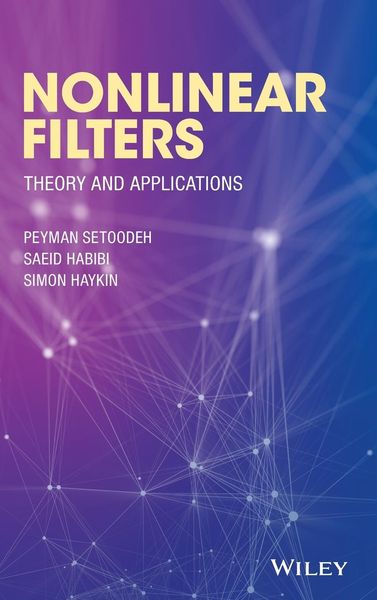
Nonlinear Filters: Theory and Applications delivers an insightful view on state and parameter estimation by merging ideas from control theory, statistical signal processing, and machine learning. Taking an algorithmic approach, the book covers both classic and machine learning-based filtering algorithms.
Readers of Nonlinear Filters will greatly benefit from the wide spectrum of presented topics including stability, robustness, computability, and algorithmic sufficiency. Readers will also enjoy:
* Organization that allows the book to act as a stand-alone, self-contained reference
* A thorough exploration of the notion of observability, nonlinear observers, and the theory of optimal nonlinear filtering that bridges the gap between different science and engineering disciplines
* A profound account of Bayesian filters including Kalman filter and its variants as well as particle filter
* A rigorous derivation of the smooth variable structure filter as a predictor-corrector estimator formulated based on a stability theorem, used to confine the estimated states within a neighborhood of their true values
* A concise tutorial on deep learning and reinforcement learning
* A detailed presentation of the expectation maximization algorithm and its machine learning-based variants, used for joint state and parameter estimation
* Guidelines for constructing nonparametric Bayesian models from parametric ones
Perfect for researchers, professors, and graduate students in engineering, computer science, applied mathematics, and artificial intelligence, Nonlinear Filters: Theory and Applications will also earn a place in the libraries of those studying or practicing in fields involving pandemic diseases, cybersecurity, information fusion, augmented reality, autonomous driving, urban traffic network, navigation and tracking, robotics, power systems, hybrid technologies, and finance.
Discover the utility of using deep learning and (deep) reinforcement learning in deriving filtering algorithms with this insightful and powerful new resource
Nonlinear Filters: Theory and Applications delivers an insightful view on state and parameter estimation by merging ideas from control theory, statistical signal processing, and machine learning. Taking an algorithmic approach, the book covers both classic and machine learning-based filtering algorithms.
Readers of Nonlinear Filters will greatly benefit from the wide spectrum of presented topics including stability, robustness, computability, and algorithmic sufficiency. Readers will also enjoy:
* Organization that allows the book to act as a stand-alone, self-contained reference
* A thorough exploration of the notion of observability, nonlinear observers, and the theory of optimal nonlinear filtering that bridges the gap between different science and engineering disciplines
* A profound account of Bayesian filters including Kalman filter and its variants as well as particle filter
* A rigorous derivation of the smooth variable structure filter as a predictor-corrector estimator formulated based on a stability theorem, used to confine the estimated states within a neighborhood of their true values
* A concise tutorial on deep learning and reinforcement learning
* A detailed presentation of the expectation maximization algorithm and its machine learning-based variants, used for joint state and parameter estimation
* Guidelines for constructing nonparametric Bayesian models from parametric ones
Perfect for researchers, professors, and graduate students in engineering, computer science, applied mathematics, and artificial intelligence, Nonlinear Filters: Theory and Applications will also earn a place in the libraries of those studying or practicing in fields involving pandemic diseases, cybersecurity, information fusion, augmented reality, autonomous driving, urban traffic network, navigation and tracking, robotics, power systems, hybrid technologies, and finance.
Noch keine Bewertungen vorhanden
Verfassen Sie die erste Bewertung zu diesem Artikel
Helfen Sie anderen Kundinnen und Kunden durch Ihre Meinung.
Kurze Frage zu unserer Seite
Vielen Dank für Ihr Feedback
Wir nutzen Ihr Feedback, um unsere Produktseiten zu verbessern. Bitte haben Sie Verständnis, dass wir Ihnen keine Rückmeldung geben können. Falls Sie Kontakt mit uns aufnehmen möchten, können Sie sich aber gerne an unseren Kund*innenservice wenden.
zum Kundenservice