KI-Beratung Beta

Gutscheinbedingungen

**Gültig am 27.11.2026 auf Spielzeug, Schreibwaren, Filme, Geschenke & Trends, Musik, tolino eReader & Zubehör, Hörbücher und Hörbuch-Downloads, nicht preisgebundene Bücher und Kalender online auf thalia.at und in der Thalia App. Einzelne Artikel können ausgeschlossen sein. Aufgrund der Buchpreisbindung sind deutschsprachige Bücher und eBooks ausgenommen. Zusätzlich ausgenommen sind Abos & Flatrates, Games, Geschenkkarten/-boxen, Shelfies, Software, Zeitschriften sowie einzelne Artikel von tonies®. Pro Einkauf einmal einlösbar. Click & Collect nur bei Onlinevorabzahlung möglich. Keine Barauszahlung. Nicht kombinierbar mit anderen Aktionen und Gutscheinen. Gutschein wird auf max. 500€ Bestellwert angerechnet. Nicht gültig für Versandkosten und Services.

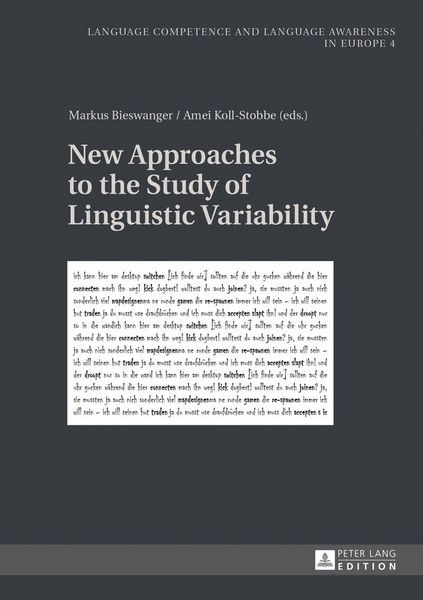
  • Produktbild: New Approaches to the Study of Linguistic Variability
  • Produktbild: New Approaches to the Study of Linguistic Variability
Band 4

New Approaches to the Study of Linguistic Variability

72,40 €

inkl. gesetzl. MwSt., Versandkostenfrei


Beschreibung

The fourth volume in the series Language Competence and Language Awareness in Europe features contributions from various philologies in the young but rapidly growing research area of linguistic variability. The book grew out of a nucleus of papers presented at a North German Linguistics Workshop organised...

Beschreibung

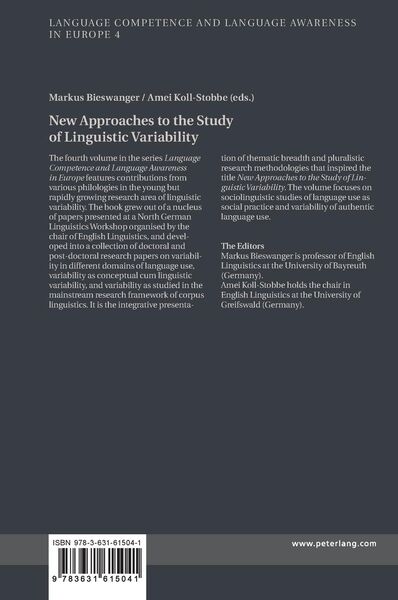
The fourth volume in the series Language Competence and Language Awareness in Europe features contributions from various philologies in the young but rapidly growing research area of linguistic variability. The book grew out of a nucleus of papers presented at a North German Linguistics Workshop organised by the chair of English Linguistics, and developed into a collection of doctoral and post-doctoral research papers on variability in different domains of language use, variability as conceptual cum linguistic variability, and variability as studied in the mainstream research framework of corpus linguistics. It is the integrative presentation of thematic breadth and pluralistic research methodologies that inspired the title New Approaches to the Study of Linguistic Variability. The volume focuses on sociolinguistic studies of language use as social practice and variability of authentic language use.

Portrait

Markus Bieswanger is professor of English Linguistics at the University of Bayreuth (Germany). Amei Koll-Stobbe holds the chair in English Linguistics at the University of Greifswald (Germany).

Produktdetails

Einband

Gebundene Ausgabe

Erscheinungsdatum

26.08.2013

Herausgeber Markus Bieswanger + weitere
Verlag Peter Lang GmbH, Internationaler Verlag der Wissenschaften

Produktdetails

Einband

Gebundene Ausgabe

Erscheinungsdatum

26.08.2013

Herausgeber
Verlag Peter Lang GmbH, Internationaler Verlag der Wissenschaften
Seitenzahl

190

Maße (L/B/H)

21,6/15,3/1,6 cm

Gewicht

410 g

Auflage

1

Sprache

Englisch

ISBN

978-3-631-61504-1

EU-Ansprechpartner

Kolibri 360 GmbH
Ettore-Bugatti-Straße 6-14
51149 Köln
DE
produktsicherheit@kolibri360.de

Herstelleradresse

Peter Lang
Avenue du Théâtre 7
1005 Lausanne
CH
orders@peterlang.com

Noch keine Bewertungen vorhanden

Verfassen Sie die erste Bewertung zu diesem Artikel

Helfen Sie anderen Kundinnen und Kunden durch Ihre Meinung.

Kundinnen und Kunden meinen

Bewertungen (0)

  • Produktbild: New Approaches to the Study of Linguistic Variability
  • Produktbild: New Approaches to the Study of Linguistic Variability
  • Contents: Markus Bieswanger: New approaches to the analysis of linguistic Variability – Andrew Wilson: Embracing Bayes Factors for key item analysis in corpus linguistics – Martin Schweinberger: A sociolinguistic analysis of the discourse marker LIKE in Northern Irish English. A look behind the scenes of quantitative reasoning – Lillian Kaviti: The evolution of urban hybrid languages in Kenya: The case of Sheng and Engsh – Melanie Burmeister: Variability in death notices from Scotland, Wales and the Republic of Ireland: A comparative perspective – Florian Dolberg: Subject to change: Decay and mutation of linguistic memory – Judith Rossow: New contexts and new concepts: The use of German «alt» – Jana Kiesendahl: Apologies and excuses in academic e-mail communication: Differentiation and characterization from a pragmatic perspective – Caroline Schilling: Assessing texting behaviour and language use in SMS communication: A survey on age differences.