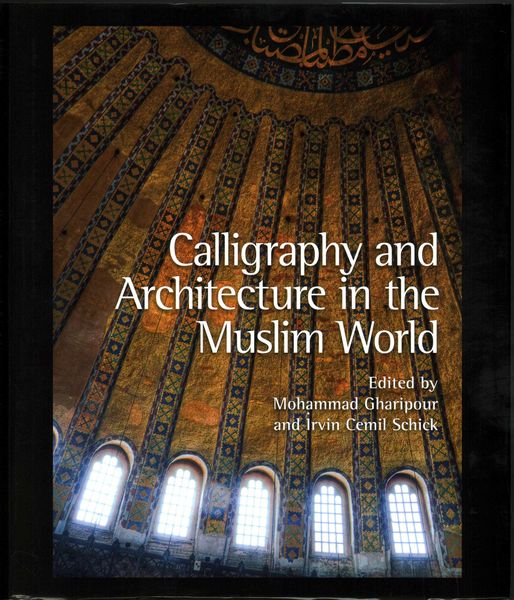
Produktbild: Calligraphy and Architecture in the Muslim World

Calligraphy and Architecture in the Muslim World

231,99 €

inkl. gesetzl. MwSt., Versandkostenfrei


Beschreibung

Produktdetails

Einband

Gebundene Ausgabe

Erscheinungsdatum

09.12.2013

Abbildungen

317 colour illustrations, 12 black and white tables

Herausgeber

Mohammad Gharipour + weitere

Verlag

Edinburgh University Press

Seitenzahl

544

Maße (L/B/H)

30/25,1/3,6 cm

Gewicht

2606 g

Sprache

Englisch

ISBN

978-0-7486-6922-6

Beschreibung

Produktdetails

Einband

Gebundene Ausgabe

Erscheinungsdatum

09.12.2013

Abbildungen

317 colour illustrations, 12 black and white tables

Herausgeber

Verlag

Edinburgh University Press

Seitenzahl

544

Maße (L/B/H)

30/25,1/3,6 cm

Gewicht

2606 g

Sprache

Englisch

ISBN

978-0-7486-6922-6

Herstelleradresse

Libri GmbH
Europaallee 1
36244 Bad Hersfeld
DE

Email: gpsr@libri.de

Noch keine Bewertungen vorhanden

Verfassen Sie die erste Bewertung zu diesem Artikel

Helfen Sie anderen Kundinnen und Kunden durch Ihre Meinung.

Kundinnen und Kunden meinen

Bewertungen (0)

Weitere Artikel finden Sie in

  • Produktbild: Calligraphy and Architecture in the Muslim World
  • A: Introduction; B: Sites; 1. Inscribing the Square: The Inscriptions on the Maidan-i Shah in I¿fahan, Sheila S. Blair; 2. Speaking Architecture: Poetry and Aesthetics in the Alhambra Palace, José Miguel Puerta Vílchez; 3. The Arabic Calligraphy on the Ceiling of the Twelfth-Century Cappella Palatina in Palermo, Sicily: Function and Identity, Hashim Al-Tawil; 4. Wall-Less Walls: The Calligraphy at the Hadzi Sinanova Tekija in Sarajevo, Snjezana Buzov; 5. Survey - The Qur'anic Inscriptions Monument From Jam, Afghanistan, Ulrike-Christiane Lintz; C: Style vs. Content; 6. Multi-Sensorial Messages of the Divine and the Personal: Qur'an Inscriptions and Recitation in Sixteenth-Century Ottoman Mosques in Istanbul, Nina Ergin; 7. The Revival of Kufi Script During the Reign of Sultan Abdülhamid II, Irvin Cemil Schick; 8. Calligraphy in Chinese Mosques: At the Intersection of Arabic and Chinese Calligraphy, Barbara Stöcker-Parnian; 9. Qur'anic Verses on Works of Architecture: The Ottoman Case, Murat Sülün; 10. Reading Qajar Epigraphs: Case Studies from Shiraz and I¿fahan, Bavand Behpoor; D: Patronage; 11. 'The Pen Has Extolled Her Virtues': Gender and Power within the Visual Legacy of Shajar al-Durr in Cairo, Caroline Olivia M. Wolf; 12. Sovereign Epigraphy in Location: Politics, Devotion and Legitimisation around the Qu¿b Minar, Delhi, Johanna Blayac; 13. Archival Evidence on the Commissioning of Architectural Calligraphy in the Ottoman Empire, Talip Mert; 14. On the Renewal of the Calligraphy at the Mosque of the Prophet (al-Masjid al-Nabawi) under the Reign of Sultan Abdülmecid, Hilal Kazan; 15. Fa¿imid Kufi Epigraphy on the Gates of Cairo: Between Royal Patronage and Civil Utility, Bahia Shehab; E: Artists; 16. An Art Ambassador: The Inscriptions of 'Ali Reza 'Abbasi, Saeid Khaghani; 17. Mustafa Râkim Efendi's Architectural Calligraphy, Süleyman Berk; 18. Yesârîzâde Mustafa Izzet Efendi and his Contributions to Ottoman Architectural Calligraphy, M. Ugur Derman; 19. The Visual Interpretation of Nasta'liq in Architecture: Mirza Gholam Reza's Monumental Inscriptions for the Sepahsalar Mosque in Tehran, Sina Goudarzi; F: Regional; 20. Ma'qili Inscriptions on the Great Mosque of Mardin: Stylistic and Epigraphic Contexts, Tehnyat Majeed; 21. The Composition of Kufi Inscriptions in Transitional and Early-Islamic Architecture of North Khurasan, Nasiba S. Baimatowa; 22. Space and Calligraphy in the Chinese Mosque, Sadiq Javer; 23. Medium and Message in the Monumental Epigraphy of Medieval Cairo, Bernard O'Kane; 24. Allegiance, Praise and Space: Monumental Inscriptions in Thirteenth-Century Anatolia as Architectural Guides, Patricia Blessing; 25. Symmetrical Compositions in Pre-Ottoman and Ottoman Architectural Inscriptions in Asia Minor, Abdülhamit Tüfekçioglu; G: Modernity; 26. Writing Less, Saying More: Calligraphy and Modernisation in the Last Ottoman Century, Edhem Eldem; 27. The Absence and Emergence of Calligraphy in Najd: Calligraphy as a Modernist Component of Architecture in Riyadh, Sumayah Al-Solaiman; 28. Cairo to Canton and Back: Tradition in the Islamic Vernacular, Ann Shafer; H: Bibliography; I: List of Figures; J: About the Contributors.