Gutscheinbedingungen

**Gültig bis 15.06.2026 auf Spiele & Spielzeug online auf thalia.at, in der Thalia App ab einem Mindestbestellwert von 30€ und in allen Thalia Buchhandlungen in Österreich. In den Buchhandlungen nur gültig auf lagernde Ware. Einzelne Artikel können ausgeschlossen sein. Ausgenommen sind preisgebundene Artikel sowie online auf thalia.at und in der Thalia App einzelne Artikel von tonies®. Pro Einkauf einmal einlösbar. Nur gültig gegen Vorlage oder im Onlineshop hinterlegter Bonuscard. Infos zur Einlösung in der Buchhandlung sind auf der Bonuscard-Vorteilspreisseite zu finden. Click & Collect nur bei Onlinevorabzahlung möglich. Keine Einlösung bei Scan & Go-Bezahlung. Keine Barauszahlung. Nicht kombinierbar mit anderen Aktionen und Gutscheinen. Gutschein wird auf max. 500€ Bestellwert angerechnet. Nicht gültig für Geschenkkarten, Versandkosten und Services.

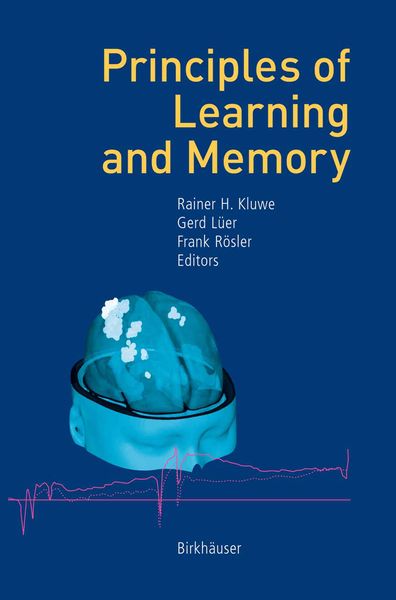
  • Produktbild: Principles of Learning and Memory
  • Produktbild: Principles of Learning and Memory

Principles of Learning and Memory

51,99 €

inkl. gesetzl. MwSt., Versandkostenfrei


Beschreibung

Produktdetails

Einband

Taschenbuch

Erscheinungsdatum

30.10.2012

Herausgeber

Rainer H. Kluwe + weitere

Verlag

Springer Basel

Seitenzahl

358

Maße (L/B/H)

23,5/15,5/2,1 cm

Gewicht

581 g

Auflage

Softcover reprint of the original 1st ed. 2003

Sprache

Englisch

ISBN

978-3-0348-9411-1

Beschreibung

Portrait

Frank Rösler ist Professor für Allgemeine und Biologische Psychologie und Experte auf dem Gebiet der kognitiven Psychophysiologie. Er lehrte viele Jahre am Fachbereich Psychologie der Philipps-Universität Marburg und ist seit 2010 am Department für Psychologie der Universität Potsdam tätig. Er hat an internationalen Institutionen geforscht und gelehrt, darunter University of California, University of Queensland, das Max-Planck-Institut für Psycholinguistik in Nijmegen, das Wissenschaftskolleg zu Berlin und das Hanse-Wissenschaftskolleg. Er ist Ehrenmitglied und Träger der Wilhelm-Wundt-Medaille der Deutschen Gesellschaft für Psychologie, gehört der Berlin-Brandenburgischen Akademie der Wissenschaften und der Leopoldina Nationale Akademie der Wissenschaften an, und er arbeitet als Beirat unter anderem am Max-Planck Institut für Bildungsforschung und für die Zeitschrift Gehirn und Geist.
Gerd Lüer, geb. 1938, ist Professor für Psychologie in Göttingen. Arbeitsschwerpunkte: Experimentelle Psychologie, Kognitive Prozesse wie Gedächtnis- und Denkvorgänge, Genese, Aufbau und Nutzung von Wissen, Informationsverarbeitung beim Menschen.

Produktdetails

Einband

Taschenbuch

Erscheinungsdatum

30.10.2012

Herausgeber

Verlag

Springer Basel

Seitenzahl

358

Maße (L/B/H)

23,5/15,5/2,1 cm

Gewicht

581 g

Auflage

Softcover reprint of the original 1st ed. 2003

Sprache

Englisch

ISBN

978-3-0348-9411-1

Herstelleradresse

Springer Nature c/o IBS
Benzstrasse 21
48619 Heek
DE

Email: Tanja.Keller@springer.com

Kundinnen und Kunden meinen

0 Bewertungen

Informationen zu Bewertungen

Zur Abgabe einer Bewertung ist eine Anmeldung im Konto notwendig. Die Authentizität der Bewertungen wird von uns nicht überprüft. Wir behalten uns vor, Bewertungstexte, die unseren Richtlinien widersprechen, entsprechend zu kürzen oder zu löschen.

Die Bewertungen sind nach Format, Anzahl Sterne und Datum sortiert.

Verfassen Sie die erste Bewertung zu diesem Artikel

Helfen Sie anderen Kund*innen durch Ihre Meinung

Kundinnen und Kunden meinen

0 Bewertungen filtern

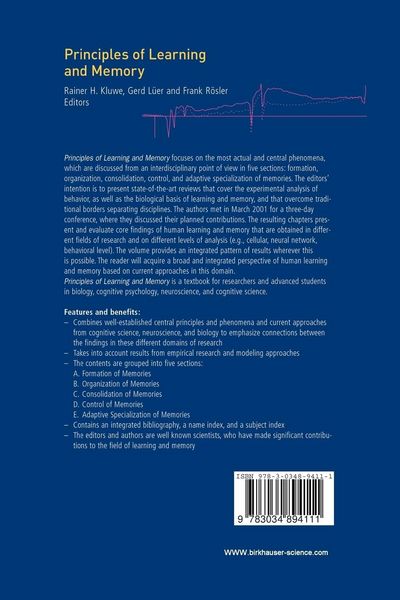
  • Produktbild: Principles of Learning and Memory
  • Produktbild: Principles of Learning and Memory
  • Short List of Contents(.-) Contents(.-) Preface(.-) A. FORMATION OF MEMORIES(.-) 1. The Principle of Contiguity (Harald Lachnit)(.-) Historical Antecedents: Philosophical Roots and Early Psychology(.)Empirical Departures from the Omnipotent Law of Contiguity(.)Theoretical Attempts to Retain the Law of Contiguity(.)Further Empirical Challenges to the Law of Contiguity(.)Competition Protects the Principle of Contiguity(.)Contiguity of Memory Traces(.)Back to the Significance of Contiguity for Learning(.)The Behavioral Expression of an Association Needs More Than Contiguity(.)Renouncing Contiguity in Favor of Time and Rate?(.-) 2. The Principle of Learning Based on Multiple Brain Structures (Thomas Kress and Irene Daum)(.-) Classical Conditioning as a Model System in the Neurobiology of Learning(.)Neuroanatomical Basis of Delay Conditioning(.)The Role of the Hippocampus(.)The Role of the Cerebellum(.)The Role of the Basal Ganglia(.)Brain Substrates of Complex Conditioning(.)Cerebellar-Hippocampal Interactions(.)Neuropsychological Studies in Patients with Damage to the Hippocampal System(.)Cerebellar-Prefrontal Interactions(.)Recent Developments(.)Conclusion(.-) 3. The Principle of Brain Plasticity (Brigitte Röder & Frank Rösler)(.-) Training-Induced Plasticity(.) Somatosensory System(.)Auditory System(.)Visual System(.)Motor System(.)Effects of enriched environments(.)Mechanisms(.)Lesion-Induced Plasticity(.)Intramodal Plasticity after Partial Deafferentiation(.) Intermodal Plasticity after Totally Deafferenting One Sensory System(.)Differences between Developmental and Adult Plasticity(.-) 4. The Principle of Emotional Learning (Gerhard Roth)(.-) Studies on the Interaction between Memory and Emotional States(.)The Memory System Inside the Brain(.)What are Emotions and Where do they Originate in the Brain?(.)The Neuronal Basis of Interaction between Memory and Emotion(.)The Role of Stress on Memory(.)CellularMechanisms of the Interaction between Memory and Emotions(.)Conclusion(.-) B. ORGANIZATION OF MEMORIES(.-) 5. The Principle of Code-Specific Memory Representations (Frank Rösler and Martin Heil)(.-) Empirical Foundations(.)Theoretical Foundations(.)Findings from Brain Imaging Studies(.)Spatial and Verbal Working Memory(.)Spatial and Object Working Memory(.)Long-term Memory for Verbal, Spatial, Color, and Motor Associations(.)Category-specific Representations(.)Conclusion(.-) 6. The Principle of Multiple Memory Systems (Axel Buchner and Martin Brandt)(.-) Distinct Memory Systems(.)Levels of Distinction(.)Working Memory(.)Modular Working Memory(.)Working Memory as Activated Memory(.)A Formal Model of Working Memory: The Feature Model(.)Summary of Working Memory Models(.)Long-Term Memory(.)Declarative versus Non-declarative Memory(.)Explicit versus Implicit Memory Measurement(.)Episodic versus Semantic Memory(.)Global Memory Models(.)Conclusion: Limits of the Principle of Multiple Memory Systems(.-) 7. Modules of Working Memory (John Jonides, Ching-Yune C. Sylvester, Steven C. Lacey, Tor D. Wager, Thomas E. Nichols, and Edward Awh)(.-) Verbal versus Spatial Storage(.)Rehearsal(.)Executive Mechanisms(.)Conclusion(.-) C. CONSOLIDATION OF MEMORIES(.-) 8. The Principle of Memory Consolidation and Its Pharmacological Modulation (Rainer K.W. Schwarting)(.-) The Consolidation Hypothesis and Its Origins(.)Experimental Procedures for Post-Trial Designs(.)Inhibitory Avoidance(.)Habituation of Exploration and Other Designs(.)Specific Aspects of Post-Trial Designs(.)Pharmacological Manipulations of Consolidation(.)An Example for a Pharmacological Post-Trial Approach: Cholinergic Manipulations in the Nucleus Accumbens of the Laboratory Rat(.)Brief Anatomy of the Nucleus Accumbens(.)Transmitters in the Nucleus Accumbens(.)Cholinergic Activity in the Nucleus Accumbens(.)Evidence for a Role of the Nucleus Accumbens in Mnestic