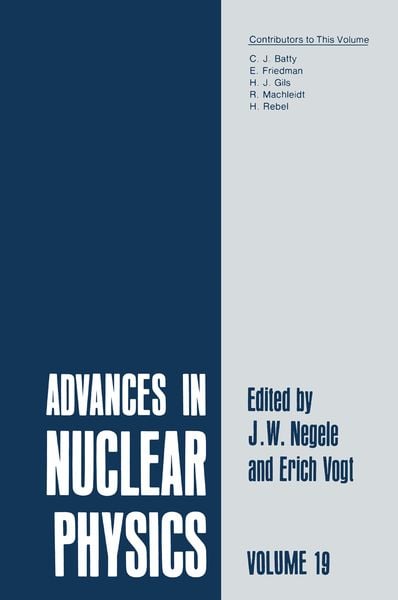

Beschreibung

Produktdetails

Einband

Taschenbuch

Erscheinungsdatum

05.07.2012

Herausgeber

J.W. Negele + weitere

Verlag

Springer Us

Seitenzahl

396

Maße (L/B/H)

22,9/15,2/2,2 cm

Gewicht

577 g

Auflage

Softcover reprint of the original 1st ed. 1989

Sprache

Englisch

ISBN

978-1-4613-9909-4

Beschreibung

Zitat

from a review of a previous volume These volumes have set a new standard for review articles which are very close to the level of text books and fulfill at the same time the task of covering new subjects in the sense of a review. They have thus been regarded among the most appreciated books in libraries for the nuclear physics community all over the world.' Institute of Physics Journal

Produktdetails

Einband

Taschenbuch

Erscheinungsdatum

05.07.2012

Herausgeber

Verlag

Springer Us

Seitenzahl

396

Maße (L/B/H)

22,9/15,2/2,2 cm

Gewicht

577 g

Auflage

Softcover reprint of the original 1st ed. 1989

Sprache

Englisch

ISBN

978-1-4613-9909-4

Herstelleradresse

Springer-Verlag KG
Sachsenplatz 4-6
1201 Wien
AT

Email: GPSR Kontakt

Noch keine Bewertungen vorhanden

Verfassen Sie die erste Bewertung zu diesem Artikel

Helfen Sie anderen Kundinnen und Kunden durch Ihre Meinung.

Kundinnen und Kunden meinen

Bewertungen (0)

  • Produktbild: Advances in Nuclear Physics
  • Produktbild: Advances in Nuclear Physics
  • 1 Experimental Methods for Studying Nuclear Density Distributions.- 1. Introduction.- 2. Nuclear Charge Distributions.- 2.1. Electron Scattering.- 2.2. Muonic Atoms.- 2.3. Electronic X Rays.- 2.4. Optical Isotope Shifts.- 2.5. Comparisons and Comments.- 3. Information on Specific Orbitals.- 3.1. Coulomb Displacement Energies.- 3.2. Nucleon Transfer Reactions.- 3.3. Charge-Exchange Reactions to Analog States.- 3.4. Magnetic Scattering of Electrons.- 3.5. Comparisons and Comments.- 4. Information on the Periphery of the Nucleus.- 4.1. Kaonic and Antiprotonic Atoms.- 4.2. Pionic Atoms.- 4.3. K? and $$\bar{p}$$ Reactions with Nuclei.- 4.4. Comments.- 5. Information on the Nuclear Surface.- 5.1. Total and Reaction Cross Sections at High Energies.- 5.2. Model-Independent Methods for the Analysis of Scattering Experiments.- 5.3. Folding Model Approaches to the Optical Potential.- 5.4. Low- and Medium-Energy Proton Scattering 95 5.5. Diffraction Scattering of Low- and Medium-Energy Alpha Particles.- 5.6. Scattering of Intermediate-Energy Pions.- 5.7. Scattering of Low-Energy Antiprotons.- 6. Toward the Nuclear Interior.- 6.1. Intermediate-Energy Alpha-Particle Scattering.- 6.2. Double-Folding versus Single-Folding in Analyses of Complex Particle Scattering and the Choice of the Interaction.- 6.3. Scattering of Intermediate-Energy Protons.- 6.4. Scattering of Low-Energy Pions.- 7. Future Methods and Probes.- 7.1. Combined Analysis of Different Types of Experiments.- 7.2. K+ Scattering.- 8. Concluding Remarks.- Acknowledgments.- References.- 2 The Meson Theory of Nuclear Forces and Nuclear Structure.- 1. Introduction.- 2. Historical Overview.- 2.1. The “Hypothetical” Period.- 2.2. The Pion as the Quantum.- 2.3. “Dispersive” Approaches.- 2.4. A Tale of Two Cities.- 2.5. More Recent Developments.- 3. Pedagogical Introduction.- 3.1. Empirical Features of the Nuclear Force.- 3.2. The Idea of Massive-Particle Exchange.- 3.3. Field Theory, Perturbation Theory, and Feynman Diagrams.- 3.4. Various Boson Fields and their Role in NN.- 4. The One-Boson Exchange Model.- 4.1. Covariant Equations.- 4.2. Meson Parameters and Two-Nucleon Properties.- 5. Advanced Meson Exchange Models.- 5.1. Models for the 2? Exchange.- 5.2. ?? Contributions.- 5.3. Other Two-Meson-Exchange Contributions.- 5.4. Results.- 5.5. Off-Shell Aspects.- 6. Charge Dependence.- 6.1. Introduction.- 6.2. Empirical Evidence.- 6.3. Some Results from Theory.- 7. Nucleon-Nucleon Scattering above the Inelastic Threshold.- 7.1. At Intermediate Energies.- 7.2. The GeV Region.- 8. Some Related Hadronic Interactions.- 8.1. Pion-Nucleon Scattering.- 8.2. The $$N\bar{N}$$ Potential.- 8.3. Strange Nuclear Interactions.- 9. Nuclear Matter I—Conventional.- 9.1. Introduction.- 9.2. History of the Conventional Many-Body Problem.- 9.3. Conventional Theories.- 9.4. Results and Problems.- 10. Nuclear Matter II—Beyond Convention.- 10.1. Possible Extensions.- 10.2. Meson Degrees of Freedom.- 10.3. Isobar Degrees of Freedom.- 10.4. Many-Body Forces.- 10.5. Relativistic Effects.- 11. Finite Nuclei.- 11.1. The Three-Nucleon System.- 11.2. The Ground State of Closed-Shell Nuclei.- 11.3. Excited States.- 12. Summary, Conclusions, and Outlook.- Acknowledgments.- Appendix A: One-Boson Exchange Potentials.- A.1. Interaction Lagrangians and OBE Amplitudes.- A.2. Relativistic Momentum Space OBEP.- A.3. Coordinate Space Potentials.- Appendix B: Models Including Isobar Degrees of Freedom.- Appendix C: Deuteron Wave Functions.- References.