Gutscheinbedingungen

**Gültig bis 25.06.2026 auf fremdsprachige Bücher online auf thalia.at und in der Thalia App. Einzelne Artikel können ausgeschlossen sein. Ausgenommen sind preisgebundene Artikel & eBooks. Pro Einkauf einmal einlösbar. Click & Collect nur bei Onlinevorabzahlung möglich. Keine Barauszahlung. Nicht kombinierbar mit anderen Aktionen und Gutscheinen. Gutschein wird auf max. 500€ Bestellwert angerechnet. Nicht gültig für Geschenkkarten, Versandkosten und Services.

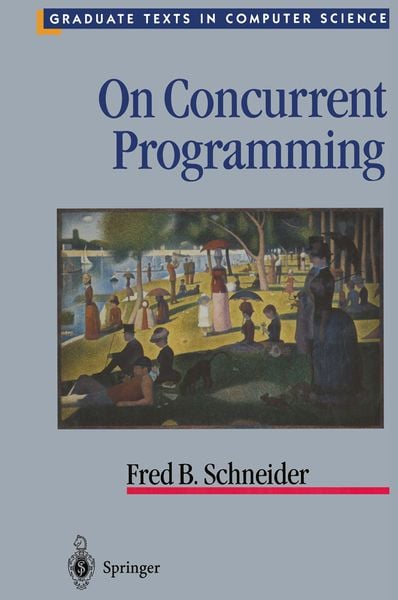
  • Produktbild: On Concurrent Programming
  • Produktbild: On Concurrent Programming

On Concurrent Programming

49,99 €

inkl. gesetzl. MwSt., Versandkostenfrei


Beschreibung

Produktdetails

Einband

Taschenbuch

Erscheinungsdatum

30.09.2012

Verlag

Springer Us

Seitenzahl

473

Maße (L/B/H)

23,5/15,5/2,7 cm

Gewicht

744 g

Auflage

Softcover reprint of the original 1st ed. 1997

Sprache

Englisch

ISBN

978-1-4612-7303-5

Beschreibung

Produktdetails

Einband

Taschenbuch

Erscheinungsdatum

30.09.2012

Verlag

Springer Us

Seitenzahl

473

Maße (L/B/H)

23,5/15,5/2,7 cm

Gewicht

744 g

Auflage

Softcover reprint of the original 1st ed. 1997

Sprache

Englisch

ISBN

978-1-4612-7303-5

Herstelleradresse

Springer-Verlag GmbH
Tiergartenstr. 17
69121 Heidelberg
DE

Email: ProductSafety@springernature.com

Kundinnen und Kunden meinen

0 Bewertungen

Informationen zu Bewertungen

Zur Abgabe einer Bewertung ist eine Anmeldung im Konto notwendig. Die Authentizität der Bewertungen wird von uns nicht überprüft. Wir behalten uns vor, Bewertungstexte, die unseren Richtlinien widersprechen, entsprechend zu kürzen oder zu löschen.

Die Bewertungen sind nach Format, Anzahl Sterne und Datum sortiert.

Verfassen Sie die erste Bewertung zu diesem Artikel

Helfen Sie anderen Kund*innen durch Ihre Meinung

Kundinnen und Kunden meinen

0 Bewertungen filtern

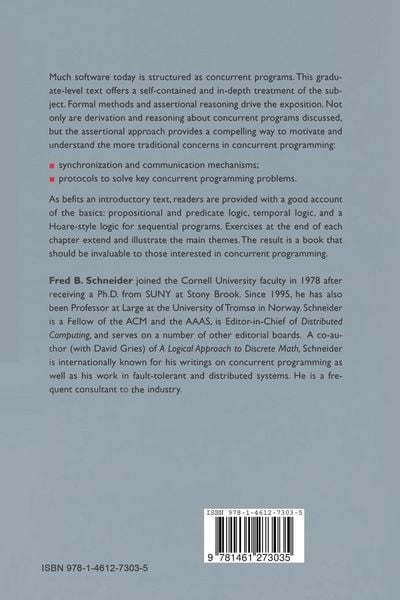
  • Produktbild: On Concurrent Programming
  • Produktbild: On Concurrent Programming
  • 1 Introduction.- 1.1 Concurrent Programs.- 1.2 Communication and Synchronization.- 1.3 Understanding Concurrent Programs.- 1.4 A Preview.- Historical Notes for Chapter 1.- Exercises for Chapter 1.- 2 Formal Logic.- 2.1 Formal Logical Systems.- 2.2 Propositional Logic.- 2.3 A Predicate Logic.- 2.4 Safety and Liveness Revisited.- Historical Notes for Chapter 2.- Exercises for Chapter 2.- 3 Temporal Logic.- 3.1 Informal Preview.- 3.2 Syntax and Meaning of Formulas.- 3.3 Axioms and Inference Rules.- 3.4 Temporal Logic Applications.- 3.5 About Modal Logics.- Historical Notes for Chapter 3.- Exercises for Chapter 3.- 4 Notation and Logic for Sequential Programming.- 4.1 Notation for Sequential Programs.- 4.2 Reasoning About Program States.- 4.3 Proof Outline Logic.- 4.4 Assignment to Composite Variables.- 4.5 A Predicate Transformer.- Historical Notes for Chapter 4.- Exercises for Chapter 4.- 5 Concurrency and Interference.- 5.1 Specifying Concurrency.- 5.2 Control Predicate Axioms.- 5.3 Interference Freedom.- 5.4 Hiding Control Predicates in Derived Terms.- 5.5 Synchronously Altered and Shared Assertions.- 5.6 Specifying Synchronization.- 5.7 Synchronization and Interference.- Historical Notes for Chapter 5.- Exercises for Chapter 5.- 6 Safety Properties: Invariance.- 6.1 Invariance Properties.- 6.2 Verifying Invariance Properties.- 6.3 Exclusion of Configurations.- 6.4 Direct Use of Proof Outlines.- 6.5 Developing Programs for Invariance Properties.- Historical Notes for Chapter 6.- Exercises for Chapter 6.- 7 Safety Properties with Past Terms.- 7.1 Historical Safety Properties.- 7.2 Past Extensions to Predicate Logic.- 7.3 Verifying Historical Safety Properties.- 7.4 Developing Programs for Historical Safety Properties.- 7.5 Auxiliary Variables.- 7.6 Some Cautions.- Historical Notes for Chapter 7.- Exercises for Chapter 7.- 8 Verifying Arbitrary Temporal Logic Properties.- 8.1 S-Temporal Logic Revisited.- 8.2 Unless Properties and Derivatives.- 8.3 Fairness Assumptions.- 8.4 Reasoning from Fairness Assumptions.- 8.5 Helpful Actions and Eventualities.- 8.6 Liveness for Mutual Exclusion.- Historical Notes for Chapter 8.- Exercises for Chapter 8.- 9 Programming with Fine-Grained Atomic Actions.- 9.1 Pretending Atomicity.- 9.2 Translation-Independent Reasoning.- 9.3 Implementing Condition Synchronization.- 9.4 Programming with the Subset.- 9.5 Synchronization and Interference Revisited.- 9.6 Interlock Instructions.- 9.7 Example: Barrier Synchronization.- Historical Notes for Chapter 9.- Exercises for Chapter 9.- 10 Semaphores, Locks, and Conditional Critical Regions.- 10.1 Semaphores.- 10.2 Change of Variable to use Semaphores.- 10.3 Binary Semaphores and Locks.- 10.4 Split Binary Semaphore Method.- 10.5 Conditional Critical Regions.- Historical Notes for Chapter 10.- Exercises for Chapter 10.- 11 Message Passing and Distributed Programming.- 11.1 Asynchronous Message-Passing.- 11.2 Synchronous Message-Passing.- 11.3 Derivation of Distributed Programs.- 11.4 Shared-Variable Representations.- Historical Notes for Chapter 11.- Exercises for Chapter 11.- 12 Putting It Together.- 12.1 On Languages.- 12.2 Principles for Verifying Safety and Liveness Properties.- 12.3 Proofs Only Increase Confidence.- 12.4 A Tool and Applications.- Historical Notes for Chapter 12.- References.