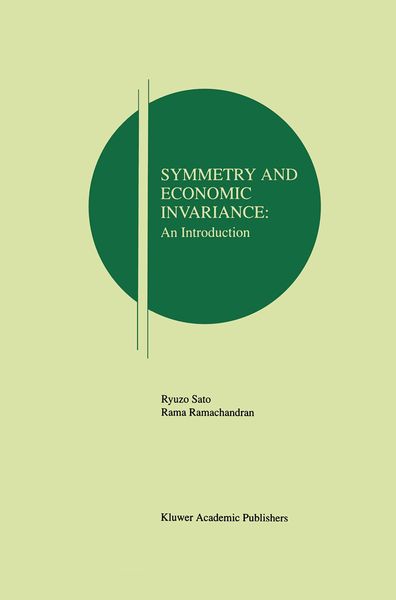
Produktbild: Symmetry and Economic Invariance: An Introduction
Band 3 - 11%

Symmetry and Economic Invariance: An Introduction

11% sparen

96,99 € UVP 109,99 €

inkl. gesetzl. MwSt., Versandkostenfrei


Beschreibung

Produktdetails

Einband

Taschenbuch

Erscheinungsdatum

13.10.2012

Verlag

Springer Us

Seitenzahl

134

Maße (L/B/H)

23,5/15,5/0,9 cm

Gewicht

237 g

Auflage

Softcover reprint of the original 1st ed. 1998

Sprache

Englisch

ISBN

978-1-4613-7519-7

Beschreibung

Produktdetails

Einband

Taschenbuch

Erscheinungsdatum

13.10.2012

Verlag

Springer Us

Seitenzahl

134

Maße (L/B/H)

23,5/15,5/0,9 cm

Gewicht

237 g

Auflage

Softcover reprint of the original 1st ed. 1998

Sprache

Englisch

ISBN

978-1-4613-7519-7

Herstelleradresse

Springer US, New York, N.Y.
Heidelberger Platz 3
14197 Berlin
Deutschland
Email: sdc-bookservice@springer.com
Fax: +49 6221 3454229

Noch keine Bewertungen vorhanden

Verfassen Sie die erste Bewertung zu diesem Artikel

Helfen Sie anderen Kundinnen und Kunden durch Ihre Meinung.

Kundinnen und Kunden meinen

Bewertungen (0)

  • Produktbild: Symmetry and Economic Invariance: An Introduction
  • 1. Introduction.- 1.1 Group Theory and Classification of Mathematical Structure.- 1.2 Lie Groups and Invariance.- 1.3 Economic Applications of Lie Groups.- 2. Technical Progress and Economies of Scale.- 2.1 A Reformulation of the Problem.- 2.2 Lie Groups.- 2.3 Holotheticity.- 2.4 Conclusion.- 3. Holothetic Production Functions.- 3.1 Types of Technical Progress Functions and Holotheticity.- 3.2 Marginal Rate of Transformation and Extended Transformation.- 3.3 Holotheticity and Lie Bracket.- 3.4 Conclusion.- 4. Utility and Demand.- 4.1 Integrability Conditions.- 4.2 Conclusion.- 5. Duality and Self Duality.- 5.1 Duality in consumer theory.- 5.2 Separability and Additivity.- 5.3 Self-Duality in Demand Theory.- 5.4 A Method of Deriving Self-Dual Demand Functions.- 5.5 Empirical Estimation of Self-Dual Demand Functions.- 5.6 Implicit Self-Duality of Production and Cost Functions.- 5.7 Conclusion.- 6. The Theory of Index Numbers.- 6.1 Statistical approach.- 6.2 Test Approach.- 6.3 Economic Index Numbers.- 6.4 Divisia Index.- 7. Dynamics and Conservation Laws.- 7.1 The Variational Problem and the Ramsey Rule.- 7.2 Steady State and the Golden Rules.- 7.3 The Hamiltonian Formulation and Control Theory.- 7.4 Noether Theorem and Its Implications.- 7.5 Conservation Laws in von Neumann Model.- 7.6 Measurement of National Income and Income-Wealth Ratios.- 7.7 Conclusion.- 8. Bibliography.