KI-Beratung Beta

Gutscheinbedingungen

**Gültig bis 11.11.2026 auf Spielzeug, Schreibwaren, Filme, Geschenke & Trends, Musik, tolino eReader & Zubehör, Hörbücher und Hörbuch-Downloads, nicht preisgebundene Bücher und Kalender online auf thalia.at und in der Thalia App. Einzelne Artikel können ausgeschlossen sein. Aufgrund der Buchpreisbindung sind deutschsprachige Bücher und eBooks ausgenommen. Zusätzlich ausgenommen sind Abos & Flatrates, Games, Geschenkkarten/-boxen, Shelfies, Software, Zeitschriften sowie einzelne Artikel von tonies®. Pro Einkauf einmal einlösbar. Click & Collect nur bei Onlinevorabzahlung möglich. Keine Barauszahlung. Nicht kombinierbar mit anderen Aktionen und Gutscheinen. Gutschein wird auf max. 500€ Bestellwert angerechnet. Nicht gültig für Versandkosten und Services.

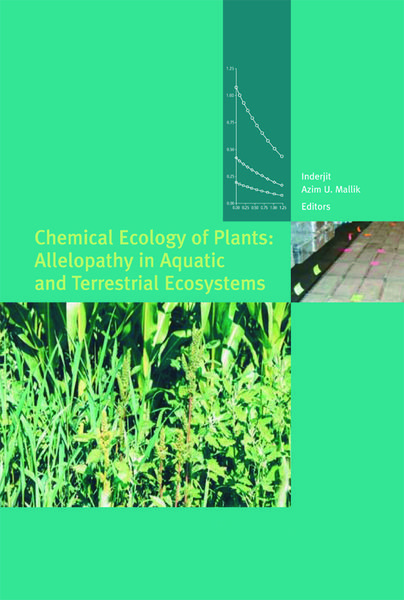
  • Produktbild: Chemical Ecology of Plants: Allelopathy in Aquatic and Terrestrial Ecosystems
  • Produktbild: Chemical Ecology of Plants: Allelopathy in Aquatic and Terrestrial Ecosystems

Chemical Ecology of Plants: Allelopathy in Aquatic and Terrestrial Ecosystems

109,99 €

inkl. gesetzl. MwSt., Versandkostenfrei


Beschreibung

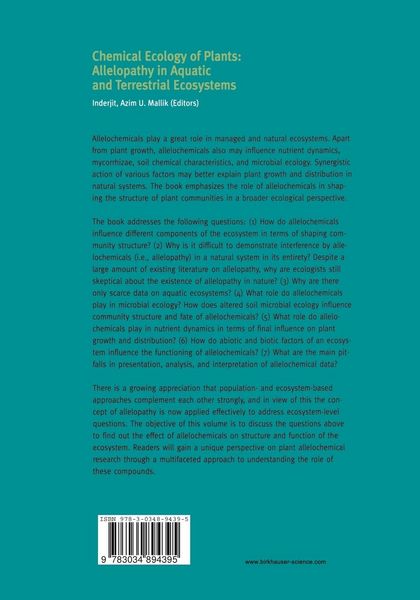
Allelochemicals play a great role in managed and natural ecosystems. Apart from plant growth, allelochemicals also may influence nutrient dynamics, mycorrhizae, soil chemical characteristics, and microbial ecology. Synergistic action of various factors may better explain plant growth and distribution...

Beschreibung

Allelochemicals play a great role in managed and natural ecosystems.
Apart from plant growth, allelochemicals also may influence nutrient
dynamics, mycorrhizae, soil chemical characteristics, and microbial
ecology. Synergistic action of various factors may better explain plant
growth and distribution in natural systems. The book emphasizes the role
of allelochemicals in shaping the structure of plant communities in a
broader ecological perspective.
The book addresses the following questions: (1) How do allelochemicals
influence different components of the ecosystem in terms of shaping
community structure? (2) Why is it difficult to demonstrate interference
by allelochemicals (i.e., allelopathy) in a natural system in its
entirety? Despite a large amount of existing literature on allelopathy,
why are ecologists still skeptical about the existence of allelopathy in
nature? (3) Why are there only scarce data on aquatic ecosystems? (4)
What role do allelochemicals play in microbial ecology?.....

Produktdetails

Einband

Taschenbuch

Erscheinungsdatum

05.11.2012

Abbildungen

X, 272 p.

Herausgeber Inderjit + weitere

Produktdetails

Einband

Taschenbuch

Erscheinungsdatum

05.11.2012

Abbildungen

X, 272 p.

Herausgeber
Verlag Springer Basel
Seitenzahl

272

Maße (B/H)

17,8/25,4 cm

Gewicht

552 g

Auflage

Softcover reprint of the original 1st ed. 2002

Sprache

Englisch

ISBN

978-3-0348-9439-5

Herstelleradresse

Springer-Verlag GmbH
Tiergartenstr. 17
69121 Heidelberg
DE

Email: ProductSafety@springernature.com

Noch keine Bewertungen vorhanden

Verfassen Sie die erste Bewertung zu diesem Artikel

Helfen Sie anderen Kundinnen und Kunden durch Ihre Meinung.

Kundinnen und Kunden meinen

Bewertungen (0)

  • Produktbild: Chemical Ecology of Plants: Allelopathy in Aquatic and Terrestrial Ecosystems
  • Produktbild: Chemical Ecology of Plants: Allelopathy in Aquatic and Terrestrial Ecosystems
  • Problems and prospects in the study of plant allelochemicals: a brief introduction.- Antifungal properties of cyanobacteria and algae: ecological and agricultural implications.- The chemistry and chemical ecology of biologically active cyanobacterial metabolites.- Compounds from Typha domingensis P..- Allelochemicals from sunflowers: chemistry, bioactivity and applications.- Feedback mechanism in the chemical ecology of plants: role of soil microorganisms.- Do allelochemicals operate independent of substratum factors?.- Ecological relevance of allelopathy: some considerations related to Mediterranean, subtropical, temperate, and boreal forest shrubs.- Linking ecosystem disturbance with changes in keystone species, humus properties and soil chemical ecology: implications for conifer regeneration with ericaceous understory.- Black walnut allelopathy: current state of the science.- Allelopathy and agroecology.- Allelochemicals phytotoxicity in explaining weed invasiveness and their function as herbicide analogues.- Shift in allelochemical functioning with selected abiotic stress factors.- Pitfalls in interpretation of allelochemical data in ecological studies: implications for plant-herbivore and allelopathic research.- Biochemical and physiological aspects of pollen allelopathy.