
KI-Beratung Beta

  • Produktbild: The Social and Political Systems of Central Polynesia
  • Produktbild: The Social and Political Systems of Central Polynesia

The Social and Political Systems of Central Polynesia Volume 2

62,99 €

inkl. gesetzl. MwSt., Versandkostenfrei


Beschreibung

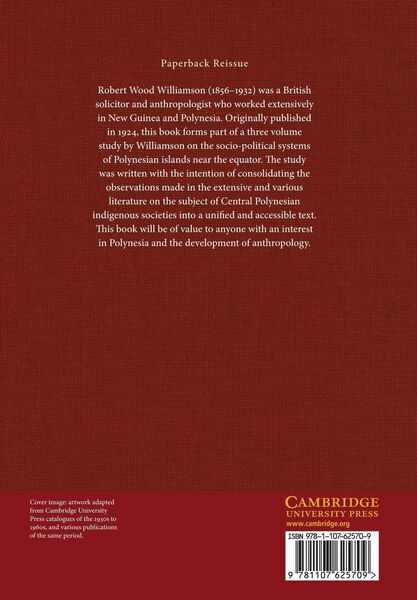
Robert Wood Williamson (1856–1932) was a British solicitor and anthropologist who worked extensively in New Guinea and Polynesia. Originally published in 1924, this book forms part of a three-volume study by Williamson on the socio-political systems of Polynesian islands near the equator.

Produktdetails

Einband

Taschenbuch

Erscheinungsdatum

30.09.2013

Verlag Cambridge Academic
Seitenzahl

504

Produktdetails

Einband

Taschenbuch

Erscheinungsdatum

30.09.2013

Verlag Cambridge Academic
Seitenzahl

504

Maße (L/B/H)

24,4/17/2,7 cm

Gewicht

800 g

Sprache

Englisch

ISBN

978-1-107-62570-9

Herstelleradresse

Libri GmbH
Europaallee 1
36244 Bad Hersfeld
DE

Email: gpsr@libri.de

Noch keine Bewertungen vorhanden

Verfassen Sie die erste Bewertung zu diesem Artikel

Helfen Sie anderen Kundinnen und Kunden durch Ihre Meinung.

Kundinnen und Kunden meinen

Bewertungen (0)

  • Produktbild: The Social and Political Systems of Central Polynesia
  • Produktbild: The Social and Political Systems of Central Polynesia
  • 14. Social and local grouping; 15. Social and local grouping (the marae as a social centre); 16. Matrilineal descent; 17. Exogamy; 18. Special relationship matters and terms (preliminary and Samoa); 19. Special relationship matters and terms (other islands, and observations); 20. Totemism (preliminary and Samoa); 21. Totemism (other islands); 22. Totemism (spirits of the dead becoming or entering into animals, and observations); 23. Clan badges; 24. The social character of war; 25. The chiefs; 26. The middle and lower classes; 27. Priests and sorcerers; 28. Council meetings.