Gutscheinbedingungen

**Gültig bis 06.07.2026 auf fremdsprachige Bücher online auf thalia.at, in der Thalia App ab einem Mindestbestellwert von 30€ und in allen Thalia Buchhandlungen in Österreich. In den Buchhandlungen nur gültig auf lagernde Ware. Einzelne Artikel können ausgeschlossen sein. Ausgenommen sind preisgebundene Artikel & eBooks. Pro Einkauf einmal einlösbar. Nur gültig gegen Vorlage oder im Onlineshop hinterlegter Bonuscard. Infos zur Einlösung in der Buchhandlung sind auf der Bonuscard-Vorteilspreisseite zu finden. Click & Collect nur bei Onlinevorabzahlung möglich. Keine Einlösung bei Scan & Go-Bezahlung. Keine Barauszahlung. Nicht kombinierbar mit anderen Aktionen und Gutscheinen. Gutschein wird auf max. 500€ Bestellwert angerechnet. Nicht gültig für Versandkosten und Services.

  • Produktbild: People and Computers XII
  • Produktbild: People and Computers XII

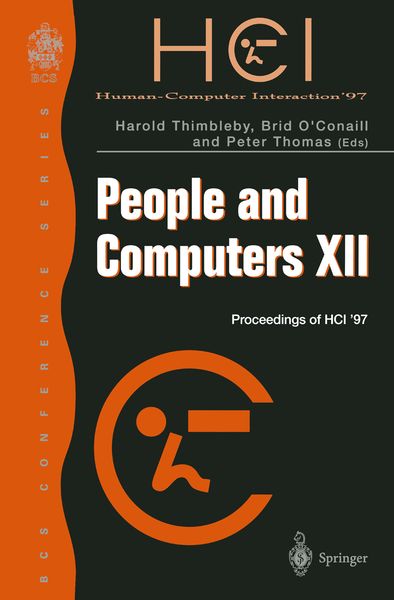
People and Computers XII Proceedings of HCI ’97

51,99 €

inkl. gesetzl. MwSt., Versandkostenfrei


Beschreibung

Produktdetails

Einband

Taschenbuch

Erscheinungsdatum

15.08.1997

Herausgeber

Harold Thimbleby + weitere

Verlag

Springer Berlin

Seitenzahl

420

Maße (L/B/H)

23,5/15,5/2,4 cm

Gewicht

664 g

Auflage

1st Edition.

Sprache

Englisch

ISBN

978-3-540-76172-3

Beschreibung

Produktdetails

Einband

Taschenbuch

Erscheinungsdatum

15.08.1997

Herausgeber

Verlag

Springer Berlin

Seitenzahl

420

Maße (L/B/H)

23,5/15,5/2,4 cm

Gewicht

664 g

Auflage

1st Edition.

Sprache

Englisch

ISBN

978-3-540-76172-3

Herstelleradresse

Springer-Verlag KG
Sachsenplatz 4-6
1201 Wien
AT

Email: GPSR Kontakt

Noch keine Bewertungen vorhanden

Verfassen Sie die erste Bewertung zu diesem Artikel

Helfen Sie anderen Kundinnen und Kunden durch Ihre Meinung.

Kundinnen und Kunden meinen

Bewertungen (0)

  • Produktbild: People and Computers XII
  • Produktbild: People and Computers XII
  • A. Adams, M.A. Sasse, P. Lunt, Making Passwords Secure and Usable.- O. Bdlter, Strategies for organising email.- S. Brewster, Navigating Telephone-Based Interfaces with Earcons.- D. Caulton, K. Dye, Do Users Always Benefit When User Interfaces Are Consistent?- L. Clark, M.A. Sasse, Conceptual Design Reconsidered - The Case of the Internet Session Directory Tool.- D. Day, P. Mdkirinne-Crofts, Computer Anxiety and the Human Computer Interface.- A. Faro, D. Giordano, Towards a situated action calculus for modelling interactions.- M. Fernstrom, L. Bannon, Explorations in Sonic Browsing.- D. Frohlich, K. Chilton, P. Drew, Remote homeplace communication: what is it like and how might we support it?- M. Jacomi, S. Chatty, P. Palanque, A Making-Movies Metaphor for Structuring Software Components in Highly Interactive Application.- C. Johnson, The Impact of Time and Place on the Operation of Mobile Computing Devices.- C. Johnson, The Impact of Marginal Utility and Time on Distributed Information Retrieval.- P. Jones, Computer-Assisted Remote Control for the User with Motor Impairment.- J. Long, Research and the Design of Human-Computer Interactions or hat Happened to Validation?- L. Love, C. Johnson, Using Diagrams to Support the Analysis of System 'Failure' and Operator 'Error'.- D. Martin, J. Bowers, D. Wastell, The Interactional Affordances of Technology.- D. Ramduny, A. Dix, Why, What, Where, When: Architectures for Cooperative work on the World Wide Web.- M. Rauterberg et al., BUILD-IT: a computer vision-based interaction technique for a planning tool.- Chris Roast, Formally Comparing and Informing Notation Design.- K. Sedighian, M. Westrom, Direct Object Manipulation vs Direct Concept Manipulation.- Y.L. Theng et al., HyperAT: HCI and Web Authoring.- P. Timmer, J. Long, Separating User Knowledge of Domain and Device.- W. Wong et al., Eliciting Information Portrayal Requirements.