KI-Beratung Beta

Gutscheinbedingungen

**Gültig bis 30.11.2026 auf Spielzeug, Schreibwaren, Filme, Geschenke & Trends, Musik, tolino eReader & Zubehör, Hörbücher und Hörbuch-Downloads, nicht preisgebundene Bücher und Kalender online auf thalia.at und in der Thalia App. Einzelne Artikel können ausgeschlossen sein. Aufgrund der Buchpreisbindung sind deutschsprachige Bücher und eBooks ausgenommen. Zusätzlich ausgenommen sind Abos & Flatrates, Games, Geschenkkarten/-boxen, Shelfies, Software, Zeitschriften sowie einzelne Artikel von tonies®. Pro Einkauf einmal einlösbar. Nur gültig mit im Onlineshop hinterlegter Bonuscard. Click & Collect nur bei Onlinevorabzahlung möglich. Keine Barauszahlung. Nicht kombinierbar mit anderen Aktionen und Gutscheinen. Gutschein wird auf max. 500€ Bestellwert angerechnet. Nicht gültig für Versandkosten und Services.

  • Produktbild: Evaluating Critical Care
  • Produktbild: Evaluating Critical Care
Band 35

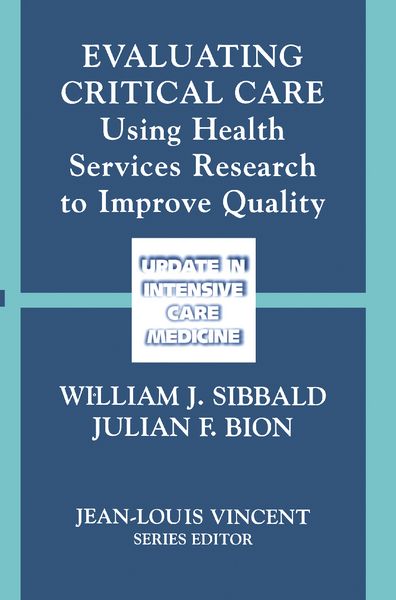
Evaluating Critical Care Using Health Services Research to Improve Quality

51,99 €

inkl. gesetzl. MwSt., Versandkostenfrei


Beschreibung

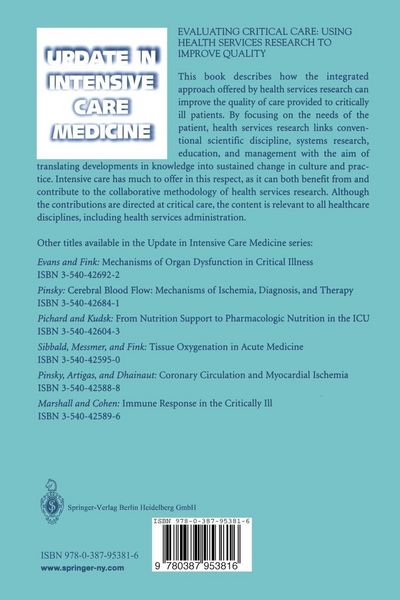
Measuring the quality of a complex service like critical care that combines the highest technology with the most intimate caring is a challenge. Recently, con sumers, clinicians, and payers have requested more formal assessments and comparisons of the quality and costs of medical care [2]. Donabedian...

Beschreibung

Measuring the quality of a complex service like critical care that combines the highest technology with the most intimate caring is a challenge. Recently, con sumers, clinicians, and payers have requested more formal assessments and comparisons of the quality and costs of medical care [2]. Donabedian [1] pro posed a framework for thinking about the quality of medical care that separates quality into three components: structure, process, and outcome. An instructive analogy for understanding this framework is to imagine a food critic evaluating the quality of a restaurant. The critic might comment on the decoration and lighting of the restaurant, how close the tables are to each other, the extent of the wine list and where the chef trained. These are all evaluations of the restaurant structure. In addition, the critic might comment on whether the service was courteous and timely - measures of process. Finally, the critic might comment on outcomes like customer satisfaction or food poisoning. Similarly, to a health care critic, structure is the physical and human resources used to deliver medi cal care. Processes are the actual treatments offered to patients. Finally, outcomes are what happens to patients, for example, mortality, quality of life, and satisfac tion with care (Table 1). There is a debate about which of these measurements is the most important measure of quality.

Produktdetails

Einband

Taschenbuch

Erscheinungsdatum

01.01.2002

Abbildungen

XIII, 379 p. 31 illus.

Herausgeber William J. Sibbald + weitere

Produktdetails

Einband

Taschenbuch

Erscheinungsdatum

01.01.2002

Abbildungen

XIII, 379 p. 31 illus.

Herausgeber
Verlag Springer Us
Seitenzahl

379

Maße (L/B/H)

23,5/15,5/2,2 cm

Gewicht

598 g

Sprache

Englisch

ISBN

978-0-387-95381-6

Herstelleradresse

Springer-Verlag KG
Sachsenplatz 4-6
1201 Wien
AT

Email: ProductSafety@springernature.com

Noch keine Bewertungen vorhanden

Verfassen Sie die erste Bewertung zu diesem Artikel

Helfen Sie anderen Kundinnen und Kunden durch Ihre Meinung.

Kundinnen und Kunden meinen

Bewertungen (0)

  • Produktbild: Evaluating Critical Care
  • Produktbild: Evaluating Critical Care
  • Overview.- — Critical Care: Problems, Boundaries and Outcomes.- Health Services Research: A Domain where Disciplines and Decision Makers Meet.- Methods of Measurement in Intensive Care.- The Structure of Intensive Care.- Process of Care Assessment and the Evaluation of Outcome from Intensive Care.- Severity of Illness.- Measuring Treatment Outcomes in Intensive Care: Mortality, Morbidity, and Organ Dysfunction.- Health-Related Quality of Life: During and Following Critical Care.- Quality of Life and Longer Term Outcomes.- Techniques for Acquiring Information.- Comparing ICU Populations: Background and Current Methods.- A Hospital-Wide System for Managing the Seriously Ill: A Model of Applied Health Systems Research.- Funding and Support.- Hypothesis Generation: Asking the Right Question, Getting the Correct Answer.- The Integration of Evidence Based Medicine and Health Services Research in the ICU.- Using Systematic Reviews to Inform Decision Makers.- Consensus Methods and Consumer Opinion.- Benchmarking in the ICU: The Measurement of Costs and Outcome to Analyze Efficiency and Efficacy.- Assessment of Medical Devices.- Health Informatics.- Databases, Registries and Networks.- Application and Interpretation: Using Data to Improve Outcomes.- Organizational Effects on Outcomes.- Geographical Differences in Outcomes.- Disaggregating Data: From Groups to Individuals.- Driving Improvements: Quality Management in the ICU.- Applied Health Services Research: Translating Evidence into Practice.- Translating the Evidence: Creating and Sustaining Change.