
KI-Beratung Beta

Gutscheinbedingungen

**Gültig bis 09.11.2026 auf tolino shine color (4016621130473), tolino vision color (4016621130183) und tolino vision color weiß (4016621131456) online auf thalia.at, in der Thalia App und in allen Thalia Buchhandlungen in Österreich. In den Buchhandlungen nur gültig auf lagernde Ware. Pro Einkauf einmal einlösbar. Nur gültig gegen Vorlage oder im Onlineshop hinterlegter Bonuscard. Infos zur Einlösung in der Buchhandlung sind auf der Bonuscard-Vorteilspreisseite zu finden. Click & Collect nur bei Onlinevorabzahlung möglich. Keine Einlösung bei Scan & Go-Bezahlung. Keine Barauszahlung. Nicht kombinierbar mit anderen Aktionen und Gutscheinen. Nicht gültig für Geschenkkarten, Versandkosten und Services. Nur solange der Vorrat reicht.

  • Produktbild: Resilient Liberalism in Europe's Political Economy
  • Produktbild: Resilient Liberalism in Europe's Political Economy

Resilient Liberalism in Europe's Political Economy

59,99 €

inkl. gesetzl. MwSt., Versandkostenfrei


Beschreibung

Produktdetails

Einband

Taschenbuch

Erscheinungsdatum

29.08.2013

Herausgeber

Vivien A. Schmidt + weitere

Verlag

Cambridge Academic

Seitenzahl

469

Maße (L/B/H)

22,9/15,2/2,5 cm

Gewicht

740 g

Sprache

Englisch

ISBN

978-1-107-61397-3

Beschreibung

Zitat

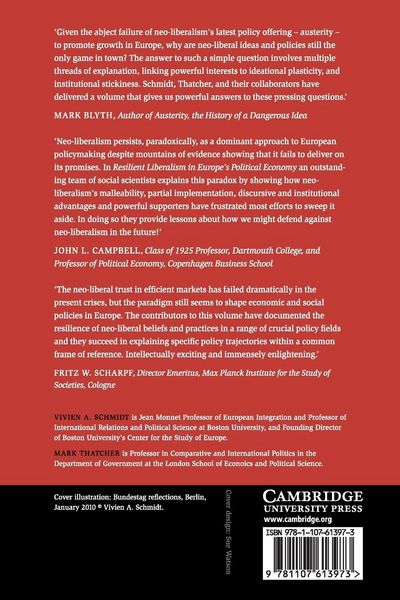
Advance praise: 'Given the abject failure of neo-liberalism's latest policy offering - austerity - to promote growth in Europe, why are neo-liberal ideas and policies still the only game in town? The answer to such a simple question involves multiple threads of explanation, linking powerful interests to ideational plasticity, and institutional stickiness. Schmidt, Thatcher, and their collaborators have delivered a volume that gives us powerful answers to these pressing questions.' Mark Blyth, author of Austerity: The History of a Dangerous Idea Advance praise: 'Neo-liberalism persists, paradoxically, as a dominant approach to European policymaking despite mountains of evidence showing that it fails to deliver on its promises. In Resilient Liberalism in Europe's Political Economy an outstanding team of social scientists explains this paradox by showing how neo-liberalism's malleability, partial implementation, discursive and institutional advantages and powerful supporters have frustrated most efforts to sweep it aside. In doing so they provide lessons about how we might defend against neo-liberalism in the future ...' John L. Campbell, Class of 1925 Professor, Dartmouth College, and Professor of Political Economy, Copenhagen Business School Advance praise: 'The neo-liberal trust in efficient markets has failed dramatically in the present crises, but the paradigm still seems to shape economic and social policies in Europe. The contributors to this volume have documented the resilience of neo-liberal beliefs and practices in a range of crucial policy fields and they succeed in explaining specific policy trajectories within a common frame of reference. Intellectually exciting and immensely enlightening.' Fritz W. Scharpf, Director Emeritus, Max Planck Institute for the Study of Societies, Cologne

Produktdetails

Einband

Taschenbuch

Erscheinungsdatum

29.08.2013

Herausgeber

Verlag

Cambridge Academic

Seitenzahl

469

Maße (L/B/H)

22,9/15,2/2,5 cm

Gewicht

740 g

Sprache

Englisch

ISBN

978-1-107-61397-3

Noch keine Bewertungen vorhanden

Verfassen Sie die erste Bewertung zu diesem Artikel

Helfen Sie anderen Kundinnen und Kunden durch Ihre Meinung.

Kundinnen und Kunden meinen

Bewertungen (0)

Die Leseprobe wird geladen.
  • Produktbild: Resilient Liberalism in Europe's Political Economy
  • Produktbild: Resilient Liberalism in Europe's Political Economy
  • Preface; 1. Theorizing ideational continuity: the resilience of neo-liberal ideas in Europe Vivien A. Schmidt and Mark Thatcher; Part I. Economy, State, and Society: 2. Neo-liberalism and fiscal conservatism Andrew Gamble; 3. Welfare-state transformations: from neo-liberalism to liberal neo-welfarism? Maurizio Ferrera; 4. The state: the bête noire of neo-liberalism or its greatest conquest? Vivien A. Schmidt and Cornelia Woll; Part II. Neo-liberalism in Major Policy Domains: 5. The collapse of the Brussels-Frankfurt consensus and the future of the euro Erik Jones; 6. Supranational neo-liberalization: the EU's regulatory model of economic markets Mark Thatcher; 7. Resilient neo-liberalism in European financial regulation Daniel Mügge; 8. Neo-liberalism and the working class hero: from organized to flexible labour markets Cathie Jo Martin; 9. European corporate governance: is there an alternative to neo-liberalism? Sigurt Vitols; Part III. Neo-liberalism in Comparative Perspective: 10. The resilience of Anglo-liberalism in the absence of growth: the UK and Irish cases Colin Hay and Nicola J. Smith; 11. Germany and Sweden in the crisis: re-coordination or resilient liberalism? Gerhard Schnyder and Gregory Jackson; 12. State transformation in Italy and France: technocratic versus political leadership on the road from non-liberalism to neo-liberalism Elisabetta Gualmini and Vivien A. Schmidt; 13. Reassessing the neo-liberal development model in Central and Eastern Europe Mitchell A. Orenstein; Part IV. Conclusion: 14. Conclusion: explaining the resilience of neo-liberalism and possible pathways out Mark Thatcher and Vivien A. Schmidt.