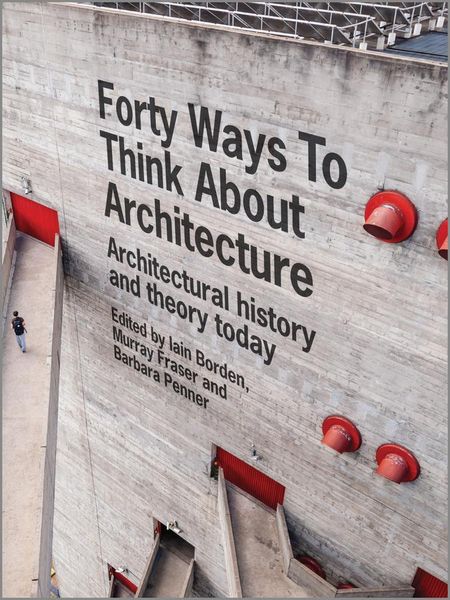
Forty Ways to Think about Architecture Architectural History and Theory Today
-
- Englisch ausgewählt
51,99 €
inkl. gesetzl. MwSt.,
Beschreibung
Produktdetails
Einband
Taschenbuch
Erscheinungsdatum
18.08.2014
Verlag
John Wiley & SonsSeitenzahl
288
Maße (L/B/H)
19,8/14,9/2 cm
Gewicht
551 g
Auflage
1. Auflage
Sprache
Englisch
ISBN
978-1-118-82261-6
The inspiration for this project is the work of Adrian Forty, Professor of Architectural History at the Bartlett School of Architecture, University College London (UCL), who has been internationally renowned as the UK's leading academic in the discipline for 40 years. Forty's many publications, notably Objects of Desire (1986), Words and Buildings (2000) and Concrete and Culture (2012), have been crucial to opening up new approaches to architectural history and theory and have helped to establish entirely new areas of study. His teaching at The Bartlett has enthused a new generation about the exciting possibilities of architectural history and theory as a field.
This collection takes in a total of 40 essays covering key subjects, ranging from memory and heritage to everyday life, building materials and city spaces. As well as critical theory, philosophy, literature and experimental design, it refers to more immediate and topical issues in the built environment, such as globalisation, localism, regeneration and ecologies. Concise and engaging entries reflect on architecture from a range of perspectives.
Contributors include eminent historians and theorists from elsewhere - such as Jean-Louis Cohen, Briony Fer, Hilde Heynen, Mary McLeod, Griselda Pollock, Penny Sparke and Anthony Vidler - as well as Forty's colleagues from the Bartlett School of Architecture including Iain Borden, Murray Fraser, Peter Hall, Barbara Penner, Jane Rendell and Andrew Saint. Forty Ways to Think about Architecture also features contributions from distinguished architects, such as Tony Fretton, Jeremy Till and Sarah Wigglesworth, and well-known critics and architectural writers, such as Tom Dyckhoff, William Menking and Thomas Weaver. Many of the contributors are former students of Adrian Forty.
Through these diverse essays, readers are encouraged to think about how architectural history and theory relates to their own research and design practices, thus using the work of Adrian Forty as a catalyst for fresh and innovative thinking about architecture as a subject.
Noch keine Bewertungen vorhanden
Verfassen Sie die erste Bewertung zu diesem Artikel
Helfen Sie anderen Kundinnen und Kunden durch Ihre Meinung.
Kurze Frage zu unserer Seite
Vielen Dank für Ihr Feedback
Wir nutzen Ihr Feedback, um unsere Produktseiten zu verbessern. Bitte haben Sie Verständnis, dass wir Ihnen keine Rückmeldung geben können. Falls Sie Kontakt mit uns aufnehmen möchten, können Sie sich aber gerne an unseren Kund*innenservice wenden.
zum Kundenservice