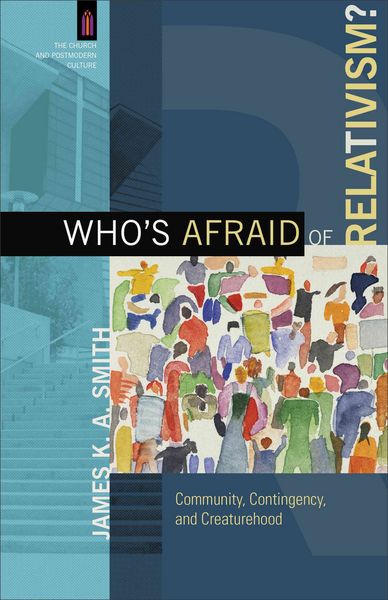
Who's Afraid of Relativism? Community, Contingency, and Creaturehood
-
- Taschenbuch ausgewählt
- eBook
-
Sprache:Englisch
28,99 €
inkl. gesetzl. MwSt.,
- Kostenlose Lieferung ab 30 € Einkaufswert
- Versandkostenfrei für Bonuscard-Kund*innen
Beschreibung
Produktdetails
Einband
Taschenbuch
Erscheinungsdatum
15.04.2014
Herausgeber
James K. A. SmithVerlag
Baker Publishing GroupSeitenzahl
192
Maße (L/B/H)
21,6/14,2/1,5 cm
Gewicht
231 g
Sprache
Englisch
ISBN
978-0-8010-3973-7
A Fresh Analysis of Relativism and Pragmatism
"It is often observed that one of the most important and revealing questions you can ask someone identified as a 'thinker' is 'What are you afraid of?' Writing with clarity and great sympathy, Smith helps us see that Christian theologians have betrayed their best insights by being afraid of relativism. He helps us see that the challenge is not relativism itself but rather the epistemological concerns that produced relativism. As is usually the case with Smith's work, this book is both clear and constructive: he not only provides a clear account of the work of Wittgenstein, Rorty, and Brandom but also develops an account of why and how Christians should navigate the contingent character of our lives."
--Stanley Hauerwas, Duke Divinity School, emeritus
"In very readable and reliable expositions of Wittgenstein, Rorty, and Brandom, Smith builds an extremely attractive case philosophically for recognizing the place of contingency, finitude, and dependence in human life. From a Christian perspective, this actually reaffirms an acceptance of creaturely existence and thus of a properly orthodox version of relativism, which there is no reason to fear. A wonderful thesis."
--Fergus Kerr, University of Edinburgh
"In Who's Afraid of Relativism? Smith takes a beautiful risk, boldly and successfully making a case for the relevance of pragmatism for contemporary Christian self-understanding. In this remarkable book, he not only succeeds in making the difficult and enigmatic work of complicated thinkers like Wittgenstein, Rorty, and Brandom accessible to the uninitiated (no small task in itself) but also argues convincingly that the pragmatist emphases on contingency and fallibility should play a key role in a Christian understanding of humans as dependent creatures. The mutual hostility between religious thinkers and pragmatists like Rorty is well known; Smith has the wisdom to see past this impasse in a timely and radical effort to encourage contemporary Christians to think differently about themselves."
--Ronald A. Kuipers, author of Richard Rorty
Noch keine Bewertungen vorhanden
Verfassen Sie die erste Bewertung zu diesem Artikel
Helfen Sie anderen Kundinnen und Kunden durch Ihre Meinung.
Kurze Frage zu unserer Seite
Vielen Dank für Ihr Feedback
Wir nutzen Ihr Feedback, um unsere Produktseiten zu verbessern. Bitte haben Sie Verständnis, dass wir Ihnen keine Rückmeldung geben können. Falls Sie Kontakt mit uns aufnehmen möchten, können Sie sich aber gerne an unseren Kund*innenservice wenden.
zum Kundenservice