Gutscheinbedingungen

**Gültig nur für Bestellungen an die Wunsch-Poststation bis 10.06.2026 auf Spielzeug, Schreibwaren, Filme, Geschenke & Trends, Musik, tolino eReader & Zubehör, Hörbücher und Hörbuch-Downloads (außer Abo), nicht preisgebundene Bücher und Kalender online auf thalia.at und in der Thalia App. Einzelne Artikel können ausgeschlossen sein. Aufgrund der Buchpreisbindung sind deutschsprachige Bücher und eBooks ausgenommen. Zusätzlich ausgenommen sind preisgebundene Artikel, Abos & Flatrates, eBooks, Games, Geschenkkarten/-boxen, Shelfies, Software, Zeitschriften sowie einzelne Artikel von tonies®. Pro Einkauf einmal einlösbar. Kein Click & Collect möglich. Keine Barauszahlung. Nicht kombinierbar mit anderen Aktionen und Gutscheinen. Gutschein wird auf max. 500€ Bestellwert angerechnet. Nicht gültig für Versandkosten und Services.

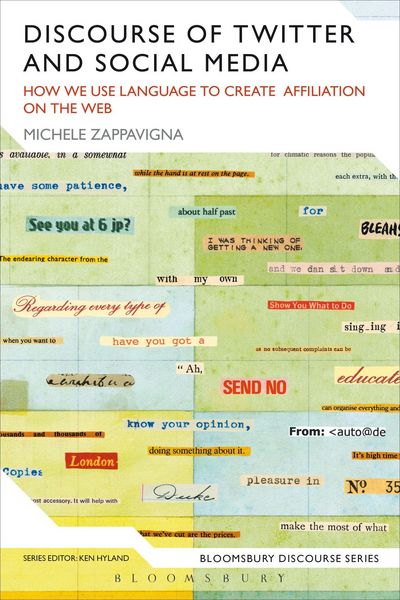
Produktbild: Discourse of Twitter and Social Media

Discourse of Twitter and Social Media How We Use Language to Create Affiliation on the Web

61,99 €

inkl. gesetzl. MwSt., Versandkostenfrei


Beschreibung

Produktdetails

Einband

Taschenbuch

Erscheinungsdatum

07.11.2013

Herausgeber

Ken Hyland

Verlag

Bloomsbury 3PL

Seitenzahl

240

Maße (L/B/H)

23,4/15,6/1,3 cm

Gewicht

371 g

Sprache

Englisch

ISBN

978-1-4725-3154-4

Beschreibung

Zitat

The Discourse of Twitter and Social Media is the first, large-scale linguistic analysis of the popular micro-blogging site, Twitter. Written in a lively and accessible style, this landmark study brings together cutting edge methods from corpus linguistics with the latest work in Systemic Functional Linguistics to bring to light the ways in which our talk is being reworked in Twitter. New concepts of 'searchable talk' and 'ambient affiliation' are important for understanding not only Twitter discourse, but are also relevant to the communicative practices found in social media more widely. Exploring a wide range of topics from internet memes to online humour, The Discourse of Twitter and Social Media is useful for linguists and scholars interested in new media texts. -- Dr Ruth Page, University of Leicester, UK The book is an interesting account of commonalities of online language. It clearly shows that users are adopting a language style that is specific to online use and that uses different signs in order to convey emotions to account for the lack of actually seeing or hearing the person that you are communicating with. The book is interesting and entertaining and some of the online inside jokes such as the "memes" are very amusing. Overall, the book is a great tool for a person interested in social networks, media and language. -- Elin Weiss has a Bachelor's Degree in Psychology and a Master's Degree in Women's Studies from University College Dublin, Ireland. -- Metapsychology Online Review

Produktdetails

Einband

Taschenbuch

Erscheinungsdatum

07.11.2013

Herausgeber

Ken Hyland

Verlag

Bloomsbury 3PL

Seitenzahl

240

Maße (L/B/H)

23,4/15,6/1,3 cm

Gewicht

371 g

Sprache

Englisch

ISBN

978-1-4725-3154-4

Herstelleradresse

Libri GmbH
Europaallee 1
36244 Bad Hersfeld
DE

Email: gpsr@libri.de

Kundinnen und Kunden meinen

0 Bewertungen

Informationen zu Bewertungen

Zur Abgabe einer Bewertung ist eine Anmeldung im Konto notwendig. Die Authentizität der Bewertungen wird von uns nicht überprüft. Wir behalten uns vor, Bewertungstexte, die unseren Richtlinien widersprechen, entsprechend zu kürzen oder zu löschen.

Die Bewertungen sind nach Format, Anzahl Sterne und Datum sortiert.

Verfassen Sie die erste Bewertung zu diesem Artikel

Helfen Sie anderen Kund*innen durch Ihre Meinung

Kundinnen und Kunden meinen

0 Bewertungen filtern

Die Leseprobe wird geladen.
  • Produktbild: Discourse of Twitter and Social Media
  • Preface (by Professor Jim Martin)
    1. Introduction: Social Media and the Cultural Movement Toward 'Searchable Talk'
    2. Social Media as Corpora
    3. Evaluative Language Online
    4. Internet Slang
    5. Internet Memes
    6. Internet Humour and Fail: "The world is full of #fail tonight"
    7. Online Political Discourse
    8. Ambient Affiliation
    9. Conclusion: Social Media and Internet Linguistics
    References
    Appendices
    Index