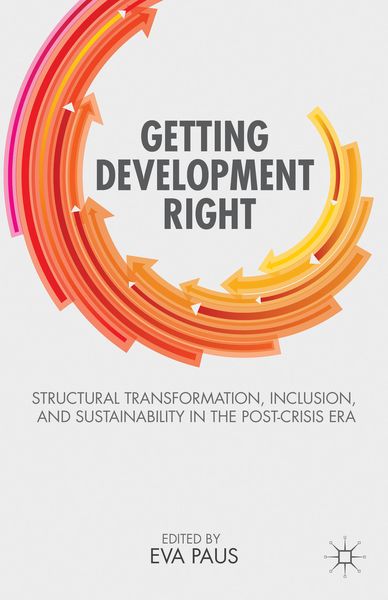
Getting Development Right Structural Transformation, Inclusion, and Sustainability in the Post-Crisis Era
-
- Hardcover
- Taschenbuch ausgewählt
- eBook
-
Sprache:Englisch
49,99 €
inkl. gesetzl. MwSt.,
Beschreibung
Produktdetails
Einband
Taschenbuch
Erscheinungsdatum
19.09.2013
Abbildungen
XIII, 226 p. 16 illus.
Herausgeber
E. PausVerlag
Palgrave Macmillan USSeitenzahl
226
Maße (L/B/H)
23,4/15,2/1,3 cm
Gewicht
318 g
Auflage
2013 edition
Sprache
Englisch
ISBN
978-1-137-36090-8
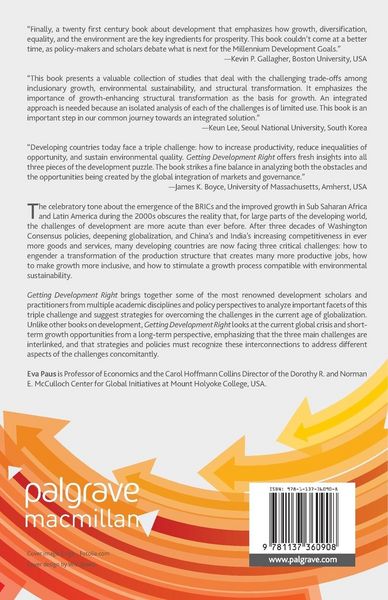
The celebratory tone about the emergence of the BRICs and the improved growth in Sub Saharan Africa and Latin America during the 2000s obscures the reality that, for large parts of the developing world, the development challenges are more acute than ever before. After three decades of Washington Consensus policies, deepening globalization, and China's and India's increasing competitiveness in ever more goods and services, many developing countries are now facing three critical challenges: how to engender a transformation of the production structure that creates many more productive jobs, how to make growth more inclusive, and how to stimulate a growth process compatible with environmental sustainability.
This book brings together development scholars and practitioners from multiple academic disciplines and policy perspectives to analyze important facets of this triple challenge, to explore interconnections among them and suggest strategies for overcoming the challenges in the current age of globalization. Three features distinguish this book from other current works in the field. First, this book looks beyond the current global crisis and short-term growth opportunities and analyzes the challenges to development from a long-term perspective. Second, books on the barriers to development tend to concentrate on one of the three challenges, e.g. Barbier (2010) A Global Green New Deal on environmental sustainability; Cimoli, Dosi, Stiglitz (2009) Industrial Policy andDevelopment on structural transformation; and Milanovic (2011) The Have and the Have-Nots on exclusion. This book, in contrast, brings the three challenges together to emphasize that they challenges are interlinked and that strategies and policies must begin to recognize these interconnections to address different aspects of the challenges concomitantly. Finally, the contributors to the book include some of the most renowned development thinkers of our time.
Noch keine Bewertungen vorhanden
Verfassen Sie die erste Bewertung zu diesem Artikel
Helfen Sie anderen Kundinnen und Kunden durch Ihre Meinung.
Kurze Frage zu unserer Seite
Vielen Dank für Ihr Feedback
Wir nutzen Ihr Feedback, um unsere Produktseiten zu verbessern. Bitte haben Sie Verständnis, dass wir Ihnen keine Rückmeldung geben können. Falls Sie Kontakt mit uns aufnehmen möchten, können Sie sich aber gerne an unseren Kund*innenservice wenden.
zum Kundenservice