• Produktbild: Building Chicago Economics
  • Produktbild: Building Chicago Economics

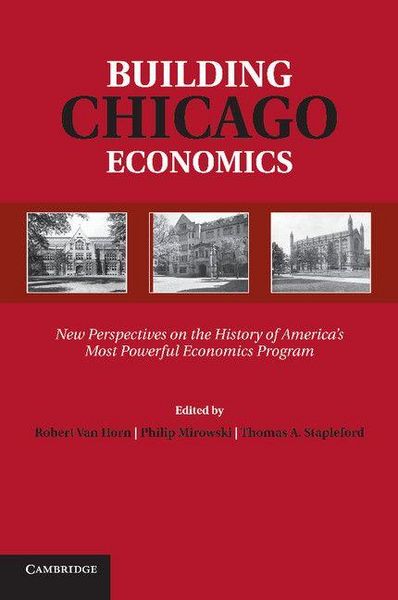
Building Chicago Economics New Perspectives on the History of America's Most Powerful Economics Program

69,99 €

inkl. gesetzl. MwSt., Versandkostenfrei


Beschreibung

Produktdetails

Einband

Taschenbuch

Erscheinungsdatum

11.04.2013

Herausgeber

Van Horn Robert + weitere

Verlag

Cambridge Academic

Seitenzahl

454

Maße (L/B/H)

22,9/15,2/2,7 cm

Gewicht

660 g

Sprache

Englisch

ISBN

978-1-107-61643-1

Beschreibung

Zitat

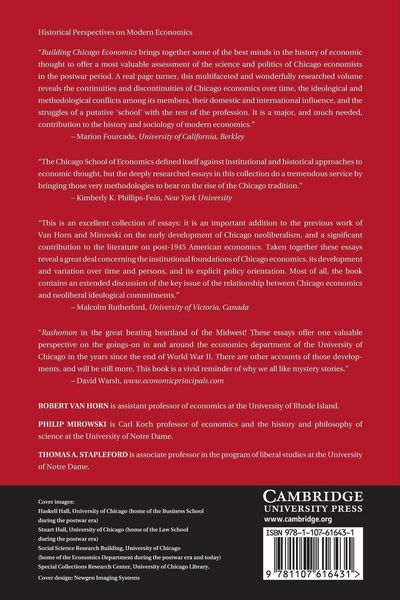
'Building Chicago Economics brings together some of the best minds in the history of economic thought to offer a most valuable assessment of the science and politics of Chicago economists in the postwar period. A real page turner, this multifaceted and wonderfully researched volume reveals the continuities and discontinuities of Chicago economics over time, the ideological and methodological conflicts among its members, their domestic and international influence, and the struggles of a putative 'school' with the rest of the profession. It is a major, and much needed, contribution to the history and sociology of modern economics.' Marion Fourcade, University of California, Berkeley 'The Chicago School of Economics defined itself against institutional and historical approaches to economic thought, but the deeply researched essays in this collection do a tremendous service by bringing those very methodologies to bear on the rise of the Chicago tradition.' Kimberly K. Phillips-Fein, New York University 'This is an excellent collection of essays: it is an important addition to the previous work of Van Horn and Mirowski on the early development of Chicago neoliberalism, and a significant contribution to the literature on post-1945 American economics. Taken together these essays reveal a great deal concerning the institutional foundations of Chicago economics, its development and variation over time and persons, and its explicit policy orientation. Most of all, the book contains an extended discussion of the key issue of the relationship between Chicago economics and neoliberal ideological commitments.' Malcolm Rutherford, University of Victoria, Canada 'Rashomon in the great beating heartland of the Midwest! These essays offer one valuable perspective on the goings-on in and around the economics department of the University of Chicago in the years since the end of World War II. There are other accounts of those developments, and will be still more. This book is a vivid reminder of why we all like mystery stories.' David Warsh, economicprincipals.com

Produktdetails

Einband

Taschenbuch

Erscheinungsdatum

11.04.2013

Herausgeber

Verlag

Cambridge Academic

Seitenzahl

454

Maße (L/B/H)

22,9/15,2/2,7 cm

Gewicht

660 g

Sprache

Englisch

ISBN

978-1-107-61643-1

Kundinnen und Kunden meinen

0 Bewertungen

Informationen zu Bewertungen

Zur Abgabe einer Bewertung ist eine Anmeldung im Konto notwendig. Die Authentizität der Bewertungen wird von uns nicht überprüft. Wir behalten uns vor, Bewertungstexte, die unseren Richtlinien widersprechen, entsprechend zu kürzen oder zu löschen.

Die Bewertungen sind nach Format, Anzahl Sterne und Datum sortiert.

Verfassen Sie die erste Bewertung zu diesem Artikel

Helfen Sie anderen Kund*innen durch Ihre Meinung

Kundinnen und Kunden meinen

0 Bewertungen filtern

Die Leseprobe wird geladen.
  • Produktbild: Building Chicago Economics
  • Produktbild: Building Chicago Economics
  • Blueprints Robert Van Horn, Philip Mirowski and Thomas Stapleford; Orientation: finding the Chicago School Jaime Peck; Part I. Economics Built for Policy: The Legacy of Milton Friedman: 1. Positive economics for democratic policy: Milton Friedman, institutionalism, and the science of history Thomas Stapleford; 2. Markets, politics, and democracy at Chicago: taking economics seriously J. Daniel Hammond; Part II. Constructing the Institutional Foundations of the Chicago School: 3. The price is not right: Theodore W. Schultz, policy planning, and agricultural economics in the cold-war United States Paul Burnett; 4. Sharpening tools in the workshop: the workshop system and the Chicago School's success Ross B. Emmett; 5. George Stigler, the graduate school of business, and the pillars of the Chicago School Edward Nik-Khah; Part III. Imperial Chicago: 6. Chicago price theory and Chicago law and economics: a tale of two transitions Steven Medema; 7. Intervening in laissez-faire liberalism: Chicago's shift on patents Robert Van Horn and Matthias Klaes; 8. Allusions to evolution: edifying evolutionary biology rather than economic theory Jack Vromen; 9. On the origins (at Chicago) of some species of evolutionary economics Philip Mirowski; Part IV. Debating Chicago Neoliberalism: 10. Jacob Viner's critique of Chicago neoliberalism Robert Van Horn; 11. The Chicago School, Hayek, and neoliberalism Bruce Caldwell; 12. The lucky consistency of Milton Friedman's science and politics, 1933-63 Béatrice Cherrier; 13. Far right of the midway: Chicago neoliberalism and the genesis of the Milton Friedman Institute (2006-9) Edward Nik-Khah.