KI-Beratung Beta

Gutscheinbedingungen

**Gültig am 27.11.2026 auf Spielzeug, Schreibwaren, Filme, Geschenke & Trends, Musik, tolino eReader & Zubehör, Hörbücher und Hörbuch-Downloads, nicht preisgebundene Bücher und Kalender online auf thalia.at und in der Thalia App. Einzelne Artikel können ausgeschlossen sein. Aufgrund der Buchpreisbindung sind deutschsprachige Bücher und eBooks ausgenommen. Zusätzlich ausgenommen sind Abos & Flatrates, Games, Geschenkkarten/-boxen, Shelfies, Software, Zeitschriften sowie einzelne Artikel von tonies®. Pro Einkauf einmal einlösbar. Click & Collect nur bei Onlinevorabzahlung möglich. Keine Barauszahlung. Nicht kombinierbar mit anderen Aktionen und Gutscheinen. Gutschein wird auf max. 500€ Bestellwert angerechnet. Nicht gültig für Versandkosten und Services.

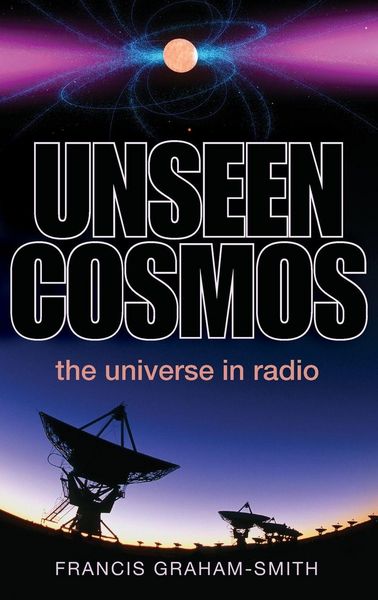
Produktbild: Unseen Cosmos

Unseen Cosmos

51,99 €

inkl. gesetzl. MwSt., Versandkostenfrei


Beschreibung

Radio telescopes have transformed our understanding of the Universe. Pulsars, quasars, Big Bang cosmology: all are discoveries of the new science of radio astronomy. Here, Francis Graham-Smith describes the birth, development, and maturity of radio astronomy, from the first discovery of cosmic radio...

Beschreibung

Radio telescopes have transformed our understanding of the Universe. Pulsars, quasars, Big Bang cosmology: all are discoveries of the new science of radio astronomy. Here, Francis Graham-Smith describes the birth, development, and maturity of radio astronomy, from the first discovery of cosmic radio waves to its present role as a major part of modern astronomy.
Radio is part of the electromagnetic spectrum, covering infra-red, visible light, ultraviolet, X-rays, and gamma-rays, and Graham-Smith explains why it is that radio waves give us a unique view of the Universe. Tracing the development of radio telescopes he shows how each new idea in observing techniques has led to new discoveries, and looks at the ways in which radio waves are generated in the various cosmic sources, relating this to the radio world of mobile phones, radio and television channels, wireless computer connections, and remote car locks.
Today a new generation of radio telescopes promises to extend our understanding of the Universe into further, as yet unknown, fields. Huge new radio telescopes are being built, such as the Atacama Large Millimetre Array (ALMA), Low Frequency Array for Radioastronomy (LOFAR), and the Square Kilometre Array (SKA). Radio telescopes on spacecraft such as the Cosmic Microwave Explorer (COBE) and Planck are tracing in minute detail the faint but universal radio signal from the expanding early Universe.
Graham-Smith shares the excitement of discovering the wonders of the radio universe, and the possibilities promised by the new age of giant radio telescopes.

Rezension

This is a first rate book ... Highly recommended! Astronomy Now

Produktdetails

Einband

Gebundene Ausgabe

Erscheinungsdatum

06.09.2012

Abbildungen

Several black and white images, and a short colour plate section

Verlag Oxford University Press

Produktdetails

Einband

Gebundene Ausgabe

Erscheinungsdatum

06.09.2012

Abbildungen

Several black and white images, and a short colour plate section

Verlag Oxford University Press
Seitenzahl

256

Maße (L/B/H)

24/16,1/1,8 cm

Gewicht

552 g

Sprache

Englisch

ISBN

978-0-19-966058-2

Herstelleradresse

Libri GmbH
Europaallee 1
36244 Bad Hersfeld
DE

Email: gpsr@libri.de

Noch keine Bewertungen vorhanden

Verfassen Sie die erste Bewertung zu diesem Artikel

Helfen Sie anderen Kundinnen und Kunden durch Ihre Meinung.

Kundinnen und Kunden meinen

Bewertungen (0)

Die Leseprobe wird geladen.
  • Produktbild: Unseen Cosmos
    • Preface

    • 1: Radio noise from space

    • 2: Hot sun and cold planets

    • 3: Our galaxy the Milky Way

    • 4: Cosmic Rays, the Synchrotron, and Molecules

    • 5: Radio galaxies and quasars

    • 6: Supernovae and Pulsars

    • 7: Pulsar clocks and relativity

    • 8: Radio expands into cosmology

    • 9: Seeing the cosmic fireball

    • 10: Radio telescopes and interfermometers

    • 11: LOFAR, ALMA and SKA

    • Endnotes