
KI-Beratung Beta

Gutscheinbedingungen

**Gültig am 20.11.2026 ab einem Mindestbestellwert von 30€ auf Spielzeug, Schreibwaren, Filme, Geschenke & Trends, Musik, tolino eReader & Zubehör, Hörbücher und Hörbuch-Downloads, nicht preisgebundene Bücher und Kalender online auf thalia.at und in der Thalia App. Einzelne Artikel können ausgeschlossen sein. Aufgrund der Buchpreisbindung sind deutschsprachige Bücher und eBooks ausgenommen. Zusätzlich ausgenommen sind Abos & Flatrates, Games, Geschenkkarten/-boxen, Shelfies, Software, Zeitschriften sowie einzelne Artikel von tonies®. Pro Einkauf einmal einlösbar. Click & Collect nur bei Onlinevorabzahlung möglich. Keine Barauszahlung. Nicht kombinierbar mit anderen Aktionen und Gutscheinen. Gutschein wird auf max. 500€ Bestellwert angerechnet. Nicht gültig für Versandkosten und Services. Preisgebundene Artikel sind vom Mindestbestellwert ausgeschlossen.

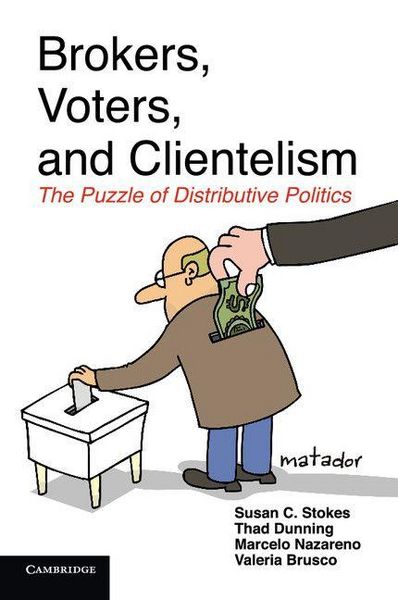
  • Produktbild: Brokers, Voters, and Clientelism
  • Produktbild: Brokers, Voters, and Clientelism

Brokers, Voters, and Clientelism

14,99 €

inkl. gesetzl. MwSt., zzgl. Versandkosten


  • Kostenlose Lieferung ab 30 € Einkaufswert
  • Versandkostenfrei für Bonuscard-Kund*innen

Beschreibung

Brokers, Voters, and Clientelism addresses major questions in distributive politics. Why is it acceptable for parties to try to win elections by promising to make certain groups of people better off, but unacceptable - and illegal - to pay people for their votes? Why do parties often lavish benefits...

Beschreibung

Brokers, Voters, and Clientelism addresses major questions in distributive politics. Why is it acceptable for parties to try to win elections by promising to make certain groups of people better off, but unacceptable - and illegal - to pay people for their votes? Why do parties often lavish benefits on loyal voters, whose support they can count on anyway, rather than on responsive swing voters? Why is vote buying and machine politics common in today's developing democracies but a thing of the past in most of today's advanced democracies? This book develops a theory of broker-mediated distribution to answer these questions, testing the theory with research from four developing democracies, and reviews a rich secondary literature on countries in all world regions. The authors deploy normative theory to evaluate whether clientelism, pork-barrel politics, and other non-programmatic distributive strategies can be justified on the grounds that they promote efficiency, redistribution, or voter participation.

Rezension

'This book advances a single broad theoretical point: vote brokers are central to any system of vote buying in mass elections. While many previous scholars have considered the role of vote brokers from one angle or another, what sets this book apart is that it provides a unified theoretical model of vote brokers. It is grounded effectively in the modern economic theory of agency, and the authors run it through a series of tests using both original primary and secondary sources. Brokers, Voters, and Clientelism will be a landmark for the next generation of studies.' Gary W. Cox, Stanford University

Produktdetails

Einband

Taschenbuch

Erscheinungsdatum

16.09.2013

Abbildungen

50 b/w illus. 16 tables

Verlag Cambridge University Press

Produktdetails

Einband

Taschenbuch

Erscheinungsdatum

16.09.2013

Abbildungen

50 b/w illus. 16 tables

Verlag Cambridge University Press
Seitenzahl

344

Maße (L/B/H)

22,9/15,2/2,1 cm

Gewicht

559 g

Sprache

Englisch

ISBN

978-1-107-66039-7

Herstelleradresse

Libri GmbH
Europaallee 1
36244 Bad Hersfeld
DE

Email: gpsr@libri.de

Noch keine Bewertungen vorhanden

Verfassen Sie die erste Bewertung zu diesem Artikel

Helfen Sie anderen Kundinnen und Kunden durch Ihre Meinung.

Kundinnen und Kunden meinen

Bewertungen (0)

Weitere Artikel finden Sie in

Die Leseprobe wird geladen.
  • Produktbild: Brokers, Voters, and Clientelism
  • Produktbild: Brokers, Voters, and Clientelism
  • Part I. Modalities of Distributive Politics: 1. Between clients and citizens: puzzles and concepts in the study of distributive politics; Part II. The Micro-Logic of Clientelism: 2. Gaps between theory and fact; 3. A theory of broker-mediated distribution; 4. Testing the theory of broker-mediated distribution; 5. A disjunction between the strategies of leaders and brokers?; 6. Clientelism and poverty; Part III. The Macro-Logic of Vote-Buying: What Explains the Rise and Decline of Political Machines?: 7. Party leaders against the machine; 8. What killed vote buying in Britain and the United States?; Part IV. Clientelism and Democratic Theory: 9. What's wrong with buying votes?