KI-Beratung Beta

  • Produktbild: The Really Useful Maths Book
  • Produktbild: The Really Useful Maths Book

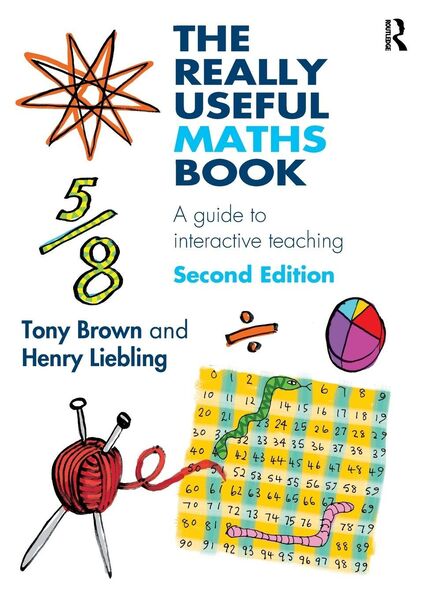
The Really Useful Maths Book A guide to interactive teaching

77,99 €

inkl. gesetzl. MwSt., Versandkostenfrei


Beschreibung

Produktdetails

Einband

Taschenbuch

Erscheinungsdatum

03.12.2013

Abbildungen

schwarz-weiss Illustrationen, Zeichnungen, schwarz-weiss, Tabellen, schwarz-weiss

Verlag

Taylor and Francis

Seitenzahl

326

Maße (L/B/H)

29,7/21/1,8 cm

Gewicht

849 g

Auflage

2. Auflage

Sprache

Englisch

ISBN

978-0-415-82949-6

Herstelleradresse

Libri GmbH
Europaallee 1
36244 Bad Hersfeld
DE

Email: gpsr@libri.de

Noch keine Bewertungen vorhanden

Verfassen Sie die erste Bewertung zu diesem Artikel

Helfen Sie anderen Kundinnen und Kunden durch Ihre Meinung.

Kundinnen und Kunden meinen

Bewertungen (0)

Die Leseprobe wird geladen.
  • Produktbild: The Really Useful Maths Book
  • Produktbild: The Really Useful Maths Book
  • Part 1: Mathematical Activities and Teaching Strategies Introduction N. Numbers and the number system 1. Counting and counting out 2. Saying and making numbers 3. Arabic and other number systems 4. Working with grids 5. Working with target boards 6. Working with sets 7. Working with square numbers 8. Exploring algebra 9. Taking ideas from 'floor to head' O. Operations and Calculations 1. Number lines 2. The story of 24 3. Arithmetic operations 4. Arithmogons and other puzzles 5. Teaching Multiplication tables 6. Divisibility rules S. Shape and space 1. Visualisation techniques and activities 2. Activities and investigations 3. Working with cloths 4. Unusual and familiar 5. Changing shapes M. Measures, statistics and data handling 1. Measures and measurement 2. Data handling and using the media 3. Statistics and probability 4. Using personal measurement 5. Investigating measurement X. Cross-curricular Approaches 1. Cross-curricular approaches 2. Playing with the language of mathematics 3. Maths in music, dannce and knitting 4. Maths, sustainability and the global dimension 5. Reasoning, logic, proof and programming Part 2: Developing Interactive Teaching Strategies Introduction A. Teaching and Learning From International Perspectives 1. Policy and content 2. Pupil performance 3. Classroom practice 4. Findings from psychology and neuroscience B. Teachers and children interacting 1. Pupil, teacher, mathematics: a dynamic model of interaction 2. Interactive teaching 3. Children talking, teachers listening 4. Questions and questioning 5. Assessment for learning C. Resources and Planning for Teaching and Learning 1. Achieving balance in the mathematics curriculum 2. Using resources to emphasise mathematical attributes 3. Resources for counting and calculation 4. Planning to optimise learning D. Contexts for Making Sense of Mathematics 1. Using different contexts to help make sense of mathematics 2. Practical activities and solving problems E. Bridges, Strategies and Personal Qualities 1. Building bridges for learning 2. The importance of strategy building 3. Eight qualities of successful learners