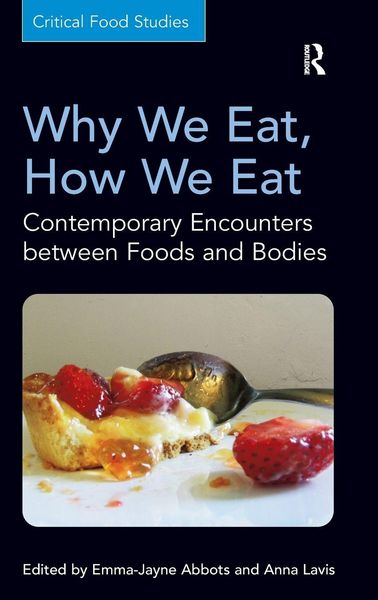
Produktbild: Why We Eat, How We Eat

Why We Eat, How We Eat Contemporary Encounters between Foods and Bodies

265,99 €

inkl. gesetzl. MwSt., Versandkostenfrei


Beschreibung

Produktdetails

Einband

Gebundene Ausgabe

Erscheinungsdatum

11.06.2013

Herausgeber

Abbots Emma-Jayne + weitere

Verlag

Taylor and Francis

Seitenzahl

326

Maße (L/B/H)

24/16,1/2,2 cm

Gewicht

612 g

Sprache

Englisch

ISBN

978-1-4094-4725-2

Beschreibung

Produktdetails

Einband

Gebundene Ausgabe

Erscheinungsdatum

11.06.2013

Herausgeber

Verlag

Taylor and Francis

Seitenzahl

326

Maße (L/B/H)

24/16,1/2,2 cm

Gewicht

612 g

Sprache

Englisch

ISBN

978-1-4094-4725-2

Herstelleradresse

Libri GmbH
Europaallee 1
36244 Bad Hersfeld
DE

Email: gpsr@libri.de

Noch keine Bewertungen vorhanden

Verfassen Sie die erste Bewertung zu diesem Artikel

Helfen Sie anderen Kundinnen und Kunden durch Ihre Meinung.

Kundinnen und Kunden meinen

Bewertungen (0)

Die Leseprobe wird geladen.
  • Produktbild: Why We Eat, How We Eat
  • Contents: Introduction: contours of eating: mapping the terrain of body/food encounters, Emma-Jayne Abbots and Anna Lavis; Part I Absences and Presences: How We (Do Not) Eat What (We Think) We Eat: Invisible foodscapes: into the blue, Kaori O’Connor; The substance of absence: exploring eating and anorexia, Anna Lavis; Home and heart, hand and eye: unseen links between pigmen and pigs in industrial farming, Kim Baker; Interlude: Eating practices and health behaviour, Simon Cohn. Part II Intimacies, Estrangements and Ambivalences: How Eating Comforts and Disquiets: Advancing critical dietetics: theorizing health at every size, Lucy Aphramor, Jennifer Brady and Jacqui Gingras; Eating and drinking kefraya: the karam in the vineyards, Elizabeth Saleh; Negotiating foreign bodies: migration, trust and the risky business of eating in highland Ecuador, Emma-Jayne Abbots; Interlude: Reflections on fraught food, Jon Holtzman. Part III Contradictions and Co-Existences: What We Should and Should Not Eat: Chewing on choice, Sally Brooks, Duika Burges Watson, Alizon Draper, Michael Goodman, Heidi Kvalvaag and Wendy Wills; ’It is the bacillus that makes our milk’: ethnocentric perceptions of yogurt in postsocialist Bulgaria, Maria Yatova; The transition to low carbon milk: dairy consumption and the changing politics of human-animal relations, Jim Ormond; Interlude: Reflections on the elusiveness of eating, Anne Murcott. Part IV Entanglements and Mobilizations: The Multiple Sites of Eating Encounters: Confessions of a vegan anthropologist: exploring the trans-biopolitics of eating in the field, Samantha Hurn; Metabolism as strategy: agency, evolution and biological hinterlands, Rachael Kendrick; Ingesting places: embodied geographies of coffee, Benjamin Coles; Complex carbohydrates: on the relevance of ethnography in nutrition education, Emily Yates-Doerr; Interlude: Entanglements: fish, guts, and bio-cultural sustainability, Elspeth Probyn; Index.