KI-Beratung Beta

Gutscheinbedingungen

**Gültig bis 30.11.2026 auf Spielzeug, Schreibwaren, Filme, Geschenke & Trends, Musik, tolino eReader & Zubehör, Hörbücher und Hörbuch-Downloads, nicht preisgebundene Bücher und Kalender online auf thalia.at und in der Thalia App. Einzelne Artikel können ausgeschlossen sein. Aufgrund der Buchpreisbindung sind deutschsprachige Bücher und eBooks ausgenommen. Zusätzlich ausgenommen sind Abos & Flatrates, Games, Geschenkkarten/-boxen, Shelfies, Software, Zeitschriften sowie einzelne Artikel von tonies®. Pro Einkauf einmal einlösbar. Nur gültig mit im Onlineshop hinterlegter Bonuscard. Click & Collect nur bei Onlinevorabzahlung möglich. Keine Barauszahlung. Nicht kombinierbar mit anderen Aktionen und Gutscheinen. Gutschein wird auf max. 500€ Bestellwert angerechnet. Nicht gültig für Versandkosten und Services.

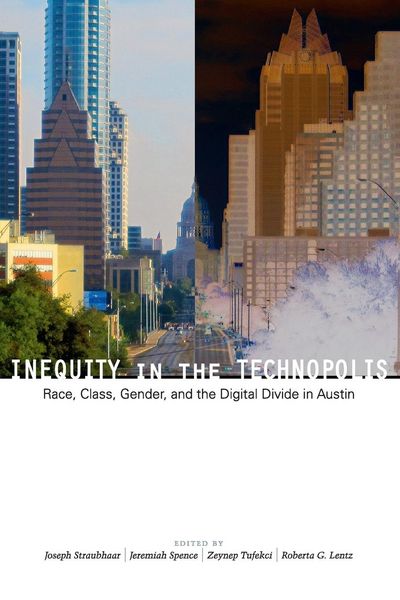
Produktbild: Inequity in the Technopolis

Inequity in the Technopolis Race, Class, Gender, and the Digital Divide in Austin

43,99 €

inkl. gesetzl. MwSt., Versandkostenfrei


Beschreibung

Over the past few decades, Austin, Texas, has made a concerted effort to develop into a "technopolis," becoming home to companies such as Dell and numerous start-ups in the 1990s. It has been a model for other cities across the nation that wish to become high-tech centers while still retaining the livability...

Beschreibung

Over the past few decades, Austin, Texas, has made a concerted effort to develop into a "technopolis," becoming home to companies such as Dell and numerous start-ups in the 1990s. It has been a model for other cities across the nation that wish to become high-tech centers while still retaining the livability to attract residents. Nevertheless, this expansion and boom left poorer residents behind, many of them African American or Latino, despite local and federal efforts to increase lower-income and minority access to technology. This book was born of a ten-year longitudinal study of the digital divide in Austin-a study that gradually evolved into a broader inquiry into Austin's history as a segregated city, its turn toward becoming a technopolis, what the city and various groups did to address the digital divide, and how the most disadvantaged groups and individuals were affected by those programs. The editors examine the impact of national and statewide digital inclusion programs created in the 1990s, as well as what happened when those programs were gradually cut back by conservative administrations after 2000. They also examine how the city of Austin persisted in its own efforts for digital inclusion by working with its public libraries and a number of local nonprofits, and the positive impact those programs had.

Zitat

"Indeed, in terms of the research effort and the materials uncovered to examine the digital divide, this study is exemplary."--Anthony M. Orum, Loyola University, Chicago, Great Plains Quarterly "Inequity in the Technopolis is a neat exploration of economic and cultural forces at play during about a twenty-five year period in metropolitan Austin related to the technology boom of the late twentieth-century." - Kevin Romig, Texas Books in Review

Produktdetails

Einband

Taschenbuch

Erscheinungsdatum

01.03.2012

Herausgeber Joseph Straubhaar
Verlag University Of Texas Press

Produktdetails

Einband

Taschenbuch

Erscheinungsdatum

01.03.2012

Herausgeber Joseph Straubhaar
Verlag University Of Texas Press
Seitenzahl

298

Maße (L/B/H)

22,9/15,2/1,8 cm

Gewicht

487 g

Sprache

Englisch

ISBN

978-0-292-75438-6

Herstelleradresse

Libri GmbH
Europaallee 1
36244 Bad Hersfeld
DE

Email: gpsr@libri.de

Noch keine Bewertungen vorhanden

Verfassen Sie die erste Bewertung zu diesem Artikel

Helfen Sie anderen Kundinnen und Kunden durch Ihre Meinung.

Kundinnen und Kunden meinen

Bewertungen (0)

  • Produktbild: Inequity in the Technopolis
    • Acknowledgments
    • Chapter 1. Digital Inequity in the Austin Technopolis: An Introduction, by Joseph Straubhaar, Zeynep Tufekci, Jeremiah Spence, and Viviana Rojas
    • Chapter 2. Structuring Race in the Cultural Geography of Austin, by Jeremiah Spence, Joseph Straubhaar, Alexander Cho, and Dean Graber
    • Chapter 3. A History of High Tech and the Technopolis in Austin, by Lisa Hartenberger, Zeynep Tufekci, and Stuart Davis
    • Chapter 4. Past and Future Divides: Social Mobility, Inequality, and the Digital Divide in Austin during the Tech Boom, by Zeynep Tufekci
    • Chapter 5. The Digital Divide: The National Debate and Federal- and State-Level Programs, by Ed Lenert, Miyase Christensen, Zeynep Tufekci, and Karen Gustafson
    • Chapter 6. Crossing the Digital Divide: Local Initiatives in Austin, by Carolyn Cunningham, Holly Custard, Joseph Straubhaar, Jeremiah Spence, Dean Graber, and Bethany Letalien
    • Chapter 7. Structuring Access: The Role of Austin Public Access Centers in Digital Inclusion, by Roberta Lentz, Joseph Straubhaar, Laura Dixon, Dean Graber, Jeremiah Spence, Bethany Letalien, and Antonio LaPastina
    • Chapter 8. Bridging the Broadband Gap or Recreating Digital Inequalities? The Social Shaping of Public Wi-Fi in Austin, by Martha Fuentes-Bautista and Nobuya Inagaki
    • Chapter 9. Communities, Cultural Capital, and Digital Inclusion: Ten Years of Tracking Techno-Dispositions and Techno-Capital, by Viviana Rojas, Joseph Straubhaar, Jeremiah Spence, Debasmita Roychowdhury, Ozlem Okur, Juan Piñon, and Martha Fuentes-Bautista
    • Chapter 10. Conclusion, by Joseph Straubhaar
    • Contributors
    • Index