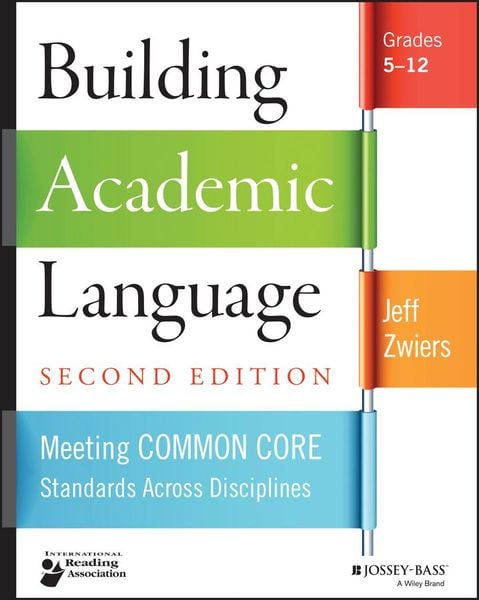
Building Academic Language Meeting Common Core Standards Across Disciplines, Grades 5-12
-
- Englisch ausgewählt
26,99 €
inkl. gesetzl. MwSt.,
- Kostenlose Lieferung ab 30 € Einkaufswert
- Versandkostenfrei für Bonuscard-Kund*innen
Beschreibung
Produktdetails
Einband
Taschenbuch
Erscheinungsdatum
07.04.2014
Verlag
John Wiley & Sons IncSeitenzahl
336
Maße (L/B/H)
23,1/17,9/3 cm
Gewicht
488 g
Auflage
2nd Revised edition
Sprache
Englisch
ISBN
978-1-118-74485-7
"Of the over one hundred new publications on the Common Core State Standards (CCSS), this one truly stands out! In the second edition of Building Academic Language, Jeff Zwiers presents a much-needed, comprehensive roadmap to cultivating academic language development across all disciplines, this time placing the rigor and challenges of the CCSS front and center. A must-have resource!"
-Andrea Honigsfeld, EdD, Molloy College
"Language is critical to the development of content learning as students delve more deeply into specific disciplines. When students possess strong academic language, they are better able to critically analyze and synthesize complex ideas and abstract concepts. In this second edition of Building Academic Language, Jeff Zwiers successfully builds the connections between the Common Core State Standards and academic language. This is the 'go to' resource for content teachers as they transition to the expectations for college and career readiness."
-Katherine S. McKnight, PhD, National Louis University
With the adoption of the Common Core State Standards (CCSS) by most of the United States, students need help developing their understanding and use of language within the academic context. This is crucially important throughout middle school and high school, as the subjects discussed and concepts taught require a firm grasp of language in order to understand the greater complexity of the subject matter. Building Academic Language shows teachers what they can do to help their students grasp language principles and develop the language skills they'll need to reach their highest levels of academic achievement.
The Second Edition of Building Academic Language includes new strategies for addressing specific Common Core standards and also provides answers to the most important questions across various content areas, including:
- What is academic language and how does it differ by content area?
- How can language-building activities support content understanding for students?
- How can teachers assist students in using language more effectively, especially in the academic context?
- How can academic language usage be modeled routinely in the classroom?
- How can lesson planning and assessment support academic language development?
An essential resource for teaching all students, this book explains what every teacher needs to know about language for supporting reading, writing, and academic learning.
Noch keine Bewertungen vorhanden
Verfassen Sie die erste Bewertung zu diesem Artikel
Helfen Sie anderen Kundinnen und Kunden durch Ihre Meinung.
Kurze Frage zu unserer Seite
Vielen Dank für Ihr Feedback
Wir nutzen Ihr Feedback, um unsere Produktseiten zu verbessern. Bitte haben Sie Verständnis, dass wir Ihnen keine Rückmeldung geben können. Falls Sie Kontakt mit uns aufnehmen möchten, können Sie sich aber gerne an unseren Kund*innenservice wenden.
zum Kundenservice