Gutscheinbedingungen

**Gültig bis 22.07.2026 ab einem Mindestbestellwert von 40€ auf Spielzeug, Schreibwaren, Filme, Geschenke & Trends, Musik, tolino eReader & Zubehör, Hörbücher und Hörbuch-Downloads (außer Abo), nicht preisgebundene Bücher und Kalender online auf thalia.at und in der Thalia App. Einzelne Artikel können ausgeschlossen sein. Aufgrund der Buchpreisbindung sind deutschsprachige Bücher und eBooks ausgenommen. Zusätzlich ausgenommen sind preisgebundene Artikel, Abos & Flatrates, eBooks, Games, Geschenkkarten/-boxen, Shelfies, Software, Zeitschriften sowie einzelne Artikel von tonies®. Pro Einkauf einmal einlösbar. Click & Collect nur bei Onlinevorabzahlung möglich. Keine Barauszahlung. Nicht kombinierbar mit anderen Aktionen und Gutscheinen. Gutschein wird auf max. 500€ Bestellwert angerechnet. Nicht gültig für Versandkosten und Services. Preisgebundene Artikel sind vom Mindestbestellwert ausgeschlossen.

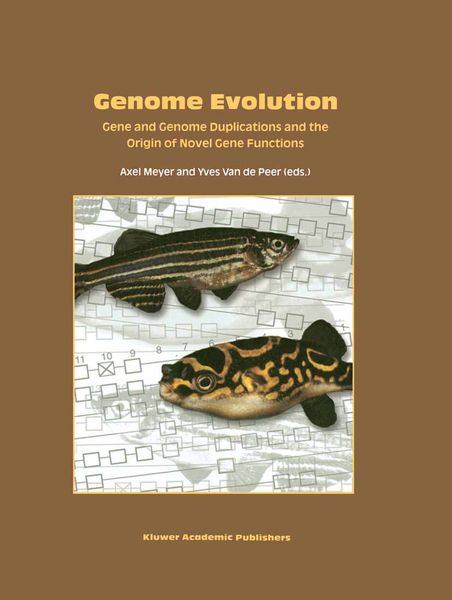
  • Produktbild: Genome Evolution
  • Produktbild: Genome Evolution

Genome Evolution Gene and Genome Duplications and the Origin of Novel Gene Functions

148,99 €

inkl. gesetzl. MwSt., Versandkostenfrei


Beschreibung

Produktdetails

Einband

Taschenbuch

Erscheinungsdatum

31.10.2012

Herausgeber

Axel Meyer + weitere

Verlag

Springer Netherland

Seitenzahl

237

Maße (L/B/H)

27,9/21/1,5 cm

Auflage

1. Auflage

Sprache

Englisch

ISBN

978-94-010-3957-4

Beschreibung

Portrait

Axel Meyer, Jahrgang 1955, hat Anthropologie und Ethnologie studiert und ist einer der Mitbegründer der Naturkost-Idee. Er ist ein ausgewiesener Fachmann für gesunde Ernährung und ganzheitliche Lebensweise und veranstaltet seit mehreren Jahren auch Seminare zu diesen Themen.

Produktdetails

Einband

Taschenbuch

Erscheinungsdatum

31.10.2012

Herausgeber

Verlag

Springer Netherland

Seitenzahl

237

Maße (L/B/H)

27,9/21/1,5 cm

Auflage

1. Auflage

Sprache

Englisch

ISBN

978-94-010-3957-4

Herstelleradresse

Springer-Verlag KG
Sachsenplatz 4-6
1201 Wien
AT

Email: GPSR Kontakt

Noch keine Bewertungen vorhanden

Verfassen Sie die erste Bewertung zu diesem Artikel

Helfen Sie anderen Kundinnen und Kunden durch Ihre Meinung.

Kundinnen und Kunden meinen

Bewertungen (0)

  • Produktbild: Genome Evolution
  • Produktbild: Genome Evolution
  • Foreword; A. Meyer, Y. Van de Peer.
    Early events in genome evolution.
    1. Gene duplication and other evolutionary strategies: from the RNA world to the future; J. Brosius. 2. Major transitions in evolution by genome fusions: from prokaryotes to eukaryotes, metazoans, bilaterians and vertebrates; J. Spring. 3. Detection of gene duplications and block duplications in eukaryotic genomes; Wen-Hsiung Li, et al. 4. The evolutionary demography of duplicate genes; M. Lynch, J.S. Conery.
    Debating the 2R and 3R genome duplication hypotheses.
    5. Functional evolution in the ancestral lineage of vertebrates or when genomic complexity was wagging its morphological tail; R. Aburomia, et al. 6. Numerous groups of chromosomal regional paralogies strongly indicate two genome doublings at the root of the vertebrates; L.-G. Lundin, et al. 7. Are (all) fishes ancient polyploids? Y. Van der Peer, et al. 8. More genes in vertebrates? P.W.H. Holland. 9. 2r or not 2R: testing the hypotheses of genome duplication in early vertebrates; A.L. Hughes, R. Friedman. 10. The 2R hypothesis and the human genome sequence; K. Hokamp, et al.
    Plant genome evolution.
    11. Introns in, introns out in plant gene families: a genomic approach of the dynamics of gene structure; A. Lecharny, et al. 12. Investigating ancient duplication events in the Arabidopsis Genome; J. Raes, et al. Case studies. 13. Crystallin genes: speciallization by changes in gene regulation mat precede gene duplication; J. Piatigorsky. 14. Expansion of the epidermal growth factor receptor family by genome and gene duplication in fish; J.-N. Volff, M. Schartl. 15. The role of gene duplication in the evolution and function of the vertebrate Dlx/distal-less bigene clusters; K. Sumiyama, et al. 16. Dopamine receptors for every species: gene duplications and functional diversification in craniates; S. Le Crom, et al. 17. Nuclear receptors are markers of animal genome evolution; H.E. García, et al. 18. The fates of zebrafish Hox gene duplicates; C. Josefowicz, et al. 19. Phylogenetic analysis of the mammalian Hoc8 non-coding region; Chang-Bae Kim, et al.
    Gene networks and evolution.
    20. Maximum likelihood methods for detecting adaptive evolution after gene duplication; J.P. Bielawski, Ziheng Yang. 21. Approach of the functional evolution of duplicated genes in Saccharomyces cerevisiae using a new classification method based on protein-protein interaction data; C. Brun, et al. 22. Developmental gene networks and evolution; J.P. Rast.
    Index.