Gutscheinbedingungen

**Gültig nur für Bestellungen an die Wunsch-Poststation bis 10.06.2026 auf Spielzeug, Schreibwaren, Filme, Geschenke & Trends, Musik, tolino eReader & Zubehör, Hörbücher und Hörbuch-Downloads (außer Abo), nicht preisgebundene Bücher und Kalender online auf thalia.at und in der Thalia App. Einzelne Artikel können ausgeschlossen sein. Aufgrund der Buchpreisbindung sind deutschsprachige Bücher und eBooks ausgenommen. Zusätzlich ausgenommen sind preisgebundene Artikel, Abos & Flatrates, eBooks, Games, Geschenkkarten/-boxen, Shelfies, Software, Zeitschriften sowie einzelne Artikel von tonies®. Pro Einkauf einmal einlösbar. Kein Click & Collect möglich. Keine Barauszahlung. Nicht kombinierbar mit anderen Aktionen und Gutscheinen. Gutschein wird auf max. 500€ Bestellwert angerechnet. Nicht gültig für Versandkosten und Services.

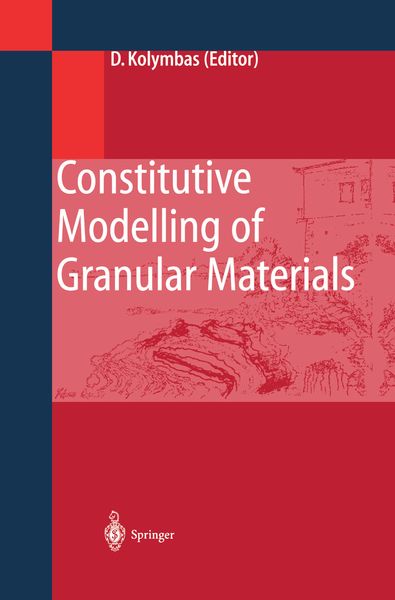
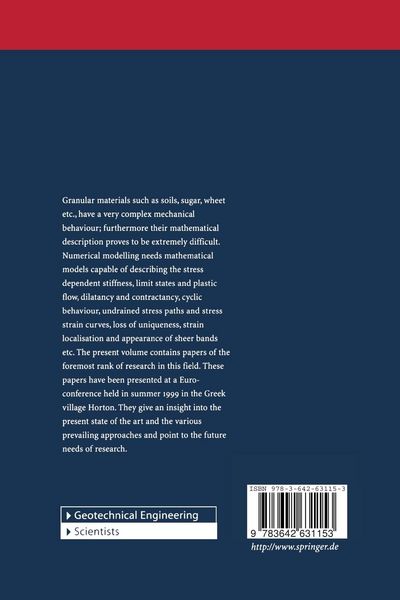
  • Produktbild: Constitutive Modelling of Granular Materials
  • Produktbild: Constitutive Modelling of Granular Materials

Constitutive Modelling of Granular Materials

302,99 €

inkl. gesetzl. MwSt., Versandkostenfrei


Beschreibung

Produktdetails

Einband

Taschenbuch

Erscheinungsdatum

09.11.2012

Verlag

Springer Berlin

Seitenzahl

554

Maße (L/B/H)

23,5/15,5/3,1 cm

Gewicht

855 g

Auflage

Softcover reprint of the original 1st ed. 2000

Sprache

Englisch

ISBN

978-3-642-63115-3

Beschreibung

Produktdetails

Einband

Taschenbuch

Erscheinungsdatum

09.11.2012

Verlag

Springer Berlin

Seitenzahl

554

Maße (L/B/H)

23,5/15,5/3,1 cm

Gewicht

855 g

Auflage

Softcover reprint of the original 1st ed. 2000

Sprache

Englisch

ISBN

978-3-642-63115-3

Herstelleradresse

Springer-Verlag GmbH
Tiergartenstr. 17
69121 Heidelberg
DE

Email: ProductSafety@springernature.com

Kundinnen und Kunden meinen

0 Bewertungen

Informationen zu Bewertungen

Zur Abgabe einer Bewertung ist eine Anmeldung im Konto notwendig. Die Authentizität der Bewertungen wird von uns nicht überprüft. Wir behalten uns vor, Bewertungstexte, die unseren Richtlinien widersprechen, entsprechend zu kürzen oder zu löschen.

Die Bewertungen sind nach Format, Anzahl Sterne und Datum sortiert.

Verfassen Sie die erste Bewertung zu diesem Artikel

Helfen Sie anderen Kund*innen durch Ihre Meinung

Kundinnen und Kunden meinen

0 Bewertungen filtern

  • Produktbild: Constitutive Modelling of Granular Materials
  • Produktbild: Constitutive Modelling of Granular Materials
  • Introductory considerations.- The misery of constitutive modelling.- Does engineering need science?.- The role of models in civil engineering.- Overview of hypoplasticity.- Hypoplasticity then and now.- A review of two different approaches to hypoplasticity.- Uniqueness, second order work and bifurcation in hypoplasticity.- Stationary states in hypoplasticity.- Generalized continua and microscopic approach.- Microscopic approach contributions to constitutive modelling..- Discrete and continuum modelling of granular materials.- 2nd Gradient constitutive models.- Micro-mechanically based higher-order continuum models for granular materials.- Relevant local variables for the change of scale in granular materials.- Physical aspects.- On the physical background of soil strength.- The influence of time derivative terras on the mechanical behaviour of loose sands.- An approach to plasticity based on generalised thermodynamics.- Comparison of different approaches.- Comparison of hypoplastic and elastoplastic modelling of undrained triaxial tests on loose sand.- Hypoplastic and elastoplastic modelling — a comparison with test data.- Strain response envelope: a complementary tool for evaluating hypoplastic constitutive equations.- Special models.- Modelling weathering effects on the mechanical behaviour of granite.- A plasticity-based constitutive model for natural soils: a hierarchical approach.- Experimental bases for a new incremental non-linear constitutive relation with 5 parameters.- Numerical applications.- Implicit integration of hypoplastic models.- Soil-water coupling analysis of progressive failure in cuts with a strain softening model.- Advances in modelling soil anisotropy.- Examples of finite element calculations with the hypoplastic law.- Hypoplastic simulationof complex loading paths.