Gutscheinbedingungen

**Gültig bis 25.06.2026 auf fremdsprachige Bücher online auf thalia.at und in der Thalia App. Einzelne Artikel können ausgeschlossen sein. Ausgenommen sind preisgebundene Artikel & eBooks. Pro Einkauf einmal einlösbar. Click & Collect nur bei Onlinevorabzahlung möglich. Keine Barauszahlung. Nicht kombinierbar mit anderen Aktionen und Gutscheinen. Gutschein wird auf max. 500€ Bestellwert angerechnet. Nicht gültig für Geschenkkarten, Versandkosten und Services.

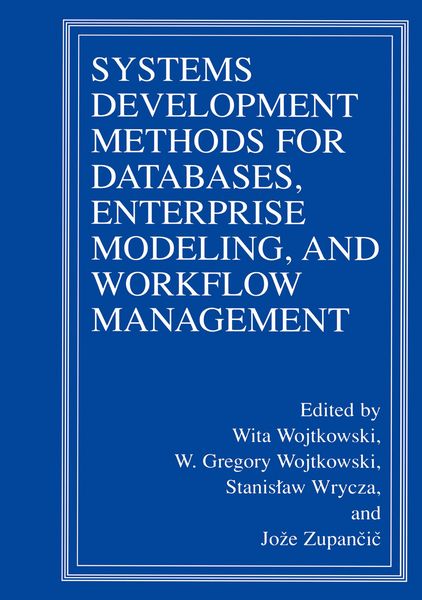
Produktbild: Systems Development Methods for Databases, Enterprise Modeling, and Workflow Management
- 13%

Systems Development Methods for Databases, Enterprise Modeling, and Workflow Management

13% sparen

189,99 € UVP 219,99 €

inkl. gesetzl. MwSt., Versandkostenfrei


Beschreibung

Produktdetails

Einband

Taschenbuch

Erscheinungsdatum

05.11.2012

Herausgeber

Wita Wojtkowski + weitere

Verlag

Springer Us

Seitenzahl

496

Maße (L/B/H)

25,4/17,8/2,8 cm

Gewicht

953 g

Auflage

1999

Sprache

Englisch

ISBN

978-1-4613-6913-4

Beschreibung

Produktdetails

Einband

Taschenbuch

Erscheinungsdatum

05.11.2012

Herausgeber

Verlag

Springer Us

Seitenzahl

496

Maße (L/B/H)

25,4/17,8/2,8 cm

Gewicht

953 g

Auflage

1999

Sprache

Englisch

ISBN

978-1-4613-6913-4

Herstelleradresse

Springer-Verlag GmbH
Tiergartenstr. 17
69121 Heidelberg
DE

Email: ProductSafety@springernature.com

Kundinnen und Kunden meinen

0 Bewertungen

Informationen zu Bewertungen

Zur Abgabe einer Bewertung ist eine Anmeldung im Konto notwendig. Die Authentizität der Bewertungen wird von uns nicht überprüft. Wir behalten uns vor, Bewertungstexte, die unseren Richtlinien widersprechen, entsprechend zu kürzen oder zu löschen.

Die Bewertungen sind nach Format, Anzahl Sterne und Datum sortiert.

Verfassen Sie die erste Bewertung zu diesem Artikel

Helfen Sie anderen Kund*innen durch Ihre Meinung

Kundinnen und Kunden meinen

0 Bewertungen filtern

  • Produktbild: Systems Development Methods for Databases, Enterprise Modeling, and Workflow Management
  • Preface. 1. State Dependent Behavioral Aspects of Objects - Automatic Synthesis; R. Polovina. 2. A CORBA Compenent Modeling Method Based on Software Architecture; C.-J. Moon, et al. 3. Dynamic Database Object Horizontal Fragmentation; C.I. Ezeife, J. Zheng. 4. An Electronic EKD Method Guide Over the Web; J. Barrios, et al. 5. Case-Based Reasoning, Genetic Algorithms and the Pile Foundation Information System; O. Babka, et al. 6. Java, Web, and Distributed Objects; Y.-W. Chiou. 7. A Data Registry-based Environment for Sharing XML Documents; H.-S. Na, et al. 8. Evaluation of a Methodology for Construction of TMN Agents in the Aspects of Cost and Performance; S.-H. Park, D.-K. Baik. 9. A Taxonomy of Strategies for Developing Spatial Decision Support System; S.L.R. Neto, M. Rodrigues. 10. Understanding IS Strategy Implementation: A Process Theory Based Framework; C.E. Moe, et al. 11. On Method Support for Developing Pre-Usage Evaluation Frameworks for Case-Tools; B. Lundell, B. Lings. 12. ASSISTing Asynchronous Software Inspection by Auto-Collation of Defect Lists; F. Macdonald, et al. 13. Metamodeling: Theory and Practical Implications; M. Drbohlav. 14. Critical Systems Thinking and the Development of Information Technology in Organisations: Another Perspective; D.R.T. Martínez. 15. Information Systems and Process Orientation: Evaluation and Change Using Business Actions Theory; U. Melin, G. Goldkuhl. 16. Towards the Shift-Free Integration of Hard and Soft IS Methods; S.K. Probert, A. Rogers. 17. Improved SoftwareQuality through Reviews and Defect Prevention: An Incremental Improvement Path; E.M. Gray, et al. 18. Identifying Success in Information Systems: Implications for Development Methodologies; S. Page. 19. Researching Organisational Memory; F. Burstein, H. Linger. 20. Data Mining Using Neural Networks and Statistical Techniques: A Comparison; J. Zurada, A.F. Salam. 21. The Year 2000 Problem in Small Companies in Slovenia; B. Verber, et al. 22. Using Discourse Analysis to Understand IS Planning and Development in Organizations: A Case Study; J.A.A. Sillince, G. Harindranath. 23. Information Systems Development Methodology &endash; The BPR Challenge; V. Repa. 24. Pervasive IT Systems: Ensuring A Positive Contribution to the Bottom Line; R. Moreton. 25. The Challenge: Providing an Information System for a Clinical Laboratory; H.M. Aus, et al. 26. The Concept of Improving and Developing an Information System for the Needs of Managing a Polish Enterprise; A. Nowicki. 27. The Implications of Changing Organisational Structures for the Future of the Information Systems (IS) Function; R. Moreton, M. Chester. 28. Middleware Orientation-Inverse Software Development Strategy; J. Král. 29. Selected Determinants of Applying Multimedia Techniques for Designing Decision Support Systems; C.M. Olszak. 30. Toward Effective Risk Management in IS Development: Introduction to Risk Based Scorecard; P. Krawczyk. 31. Hypermedia Based Distance Learning Systems and its Applications; C.A. Schumann, et al. 32. Multi-media Instructional Support: Status, Issues, and