• Produktbild: Thoracic Trauma and Critical Care
  • Produktbild: Thoracic Trauma and Critical Care

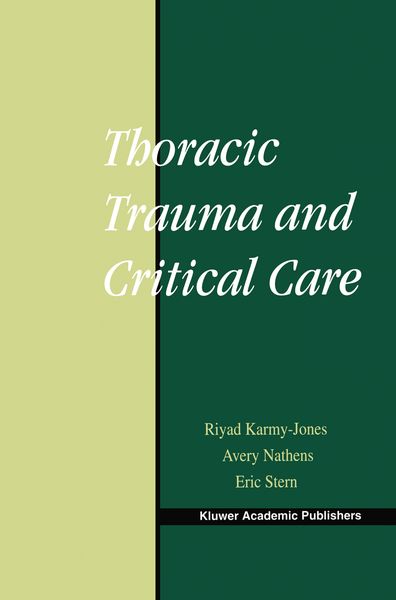
Thoracic Trauma and Critical Care

198,99 €

inkl. gesetzl. MwSt., Versandkostenfrei


Beschreibung

Produktdetails

Einband

Taschenbuch

Erscheinungsdatum

05.11.2012

Herausgeber

Riyad Karmy-Jones + weitere

Verlag

Springer Us

Seitenzahl

556

Maße (L/B/H)

23,5/15,5/3,2 cm

Gewicht

920 g

Auflage

Softcover reprint of the original 1st ed. 2002

Sprache

Englisch

ISBN

978-1-4613-5407-9

Beschreibung

Produktdetails

Einband

Taschenbuch

Erscheinungsdatum

05.11.2012

Herausgeber

Verlag

Springer Us

Seitenzahl

556

Maße (L/B/H)

23,5/15,5/3,2 cm

Gewicht

920 g

Auflage

Softcover reprint of the original 1st ed. 2002

Sprache

Englisch

ISBN

978-1-4613-5407-9

Herstelleradresse

Springer-Verlag GmbH
Tiergartenstr. 17
69121 Heidelberg
DE

Email: ProductSafety@springernature.com

Kundinnen und Kunden meinen

0 Bewertungen

Informationen zu Bewertungen

Zur Abgabe einer Bewertung ist eine Anmeldung im Konto notwendig. Die Authentizität der Bewertungen wird von uns nicht überprüft. Wir behalten uns vor, Bewertungstexte, die unseren Richtlinien widersprechen, entsprechend zu kürzen oder zu löschen.

Die Bewertungen sind nach Format, Anzahl Sterne und Datum sortiert.

Verfassen Sie die erste Bewertung zu diesem Artikel

Helfen Sie anderen Kund*innen durch Ihre Meinung

Kundinnen und Kunden meinen

0 Bewertungen filtern

  • Produktbild: Thoracic Trauma and Critical Care
  • Produktbild: Thoracic Trauma and Critical Care
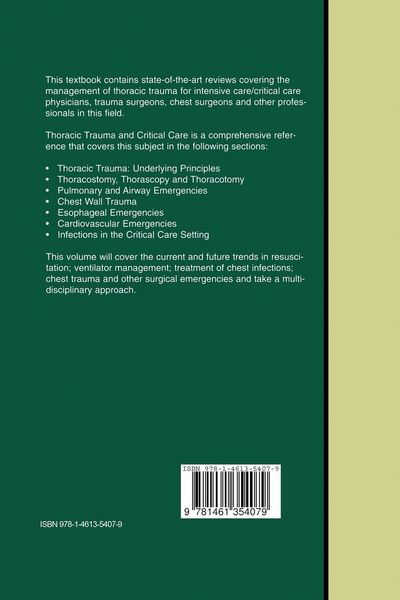
  • 1. Underlying Principles.- 1.1 Trauma Scores: Recent Advances.- 1.2 Care of the Multiple Injured Patient with Thoracic Trauma.- 1.3 Assessing adequacy of resuscitation.- 1.4 Reperfusion Injury.- 2. Thoracostomy, Thoracoscopy and Thoracotomy.- 2.1 Tube Thoracostomy.- 2.2 Incisions and approaches.- 2.3 ER-Thoracotomy.- 2.4 Urgent Non-ER Thoracotomy.- 2.5 Abbreviated Thoracotomy; The Evolving Role of Damage Control in Thoracic Trauma.- 2.6 Transmediastinal Gunshot Wounds.- 2.7 Role of Thoracoscopy in Chest Trauma.- 2.8 Management of Retained Hemothorax.- 2.9 Thoracotomy for Medical Arrest.- 3. Pulmonary and Airway Emergencies.- 3.1 Lung Injuries.- 3.2 Tracheo-bronchial Injuries.- 3.3 Traumatic Asphyxia.- 3.4 Pulmonary Blast Injury.- 3.5 Inhalation Injury.- 3.6 Thoracic Missile Embolism and Retained Bullets.- 3.7 Radiological Evaluation of Parenchymal Injuries.- 3.8 Airway Obstruction.- 3.9 Complications of Lung Transplantation.- 3.10 Air Embolism.- 3.11 Massive Hemoptysis.- 3.12 Tracheo-Inominant Artery Fistula.- 3.13 Hemoptysis Following Catheter Induced Ruptures of the Pulmonary Artery.- 3.14 Re-expansion Pulmonary Edema.- 3.15 Postpneumonectomy Pulmonary Edema.- 3.16 The Sonographic Detection of Pneumothoraces.- 4.0 Chest Wall Trauma.- 4.1 Pulmonary Contusion and Flail Chest: Medical Management.- 4.2 Reconstruction of Complex Chest Wall Defects.- 4.3 Chest Wall Burns.- 4.4 Chest Wall Hernia.- 4.5 Diaphragmatic Injuries.- 5.0 Esophageal Emergencies.- 5.1 Caustic Injuries.- 5.2 Esophageal trauma and perforation.- 6.0 Cardiovascular Emergencies.- 6.1 Blunt Cardiac Injury.- 6.2 Blunt Cerebrovascular Trauma.- 6.3 Penetrating Cardiac Injury.- 6.4 Management of Great Vessel Injury.- 6.5 Blunt Aortic Injury.- 6.6 Operative Management of Blunt Thoracic Aortic Injuries.- 6.7 Non-operative Management of Blunt Thoracic Aortic Injury.- 6.8 Blunt Aortic and Great Vessel Injuries: The Role of Endovascular.- 6.9 Pharmacological Support of Shock.- 6.10 Intra-aortic Balloon Pump.- 6.11 Cardiopulmonary Bypass.- 6.12 Deep Venous Thrombosis: Prophylaxis and Treatment in the Critically Ill and Injured Patient.- 6.13 Management of Acute PE.- 6.14 Post-Operative Complications of Cardiovascular Surgery.- 7.0 Infections in the Critical Care Setting.- 7.1 Diagnosis of ventilator associated pneumonia.- 7.2 Empyema.- 7.3 Necrotizing pneumonia.- 7.4 Surgical Management of Complex Parenchymal Infections.- 7.5 Descending Necrotizing Mediastinitis.- 8.0 Respiratory Intensive Care.- 8.1 Ventilation: An Overview.- 8.2 Adult Respiratory Distress Syndrome.- 8.3 High Frequency Ventilation.- 8.4 Pressure Control-Inverse Ratio Ventilation.- 8.5 Prone Ventilation in the Acute Respiratory Distress Syndrome.- 8.6 ECMO in the surgical patient.- 8.7 Liquid Ventilation.- 8.8 The role of Nitric Oxide in Sepsis and Respiratory Failure.- 8.9 Evaluation and Management of Persistent Air Leaks in Trauma Patients.- 8.10Surgical Lung Biopsy:Indications, Techniques, Outcomes and Controversies.- 8.11 Fat Embolism.- 8.12Timing of Long Bone Fracture Fixation in Patients with Blunt Thoracic Trauma.- 8.13Acquired Neuromuscular Disorders in the Intensive Care Unit.- 8.14Weaning the chronically ventilated patient.- 8.15Tracheostomy.