
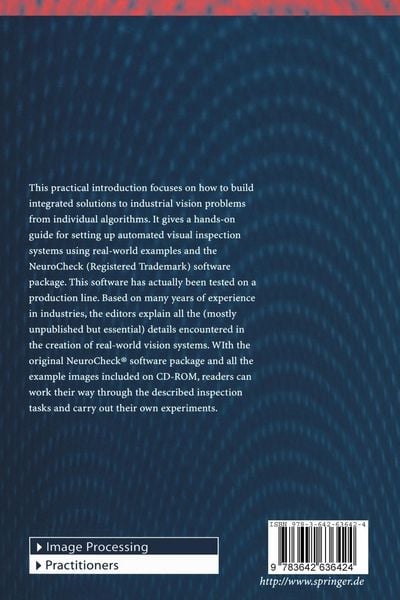
• Produktbild: Industrial Image Processing
  • Produktbild: Industrial Image Processing

Industrial Image Processing Visual Quality Control in Manufacturing

49,99 €

inkl. gesetzl. MwSt., Versandkostenfrei


Beschreibung

Produktdetails

Einband

Taschenbuch

Erscheinungsdatum

02.11.2012

Verlag

Springer Berlin

Seitenzahl

353

Maße (L/B/H)

23,5/15,5/2 cm

Gewicht

540 g

Auflage

Softcover reprint of the original 1st ed. 1999

Übersetzt von

M. Strick + weitere

Sprache

Englisch

ISBN

978-3-642-63642-4

Beschreibung

Produktdetails

Einband

Taschenbuch

Erscheinungsdatum

02.11.2012

Verlag

Springer Berlin

Seitenzahl

353

Maße (L/B/H)

23,5/15,5/2 cm

Gewicht

540 g

Auflage

Softcover reprint of the original 1st ed. 1999

Übersetzt von

  • M. Strick
  • G. Schmidt

Sprache

Englisch

ISBN

978-3-642-63642-4

Herstelleradresse

Springer Heidelberg
Tiergartenstr. 17
69121 Heidelberg
DE
buchhandel-buch@springer.com

Kundinnen und Kunden meinen

0 Bewertungen

Informationen zu Bewertungen

Zur Abgabe einer Bewertung ist eine Anmeldung im Konto notwendig. Die Authentizität der Bewertungen wird von uns nicht überprüft. Wir behalten uns vor, Bewertungstexte, die unseren Richtlinien widersprechen, entsprechend zu kürzen oder zu löschen.

Die Bewertungen sind nach Format, Anzahl Sterne und Datum sortiert.

Verfassen Sie die erste Bewertung zu diesem Artikel

Helfen Sie anderen Kund*innen durch Ihre Meinung

Kundinnen und Kunden meinen

0 Bewertungen filtern

  • Produktbild: Industrial Image Processing
  • Produktbild: Industrial Image Processing
  • 1. Introduction.- 1.1 Why write another book about image processing?.- 1.2 Possibilities and limitations.- 1.3 Types of inspection tasks.- 1.4 Structure of image processing systems.- 1.4.1 Hardware setup.- 1.4.2 Signal flow in the process environment.- 1.4.3 Signal flow within an image processing system.- 1.5 Solution approach.- 1.6 Introductory example.- 1.6.1 Character recognition.- 1.6.2 Thread depth.- 1.6.3 Presence verification.- 1.7 From here.- 2. Overview: Image Preprocessing.- 2.1 Gray scale transformations.- 2.1.1 Look-up tables.- 2.1.2 Linear gray level scaling.- 2.1.3 Contrast enhancement.- 2.1.4 Histogram equalization.- 2.1.5 Local contrast enhancement.- 2.2 Image arithmetic.- 2.2.1 Image addition and averaging.- 2.2.2 Image subtraction.- 2.2.3 Minimum and maximum of two images.- 2.2.4 Shading correction.- 2.3 Linear filters.- 2.3.1 Local operations and neighborhoods.- 2.3.2 Principle of linear filters.- 2.3.3 Smoothing filter.- 2.3.4 Edge filters.- 2.4 Median filter.- 2.5 Morphological filters.- 2.6 Other non-linear filters.- 2.7 Global operations.- 2.8 Key terms.- 3. Positioning.- 3.1 Position of an individual object.- 3.1.1 Positioning using the entire object.- 3.1.2 Positioning using an edge.- 3.2 Orientation of an individual object.- 3.2.1 Orientation computation using principal axis.- 3.2.2 Distance-versus-angle signature.- 3.3 Robot positioning.- 3.3.1 Setting of tasks.- 3.3.2 Image processing components.- 3.3.3 Position determination on one object.- 3.3.4 Orientation of an object configuration.- 3.3.5 Comments concerning position adjustment.- 3.4 Key terms.- 4. Overview: Segmentation.- 4.1 Regions of interest.- 4.1.1 Regions and objects.- 4.2 Thresholding.- 4.2.1 Thresholds.- 4.2.2 Threshold determination from histogram analysis.- 4.2.3 Gray level histograms.- 4.2.4 Generalizations of thresholding.- 4.3 Contour tracing.- 4.3.1 Pixel connectedness.- 4.3.2 Generating object contours.- 4.3.3 Contour representation.- 4.4 Edge based methods.- 4.4.1 Edge probing in industrial image scenes.- 4.4.2 Edge detection with subpixel accuracy.- 4.5 Template matching.- 4.5.1 Basic operation.- 4.5.2 Optimizing template matching.- 4.5.3 Comments on template matching.- 4.6 Key terms.- 5. Mark Identification.- 5.1 Bar code identification.- 5.1.1 Principle of gray-level-based bar code identification.- 5.1.2 Bar code symbologies.- 5.1.3 Examples of industrial bar code identification.- 5.1.4 Further information.- 5.2 Character recognition.- 5.2.1 Laser-etched characters on an IC.- 5.2.2 Basic configuration of the character recognition.- 5.2.3 Fundamental structure of a classifier application.- 5.2.4 Position adjustment on the IC.- 5.2.5 Improving character quality.- 5.2.6 Optimization in operation.- 5.3 Recognition of pin-marked digits on metal.- 5.3.1 Illumination.- 5.3.2 Preprocessing.- 5.3.3 Segmentation and classification.- 5.4 Block codes on rolls of film.- 5.5 Print quality inspection.- 5.5.1 Procedure.- 5.5.2 Print quality inspection in individual regions.- 5.5.3 Print quality inspection with automatic subdivision.- 5.6 Key terms.- 6. Overview: Classification.- 6.1 What is classification?.- 6.2 Classification as function approximation.- 6.2.1 Machine learning.- 6.2.2 Statistical foundations.- 6.2.3 Constructing classifiers.- 6.3 Instance-based classifiers.- 6.3.1 Nearest neighbor classifier.- 6.3.2 RCE networks.- 6.3.3 Radial basis functions.- 6.3.4 Vector quantization.- 6.3.5 Template matching.- 6.3.6 Remarks on instance-based classifiers.- 6.4 Function-based classifiers.- 6.4.1 Polynomial classifier.- 6.4.2 Multilayer perceptron-type neural networks.- 6.4.3 Representation of other classifiers as neural networks.- 6.5 Remarks on the application of neural networks.- 6.5.1 Composition of the training set.- 6.5.2 Feature scaling.- 6.5.3 Rejection.- 6.5.4 Arbitrariness.- 6.6 Key terms.- 7. Dimensional Checking.- 7.1 Gauging tasks.- 7.2 Simple gauging.- 7.2.1 Center point distance.- 7.2.2 Contour distances.- 7.2.3 Angle measurements.- 7.3 Shape checking on a punched part.- 7.3.1 Inspection task.- 7.3.2 Modeling contours by lines.- 7.3.3 Measuring the contour angle.- 7.4 Angle gauging on toothed belt.- 7.4.1 Illumination setup.- 7.4.2 Edge creation.- 7.5 Shape checking on injection-molded part.- 7.5.1 Computing radii.- 7.5.2 Remarks on model circle computation.- 7.6 High accuracy gauging on thread flange.- 7.6.1 Illumination and image capture.- 7.6.2 Subpixel-accurate gauging of the thread depth.- 7.7 Calibration.- 7.7.1 Calibration mode.- 7.7.2 Inspection-related calibration.- 7.8 Key terms.- 8. Overview: Image Acquisition and Illumination.- 8.1 Solid-state sensors.- 8.1.1 CCD sensor operation.- 8.1.2 Properties of CCD sensors.- 8.1.3 Image degradation.- 8.2 Standard video cameras.- 8.2.1 Basic structure.- 8.2.2 The video standard.- 8.2.3 Sampling of the line signal.- 8.2.4 Extensions of the video standard.- 8.2.5 Image quality.- 8.3 Other camera types.- 8.3.1 Progressive scan cameras.- 8.3.2 Asynchronous cameras.- 8.3.3 Digital cameras.- 8.3.4 Line-scan cameras.- 8.3.5 Additional camera properties.- 8.4 Transmission to the computer.- 8.4.1 Basic operation of a frame grabber.- 8.4.2 Frame grabbers for standard video cameras.- 8.4.3 Frame grabbers for other camera types.- 8.4.4 Direct digital transmission.- 8.5 Optical foundations.- 8.5.1 F-number.- 8.5.2 Thin lens imaging equation.- 8.5.3 Depth of field.- 8.5.4 Typical imaging situations.- 8.5.5 Aberrations.- 8.5.6 Lens selection.- 8.5.7 Special optical devices.- 8.6 Illumination technology.- 8.6.1 Light sources.- 8.6.2 Front lighting.- 8.6.3 Back Lighting.- 8.7 Key terms.- 9. Presence Verification.- 9.1 Simple presence verification.- 9.1.1 Part geometry.- 9.1.2 Illumination.- 9.1.3 Position adjustment.- 9.1.4 Segmentation.- 9.1.5 Evaluation.- 9.1.6 Segmentation with template matching.- 9.2 Simple gauging for assembly verification.- 9.2.1 Illumination.- 9.2.2 Inspection criteria.- 9.2.3 Object creation and measurement computation.- 9.2.4 Position adjustment.- 9.3 Presence verification using classifiers.- 9.3.1 Illumination.- 9.3.2 Inspection of the caulking.- 9.3.3 Type verification of the flange.- 9.4 Contrast-free presence verification.- 9.5 Key terms.- 10. Overview: Object Features.- 10.1 Basic geometrical features.- 10.1.1 Enclosing rectangle.- 10.1.2 Area and perimeter.- 10.1.3 Center of gravity.- 10.1.4 Axes and radii.- 10.2 Shape-descriptors.- 10.2.1 Curvature.- 10.2.2 Fiber features.- 10.2.3 Euler’s number.- 10.2.4 Moments and Fourier descriptors.- 10.3 Gray level features.- 10.3.1 First-order statistics.- 10.3.2 Texture features.- 10.4 Key terms.- 11. Outlook: Visual Inspection Projects.- A. Mathematical Notes.- A.1 Backpropagation training.- A.1.1 Neural networks — concept and history.- A.1.2 Fundamentals.- A.1.3 Backpropagation.- A.2 Computation of the depth of field.- A.2.1 Limit distances.- A.2.2 Depth of field at infinite distance.- A.2.3 Dependence of the depth of field on the focal length.- B. The Companion CD.- References.