KI-Beratung Beta

  • Produktbild: Multi-Carrier Spread-Spectrum
  • Produktbild: Multi-Carrier Spread-Spectrum

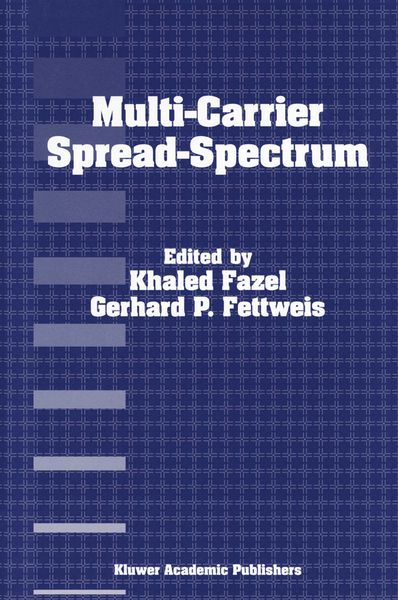
Multi-Carrier Spread-Spectrum

49,99 €

inkl. gesetzl. MwSt., Versandkostenfrei


Beschreibung

l 1 Khaled Fazel , Gerhard P. Fettweis lGerman Aerospace Research Establishment (DLR) Institute for Communications Technology 0-82234 Oberpfaffenhofen, Germany lDresden University of Technology Department of Electrical Engineering 0-01062 Dresden, Germany To operate future generation multimedia communications...

Beschreibung

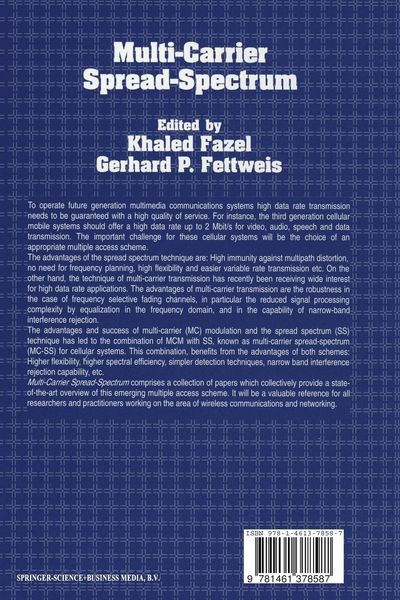
l 1 Khaled Fazel , Gerhard P. Fettweis lGerman Aerospace Research Establishment (DLR) Institute for Communications Technology 0-82234 Oberpfaffenhofen, Germany lDresden University of Technology Department of Electrical Engineering 0-01062 Dresden, Germany To operate future generation multimedia communications systems high data rate transmission needs to be guaranteed with a high quality of service. For instance, the third generation cellular mobile systems should offer a high data rate up to 2 Mbitls for video, audio, speech and data transmission [1]. In addition, the important challenge for these cellular systems will be the choice of an appropriate multiple access scheme. These trends motivated many researchers to look for multiple access systems that offer high spectral efficiency. The technique of spread spectrum originating from the military applications may allow partly to fulfill the above requirements. Advantages of spread spectrum technique are broadly known: High immunity against multipath distortion, no need for frequency planning, high flexibility, easier variable rate transmission etc. [1-2]. A multiple access scheme based on direct sequence spread spectrum, known as direct sequence code division multiple access (DS-CDMA) relies on spreading the data stream using an assigned spreading code for each user in the time domain. The capability of minimising multiple access interference (MAl) is given by the cross correlation properties of spreading codes. In the case of multipath propagation the capability of distinguishing one component from others in the composite received signal is offered by the auto-correlation properties of the spreading codes [2].

Produktdetails

Einband

Taschenbuch

Erscheinungsdatum

14.10.2012

Abbildungen

XVII, 242 p.

Herausgeber Khaled Fazel + weitere

Produktdetails

Einband

Taschenbuch

Erscheinungsdatum

14.10.2012

Abbildungen

XVII, 242 p.

Herausgeber
Verlag Springer Us
Seitenzahl

242

Maße (L/B/H)

24/16/1,5 cm

Gewicht

428 g

Auflage

Softcover reprint of the original 1st ed. 1997

Sprache

Englisch

ISBN

978-1-4613-7858-7

Herstelleradresse

Springer-Verlag KG
Sachsenplatz 4-6
1201 Wien
AT

Email: ProductSafety@springernature.com

Noch keine Bewertungen vorhanden

Verfassen Sie die erste Bewertung zu diesem Artikel

Helfen Sie anderen Kundinnen und Kunden durch Ihre Meinung.

Kundinnen und Kunden meinen

Bewertungen (0)

  • Produktbild: Multi-Carrier Spread-Spectrum
  • Produktbild: Multi-Carrier Spread-Spectrum
  • Multi-Carrier Spread-Spectrum: An Attractive Special Case of General Multiuser/Multisubchannel Transmission Methods*.- Overview of the Results about Multitone CDMA Detection*.- Comparison of Multiple Access Schemes for an OFDM Downlink System*.- Link/System Level Performance of an OFDM/CDMA Downlink Configuration.- Performance Analysis of a New Multi-Code and Multi-Carrier Hybrid Transmission Scheme for Future Broadband Mobile Communication Systems*.- A Spread-Spectrum Multi-Carrier Multiple-Access System for Mobile Communications.- Orthogonal Frequency-Division Multiple-Access with Frequency Hopping and Diversity.- M-ary Orthogonal Modulation for MC-CDMA Systems in Indoor Wireless Radio Networks.- Comparison of WLAN Multicarrier DS-SS Physical Layer Configuration in Measured Indoor Environment.- Multi-Carrier CDMA using Convolutional Coding and Interference Cancellation over Fading Channels.- An Approach for a Multi-Carrier Spread-Spectrum System with RAKE Receiver.- Multi-Carrier Modulated Orthogonal Code-Division Multiple-Access (MCM-OCDMA).- Interleaved FDMA — A New Spread-Spectrum Multiple-Access Scheme.- Aspects on Wideband Multi-Carrier Communication.- Equalization and Coding for Extended MC-CDMA over Time and Frequency Selective Channels.- Detection Method for MC-CDMA Based on a Recurrent Neural Network Structure.- Sensitivity of OFDM/CDMA to Carrier Phase Jitter.- Time Domain Uplink Channel Estimation in Multicarrier-CDMA Mobile Radio System Concepts.- Subspace-Based Joint Time-Delay and Frequency-Shift Estimation in Multitone-Code Division Multiple Access (MT-CDMA) Systems.- Pilot-Symbol-Aided Channel Estimation in Time and Frequence.- A Family of Extended Gaussian Functions with a Nearly Optimal Localization Property.- On the Duality of Multi-CarrierSpread-Spectrum and Single-Carrier Transmission.- Mismatched Multicarrier Complementary Spread-Spectrum Radar and Sonar Systems.- An OFDM/SFH-CDMA Transmission Scheme for the Uplink*.- Uplink Spectral Efficiency of Multicarrier Joint Detection Code Division Multiple Access Based Cellular Radio Systems*.- Simulation of a DSSS/MCM System in a Doppler Spread Channel.- On the Performance of Asynchronous Multi-Carrier CDMA.- Performance Comparison between OC-FD/DS-CDMA and MC-CDMA over Rayleigh Fading Channels.