• Produktbild: The Many Faces of the Sun
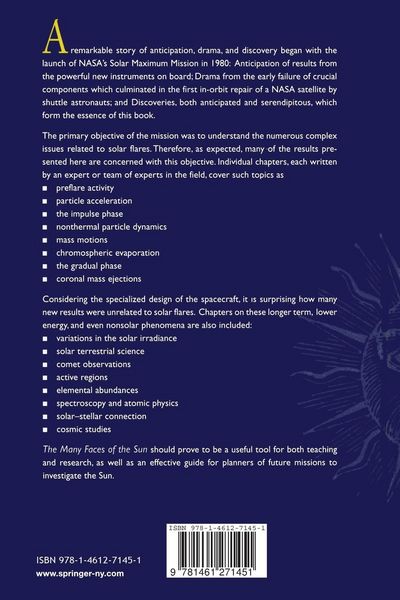
  • Produktbild: The Many Faces of the Sun
  • Produktbild: The Many Faces of the Sun

The Many Faces of the Sun A Summary of the Results from NASA’s Solar Maximum Mission

49,99 €

inkl. gesetzl. MwSt., Versandkostenfrei


Beschreibung

Produktdetails

Einband

Taschenbuch

Erscheinungsdatum

23.10.2012

Herausgeber

Keith T. Strong + weitere

Verlag

Springer Us

Seitenzahl

610

Maße (L/B/H)

23,5/15,5/3,5 cm

Gewicht

955 g

Auflage

Softcover reprint of the original 1st ed. 1999

Sprache

Englisch

ISBN

978-1-4612-7145-1

Beschreibung

Produktdetails

Einband

Taschenbuch

Erscheinungsdatum

23.10.2012

Herausgeber

Verlag

Springer Us

Seitenzahl

610

Maße (L/B/H)

23,5/15,5/3,5 cm

Gewicht

955 g

Auflage

Softcover reprint of the original 1st ed. 1999

Sprache

Englisch

ISBN

978-1-4612-7145-1

Herstelleradresse

Springer-Verlag KG
Sachsenplatz 4-6
1201 Wien
AT

Email: GPSR Kontakt

Noch keine Bewertungen vorhanden

Verfassen Sie die erste Bewertung zu diesem Artikel

Helfen Sie anderen Kundinnen und Kunden durch Ihre Meinung.

Kundinnen und Kunden meinen

Bewertungen (0)

  • Produktbild: The Many Faces of the Sun
  • Produktbild: The Many Faces of the Sun
  • Produktbild: The Many Faces of the Sun
  • 1. The Solar Maximum Mission.- 1.1 The Origins of the Mission.- 1.2 Scientific Objectives of the Mission.- 1.3 The SMM Instrument Package.- 1.3.1 The ?-Ray Spectrometer (GRS).- 1.3.2 The Hard X-Ray Burst Spectrometer (HXRBS).- 1.3.3 The Hard X-Ray Imaging Spectrometer (HXIS).- 1.3.4 The Bent Crystal Spectrometer (BCS).- 1.3.5 The Flat Crystal Spectrometer (FCS).- 1.3.6 The Ultraviolet Spectrometer/Polarimeter (UVSP).- 1.3.7 The Coronagraph/Polarimeter (C/P).- 1.3.8 The Active Cavity Radiometer Irradiance Monitor (ACRIM).- 1.4 Scientific Discoveries.- 1.5 Concluding Remarks.- 2. Solar Irradiance Variations.- 2.1 Development of Solar Irradiance Monitors.- 2.1.1 Early Space-Based Solar Observations.- 2.1.2 Sounding-Rocket Experiments.- 2.1.3 Nimbus-7 ERB Experiment.- 2.1.4 The SMM ACRIM Experiment.- 2.1.5 ACRIM I Results During Solar Cycles 21 and 22.- 2.1.5.1 Variability on Solar Cycle Timescales.- 2.1.6 Level of Significance of the Long-Term Data Base.- 2.1.7 Variability on Solar Active-Region Timescales.- 2.1.7.1 The “Sunspot Deficit” Effect.- 2.1.7.2 Facular “Excess” Effect.- 2.1.7.3 Energy Balance in Active Regions.- 2.1.8 Short-Term Variability: Global Oscillations.- 2.2 Models of the Solar-Cycle TSI Variation.- 2.2.1 Active-Region Timescales.- 2.2.2 Solar-Cycle Timescales.- 2.2.3 Shortcomings of Linear Regression Models.- 2.2.4 Multivariate Spectral Analysis.- 2.3 ACRIM I and Succeeding Observations.- 2.3.1 Solar Monitoring by ERBE Experiments.- 2.3.2 ACRIM II on UARS.- 2.3.3 Measurement Strategy for the Climate TSI Data Base.- 2.4 The Long-Term Climate TSI Data Base.- 2.4.1 ACRIM II Relationship to ACRIM I, ERB and ERBS.- 2.4.2 Sustaining the TSI Database.- 2.4.3 Future Total Solar Irradiance Monitoring.- 3. Active Regions.- 3.1 Magnetic Field Strength and Structure.- 3.1.1 Results Prior to SMM.- 3.1.2 First Results with SMM.- 3.1.3 Subsequent Results: 1983–1987.- 3.1.4 The Coronal Magnetic Structures Observing Campaign.- 3.1.5 Coronal Magnetic Field Studies after SMM.- 3.2 Dynamics and Heating of the Solar Corona.- 3.2.1 FCS Line-Broadening Measurements.- 3.2.1.1 Large Nonthermal Velocities.- 3.2.1.2 Spatial Variations.- 3.2.1.3 Correlation Studies.- 3.2.2 FCS Line-Broadening Data.- 3.2.3 Interpreting the FCS Line Broadening.- 3.2.3.1 Constraints on Mass Motions.- 3.2.3.2 Link to Heating.- 3.2.3.3 Discussion.- 3.2.4 Coronal Heating, Magnetic Fields, and Flares.- 3.2.4.1 UVSP Observations of Active Regions.- 3.3 Transition Region Brightenings: UV Microflares.- 3.4 Sunspots.- 3.4.1 Magnetic Field and Height of the Transition Region.- 3.4.2 Sunspot Plumes.- 3.4.3 Sunspot Flows.- 3.4.3.1 Horizontal Flows.- 3.4.3.2 Vertical Flows.- 3.4.3.3 Nonthermal Line Broadening.- 3.4.3.4 Umbral Oscillations.- 3.4.3.5 A Look Backward, a Look Forward.- 3.5 Prominences and Filaments.- 3.5.1 Prominence Environment and Structure.- 3.5.2 Steady Flows in Prominence Material.- 3.5.3 Activity in Prominences.- 3.5.4 Postflare Loops and Surges.- 3.5.5 Conclusion.- 4. Coronal Abundances.- 4.1 Flare X-Ray Measurements from BCS.- 4.1.1 Calcium Abundance.- 4.1.2 Fe/H and Fe/Ca Abundance.- 4.1.3 Relative Abundances of Ar, Ca, and Fe in Flares.- 4.1.4 Factors Affecting Abundance Determinations from X-Ray Spectra.- 4.2 FCS Abundances.- 4.2.1 FCS Active-Region Abundances.- 4.2.1.1 Abundance Variability in Active Regions.- 4.2.1.2 Impact of Resonance Scattering.- 4.2.1.3 Assessment of FCS Active-Region Abundance Results.- 4.2.2 FCS Flare Abundance Studies.- 4.2.2.1 Coronal Cl/S and Ar/S Measurements.- 4.2.2.2 DEM Studies of Flare Abundances.- 4.3 Determination of Solar Abundances by Solar Flare ?-Ray Spectrometry.- 4.3.1 ?-Ray Spectral Analysis.- 4.3.2 ?-Ray Results.- 4.4 Solar Energetic Particles.- 4.4.1 Major Proton Events.- 4.4.2 CIR Events from Coronal Holes.- 4.4.3 Impulsive Flare Events.- 4.5 Theory of Abundance Fractionation.- 4.5.1 Gravitational Settling.- 4.5.2 Pressure Gradient and Stationary Diffusion.- 4.5.3 Ion-Neutral Separation Due to Currents.- 4.5.4 Ion-Neutral Separation Due to Electromagnetic Forces.- 4.5.5 Discussion.- 4.6 Summary.- 5. Coronal Mass Ejections.- 5.1 Nature and Structure of Coronal Mass Ejections.- 5.1.1 Specific Examples.- 5.1.2 Pre-Ejection “Swelling” of the Coronal Helmet Streamer.- 5.1.3 Formation and Outward Propagation of the Mass Ejection.- 5.1.4 Post-Ejection Depletion of the Helmet Streamer Region.- 5.1.5 Pre-Eruption Evolution of the Prominence and Corona.- 5.1.6 The Mass Ejection and Prominence Eruption.- 5.1.7 The Post-Ejection Corona.- 5.1.8 Summary.- 5.1.9 Some Measured Properties.- 5.1.9.1 Shape or Geometry.- 5.1.9.2 Angular Size.- 5.1.9.3 Locations.- 5.2 The Propagation of Mass Ejections Through the Corona.- 5.3 The Origin of Coronal Mass Ejections.- 5.3.1 Some Essential Facts.- 5.3.1.1 Large Spatial Scales.- 5.3.1.2 Occurrence in (and Disruption of) Closed Magnetic Structures, Including Those not Related to Active Regions.- 5.3.1.3 The Huge Variability in the Phenomenon.- 5.3.1.4 Mass Ejections and Prominence Eruptions.- 5.3.2 Mass Ejections and “Optical” Solar Flares.- 5.3.3 Mass Ejections and Soft X-Ray Flares.- 5.3.3.1 Formation (and Acceleration) of a Mass Ejection Within the SMM Field of View.- 5.3.3.2 Formation (and Initial Acceleration) of a Mass Ejection in the Low Corona.- 5.3.3.3 Association with an X-Ray Flare That Rises from a Very Low Background Level in the GOES Data.- 5.3.3.4. A Major Coronal Mass Ejection with no Detectable X-Ray Flare.- 5.3.3.5 What, Then, is the Origin of Coronal Mass Ejections?.- 5.4 Summary.- 6. Preflare Activity.- 6.1 General Activity in Active Regions.- 6.2 Precursors to Major Flares.- 6.2.1 UV Emission.- 6.2.2 Soft X-Rays.- 6.2.3 Preflare Radio Emission.- 6.3 Chromospheric Evaporation.- 6.4 The Onset of Coronal Mass Ejections.- 6.5 Surges.- 6.6 Conclusions.- 7. Particle Acceleration in Flares.- 7.1 The “Pre-SMM” Paradigm.- 7.2 High-Energy Flare Observations.- 7.2.1 Temporal Phenomena.- 7.2.1.1 Rapid Acceleration to Very High Energies.- 7.2.1.2 Rapid X-Ray Variations.- 7.2.1.3 Energy-Dependent Delays.- 7.2.2 Properties of Interacting Particles.- 7.2.2.1 Electron Spectra.- 7.2.2.2 Ion Spectra.- 7.2.2.3 Electron/Proton Ratio.- 7.2.3 Interplanetary Particles and Interacting Particles.- 7.2.4 Is There a Threshold for Particle Acceleration?.- 7.2.5 Geometry of the Interaction Region.- 7.2.5.1 Directivity.- 7.2.5.2 Height and Extent of Interaction Region.- 7.2.6 Very-High-Energy Phenomena.- 7.2.6.1 Energetic Solar Neutrons.- 7.2.6.2 High-Energy Photons.- 7.3 Mechanisms for Particle Acceleration.- 7.3.1 Stochastic Acceleration.- 7.3.2 Shock Acceleration.- 7.3.3 Direct Acceleration by DC Electric Fields.- 7.4 Summary.- 8. Nonthermal Flare Emissions.- 8.1 Statistical Aspects of Hard X-Ray Flares.- 8.1.1 Variability during the Solar Activity Cycle.- 8.1.2 Periodicities during the Solar Activity Cycle.- 8.1.3 Frequency Distributions and Correlations.- 8.1.4 The Concept of Self-Organized Criticality.- 8.2 Particle Acceleration and Injection.- 8.2.1 Fast Time Structures in Hard X-Rays.- 8.2.2 The Concept of a “Statistical Flare”.- 8.2.3 Electron Beam Signatures in Hard X-Rays and Radio.- 8.2.4 Pulsed Injection of Particles.- 8.2.5 Second-Step Acceleration.- 8.3 Particle Trapping and Precipitation.- 8.3.1 Incoherent Radiation from Trapped Particles.- 8.3.1.1 Temporal Aspects.- 8.3.1.2 Spectral Analysis.- 8.3.1.3 Imaging Data.- 8.3.2 Coherent Emission from Trapped Particles.- 8.3.2.1 Beam-Driven Emission in the Trap.- 8.3.2.2 Loss-Cone-Driven Emission.- 8.3.3 Pulsation Mechanisms in the Trap.- 8.3.4 Precipitation Signatures.- 8.4 Flare Diagnostics from Hard X-Ray/Radio Observations.- 9. Chromospheric Evaporation Theory.- 9.1 Pre-SMM Results.- 9.1.1 Early Observations.- 9.1.2 Theories prior to SMM.- 9.1.3 P78-1 Observations.- 9.2 Early SMM Results.- 9.2.1 Initial SMM Observations of Soft X-Ray Line Profiles.- 9.2.2 Hinotori Observations.- 9.2.3 Theories after Initial SMM Observations.- 9.2.3.1 Thermal Models.- 9.2.3.2 Nonthermal Model.- 9.2.3.3 Other Models.- 9.2.4 Combined SMM X-Ray and H? Observations.- 9.3 Later SMM Results.- 9.3.1 Later SMM Observations of Soft X-Ray Line Profiles.- 9.3.2 Other Wavelengths.- 9.3.3 Recent Theories.- 9.4 Future Developments.- 9.5 Conclusions.- 10. Flare Dynamics.- 10.1 Results from Soft X-Ray Spectra.- 10.1.1 Physical Properties of the Flare Plasmas.- 10.1.1.1 Electron Temperature Measurements.- 10.1.1.2 Temperature Distribution of the Flare Plasma.- 10.1.1.3 Density Measurements.- 10.1.1.4 Departures from Ionization Equilibrium.- 10.1.2 Dynamics.- 10.1.2.1 Impulsive-Phase X-Ray Line Profiles.- 10.1.2.2 Analysis Techniques for Soft X-Ray Spectra.- 10.2 Chromospheric Evaporation.- 10.2.1 Properties of Plasma Upflows.- 10.2.1.1 Blueshifted Spectral Emission.- 10.2.1.2 Velocity-Temperature Distribution of Convective Flows.- 10.2.1.3 Upflows during the Cooling Phase.- 10.2.1.4 Soft and Hard X-Ray Imaging Observations.- 10.2.2 Energetics of Chromospheric Evaporation.- 10.2.2.1 Mass and Energy Balance as Deduced from Soft X-Rays.- 10.2.2.2 Results of Coordinated H? and X-Ray Observations.- 10.2.3 Simulations of the Hydrodynamics of Flare Loops.- 10.2,3.1 Model Equations.- 10.2.3.2 Numerical Design Issues.- 10.2.3.3 Results of Modeling.- 10.2.4 Simulations of the Soft X-Ray Spectral Emission.- 10.2.4.1 Results on the Dynamics from Simulated Line Profiles.- 10.2.4.2 Simulations of the Average Properties of the Evaporated Plasma.- 10.2.4.3 Constraints on Flare Models from Impulsive-Phase Spectra.- 10.3 Nature of Nonthermal Line Broadenings.- 10.3.1 Properties of Nonthermal Broadenings.- 10.3.1.1 Determination of vnt.- 10.3.2 Broadening Mechanisms.- 10.3.3 Interpretations of the Observations.- 10.3.4 Line Broadening as a Signature of Magnetic Reconnection.- 10.3.4.1 Models of RCSs and Suprathermal Line Profiles.- 10.4 Concluding Remarks.- 11. Ultraviolet Flare Studies.- 11.1 UV Flare Plasma Diagnostics.- 11.2 UV and Hard X-Ray Bursts.- 11.3 Flare Topology: Interacting Loops.- 11.4 Discussion.- 12. The Gradual Phase of Flares.- 12.1 Heating and Cooling in the Gradual Phase.- 12.2 Emission Measure-Temperature Diagrams.- 12.3 Flaring Arches.- 12.4 Gradual Phase of Eruptive Flares.- 12.5 Postflare Giant Arches.- 12.6 Giant Arches: Modeling and Interpretation.- 13. Spectroscopy and Atomic Physics.- 13.1 Theory of Line Intensities.- 13.2 Density-Sensitive Line Ratios.- 13.3 Temperature-Sensitive Line Ratios.- 13.4 Element Abundances.- 13.5 Photospheric X-Ray Lines.- 13.6 Checking and Correcting Atomic Data.- 13.7 Summary and Future Directions.- 14. Solar-Terrestrial and Terrestrial Science.- 14.1 SMM’s Impact on Solar-Terrestrial Studies.- 14.1.1 Paradigm Shift in Solar-Terrestrial Physics.- 14.1.2 Two Classes of SEP Events.- 14.2 ?-Rays from the Earth.- 14.2.1 Galactic Cosmic Ray-Induced ?-Rays from the Earth.- 14.2.2 Solar Cosmic Ray-Induced ?-Rays from the Earth.- 14.3 Transient Radiation Belts from Orbiting Nuclear Reactors.- 14.4 Mesospheric Chemistry Studies with UVSP.- 14.4.1 Ozone Measurements.- 14.4.2 Molecular Oxygen Measurements.- 15. Solar-Stellar Connection.- 15.1 Stellar Coronae and Acoustic Heating.- 15.2 The Dividing Line.- 15.3 The Rotation-Activity Relation: Calibrating the Dynamo.- 15.4 Age versus Activity: The Evolution of the Sun.- 15.5 Stellar Activity Cycles.- 15.6 Mapping Stellar Surfaces.- 15.7 Flares on Other Stars.- 15.8 What is the Range of Stellar Power Ratios?.- 15.9 Conclusion.- 16. Comet Observations.- 16.1 Comet Halley and Comet Machholz.- 16.2 Comet Machholz (1988 XV).- 16.3 Kreutz Family of Sungrazing Comets.- 16.4 Summary.- 17. Cosmic Studies.- 17.1 Hard X-Ray Sources.- 17.1.1 A0535+26.- 17.1.2 Cygnus X-1.- 17.1.3 HXRBS Studies of Galactic Hard X-Ray Sources.- 17.2 ?-Ray Bursts.- 17.2.1 Spectra.- 17.2.2 Spectral Evolution.- 17.2.3 Periodicities.- 17.2.4 Statistical Studies.- 17.2.5 Soft ?-Ray Repeaters.- 17.3 ?-Ray Observations of Recent Supernovae.- 17.3.1 Discovery of ?-Rays from SN1987a.- 17.3.2 Limits on 56Ni Production in a Type I Supernova.- 17.4 ?-Ray Observations of Recent Novae.- 17.5 Searches for ?-Ray Transients.- 17.5.1 ?-Ray Lines from SS433.- 17.5.2 Search for Short Annihilation Line Transients.- 17.5.3 Search for Transient Lines from the Crab Nebula.- 17.5.4 Narrow or Moderately Broadened Transient Lines.- 17.5.5 Transient Emissions from Relativistic-Pair Plasmas.- 17.6 Galactic Observations.- 17.6.1 Observations of Interstellar 26Al.- 17.6.2 Galactic Positron Annihilation Radiation.- 17.6.3 The Diffuse Galactic Spectrum from 0.3 to 8.5 MeV.- 17.6.4 Limits on Galactic 44Ti and 60Fe.- 17.6.5 Limits on Deexcitation Lines from Interstellar Carbon and Oxygen.- 17.6.6 Neutron Capture in Black Hole Candidates.- 17.7 Summary of ?-Ray Line Observations.- References.- Acronyms.- Acknowledgment of Copyright.