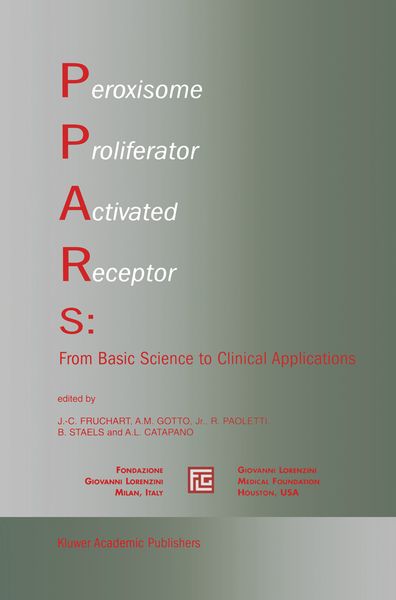
• Produktbild: Peroxisome Proliferator Activated Receptors: From Basic Science to Clinical Applications
  • Produktbild: Peroxisome Proliferator Activated Receptors: From Basic Science to Clinical Applications
Band 18

Peroxisome Proliferator Activated Receptors: From Basic Science to Clinical Applications From Basic Science to Clinical Applications

99,99 €

inkl. gesetzl. MwSt., Versandkostenfrei


Beschreibung

Produktdetails

Einband

Taschenbuch

Erscheinungsdatum

14.10.2012

Herausgeber

J.-C. Fruchart + weitere

Verlag

Springer Us

Seitenzahl

172

Maße (L/B/H)

23,5/15,5/1,1 cm

Gewicht

306 g

Auflage

Softcover reprint of the original 1st ed. 2002

Sprache

Englisch

ISBN

978-1-4613-5427-7

Beschreibung

Produktdetails

Einband

Taschenbuch

Erscheinungsdatum

14.10.2012

Herausgeber

Verlag

Springer Us

Seitenzahl

172

Maße (L/B/H)

23,5/15,5/1,1 cm

Gewicht

306 g

Auflage

Softcover reprint of the original 1st ed. 2002

Sprache

Englisch

ISBN

978-1-4613-5427-7

Herstelleradresse

Libri GmbH
Europaallee 1
36244 Bad Hersfeld
DE

Email: gpsr@libri.de

Noch keine Bewertungen vorhanden

Verfassen Sie die erste Bewertung zu diesem Artikel

Helfen Sie anderen Kundinnen und Kunden durch Ihre Meinung.

Kundinnen und Kunden meinen

Bewertungen (0)

  • Produktbild: Peroxisome Proliferator Activated Receptors: From Basic Science to Clinical Applications
  • Produktbild: Peroxisome Proliferator Activated Receptors: From Basic Science to Clinical Applications
  • Preface. List of Contributors.
    Structure, Function, and Molecular Mechanisms of PPAR Action. 1. Peroxisome Proliferator Activated Receptor Alpha Coordinates Intermediary Metabolism During Fasting; S. Kersten, et al. 2. Design, Structure, and Function of Novel PPAR Ligands; T.M. Willson, et al. 3. Functions of PPAR Gamma in Macrophages and Atherosclerosis; A. Chawla, et al.
    Inflammation and Atherosclerosis. 4. PPARs and Atherogenesis: Mediators or Modulators of the Inflammatory Response in the Vessel Wall? N. Marx. 5. Role of PPARs in Inflammation, Atherosclerosis, and Thrombosis; A. Pilon, et al. 6. Effects of Thiazolidinediones on Vascular Reactivity and Endothelial Dysfunction; E.S. Horton, et al.
    PPARgamma and alpha as Therapeutic Targets in Diabetes. 7. Activation of Human PPAR Subtypes by Pioglitazone; H. Kimura, et al. 8. PPARgamma Mechanism of Action Studies; S. Kliewer.
    Animal Models to Study PPAR Functions. 9. The Role of PPARalpha in Fatty Acid Metabolism and Hepatocarcinogenesis: Studies with PPARalpha-Null Mice; F.J. Gonzalez. PPARalpha: From Basic Science to Clinical Applications. 10. PPARalpha, Lipoprotein Metabolism, Metabolic Disease, and Atherosclerosis; J.-C. Fruchart, et al. 11. PPARalpha and Atherosclerosis; J. Plutzky. 12. Regulation of CD36 by PPARgamma: Pro- or Anti-atherogenic? M. Febbraio, et al.
    Lipid and Lipoprotein Metabolism and Atherosclerosis. 13. Anti-inflammatory Properties of HighDensity Lipoproteins; P. Barter, et al.
    The Importance of Raising HDL: From PPARalpha to Clinical Implications. 14. The Low-HDL Syndrome: Epidemiology and Pathophysiology; G. Franceschini, et al. 15. Diabetes: A Growing CHD Epidemic; A. Hamsten, G. Steiner.
    Adipose Tissue, Obesity, and Diabetes. 16. Influence of PPARs on Muscle Lipid Metabolism and Insulin Resistance; E.W. Kraegen, et al. 17. PPARgamma in Adipogenesis and Insulin Resistance; S.R. Farmer, et al.
    PPARdelta: Function and Biology. 18. Pharmacology of a Selective Peroxisome Proliferator-Activated Receptor delta Agonist, GW 501516, in Obese Dyslipidemic Primates; W. Oliver, et al.
    PPARgamma: From Basic Science to Clinical Applications. 19. PPARgamma: A Regulator of Growth and Differentiation; S.R. Farmer, et al. 20. Peroxisome Proliferator Activator Receptor Gamma Agonists Inhibit the Development of Atherosclerosis in Low Density Lipoprotein Receptor-Deficient Male Mice; A.C. Li, C.K. Glass. 21. Are Thiazolidinediones Superior to Standard Therapy in the Treatment of Type 2 Diabetes? M.-R. Taskinen.
    Clinical Studies with PPAR Ligands. 22. PPARgamma Ligands and Intestinal Inflammation; A. Flanigan, et al. 23. Inflammatory Mechanisms in Alzheimer's Disease: beta-Amyloidd-Stimulated Proinflammatory Responses Are Blocked by PPARgamma Agonists; G. Landreth, et al.
    Index.