Gutscheinbedingungen

**Gültig bis 28.07.2026 auf Spielzeug, Schreibwaren, Filme, Geschenke & Trends, Musik, tolino eReader & Zubehör, Hörbücher und Hörbuch-Downloads (außer Abo), nicht preisgebundene Bücher und Kalender in der Thalia App. Einzelne Artikel können ausgeschlossen sein. Aufgrund der Buchpreisbindung sind deutschsprachige Bücher und eBooks ausgenommen. Zusätzlich ausgenommen sind preisgebundene Artikel, Abos & Flatrates, eBooks, Games, Geschenkkarten/-boxen, Shelfies, Software, Zeitschriften sowie einzelne Artikel von tonies®. Pro Einkauf einmal einlösbar. Click & Collect nur bei Onlinevorabzahlung möglich. Keine Barauszahlung. Nicht kombinierbar mit anderen Aktionen und Gutscheinen. Gutschein wird auf max. 500€ Bestellwert angerechnet. Nicht gültig für Versandkosten und Services.

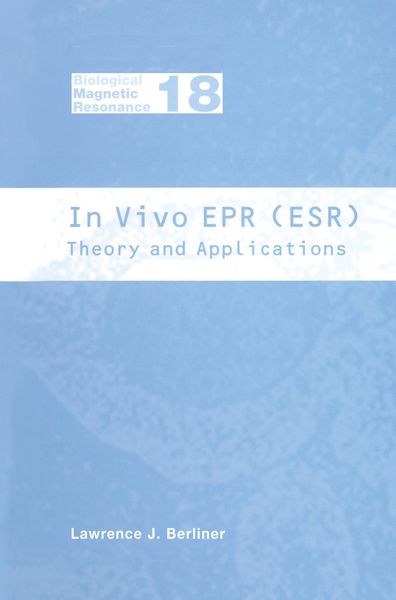
Produktbild: In Vivo EPR (ESR)
Band 18

In Vivo EPR (ESR) Theory and Application

198,99 €

inkl. gesetzl. MwSt., Versandkostenfrei


Beschreibung

Produktdetails

Einband

Taschenbuch

Erscheinungsdatum

21.11.2012

Herausgeber

Lawrence J. Berliner

Verlag

Springer Us

Seitenzahl

656

Maße (L/B/H)

23,5/15,5/3,7 cm

Gewicht

1031 g

Auflage

Softcover reprint of the original 1st ed. 2003

Sprache

Englisch

ISBN

978-1-4613-4906-8

Beschreibung

Portrait

Dr. Lawrence J. Berliner is currently Professor and Chair of the Department of Chemistry and Biochemistry at the University of Denver after retiring from Ohio State University, where he spent a 32-year career in the area of biological magnetic resonance (EPR and NMR). He is the Series Editor for Biological Magnetic Resonance , which he launched in 1979.

Produktdetails

Einband

Taschenbuch

Erscheinungsdatum

21.11.2012

Herausgeber

Lawrence J. Berliner

Verlag

Springer Us

Seitenzahl

656

Maße (L/B/H)

23,5/15,5/3,7 cm

Gewicht

1031 g

Auflage

Softcover reprint of the original 1st ed. 2003

Sprache

Englisch

ISBN

978-1-4613-4906-8

Herstelleradresse

Springer-Verlag KG
Sachsenplatz 4-6
1201 Wien
AT

Email: GPSR Kontakt

Noch keine Bewertungen vorhanden

Verfassen Sie die erste Bewertung zu diesem Artikel

Helfen Sie anderen Kundinnen und Kunden durch Ihre Meinung.

Kundinnen und Kunden meinen

Bewertungen (0)

  • Produktbild: In Vivo EPR (ESR)
  • 1 Introduction to in Vivo EPR.- 1. Aim and Scope of the Book.- 2. Rationale for in Vivo EPR.- 3. Challenges of in Vivo EPR.- 4. Types of Paramagnetic Species Observable with in Vivo EPR.- 5. Types of Instrumental Approaches Used for in Vivo EPR.- 6. Experiments with Animals.- 7. Conclusions and a Look to the Future.- 8. The Nomenclature of Biomedical EPR—Reducing the Confusion.- 9. References.- Section I. Theory and Instrumentation.- 2 Principles of in Vivo EPR.- 1. Introduction.- 2. Time-Domain EPR.- 3. CW versus Time Domain EPR.- 4. Summary and Conclusions.- 5. References.- 3 Frequency and Power Considerations for in Vivo EPR and Related Techniques.- 1. Introduction.- 2. RF Absorption in Ideal Sample Shapes.- 3. Resonators and RF Absorption.- 4. B1 and Power.- 5. Localised EPR and Surface Coils.- 6. Summary and Conclusions.- 7. References.- 4 CW EPR Signal Detection Bridges.- 1. Introduction.- 2. Principles of CW Mode Signal Detection.- 3. Bridge Devices.- 4. Detectors.- 5. Automatic Frequency Control Circuits.- 6. The Complete CW EPR System.- 7. Conclusions.- 8. Acknowledgments.- 9. References.- 5 Resonators for Low-Field in Vivo EPR.- 1. Origin of Radiofrequency Resonance.- 2. Transmission Lines.- 3. Matching Impedances.- 4. Resonant Structures Used in Vivo.- 5. References.- 6 Principles of Imaging.- 1. Introduction.- 2. Fundamentals of Imaging.- 3. Definition of Projection.- 4. Field Gradient Techniques.- 5. Projection Data Acquisition.- 6. Data Processing and Image Reconstruction.- 7. Software.- 8. Instrumentation.- 9. Magnet and Gradient Coil Design.- 10. Special Imaging Techniques/Applications.- 11. Scope and Limitations.- 12. Acknowledgments.- 13. References.- 7 Time-Domain Radio Frequency EPR Imaging.- 1. Introduction.- 2. Challenges in Time Domain EPR Spectroscopy and Imaging at RF.- 3. Instrumentation.- 4. Data Collection and Image Reconstruction.- 5. Spin Probes.- 6. Examples of Time-Domain Imaging Experiments at 300 MHz.- 7. Conclusion and Future Directions.- 8. Acknowledgements.- 9. References.- Section II. Biochemical Applications: Biochemistry and Biophysics.- 8 Stable Soluble Paramagnetic Compounds.- 1. Introduction.- 2. What’s in a Spectrum?.- 3. Nitroxyls.- 4. Trityls.- 5. Overview of Application of Infusible Paramagnetic Compounds.- 6. Conclusions.- 7. Acknowledgments.- 8. References.- 9 Stable Particulate Paramagnetic Materials as Oxygen Sensors in EPR Oximetry: Coals, Lithium Phthalocyanine, and Carbon Chars.- 1. Introduction.- 2. Oxygen and EPR Line Width.- 3. Carbon Char Synthesis.- 4. Sensor Morphology.- 5. Chars as Oxygen Sensors.- 6. Dynamic Nuclear Polarization.- 7. DNP Imaging and Oximetry.- 8. Conclusions.- 9. Acknowledgments.- 10. References.- 10 Packaging of Paramagnetic Materials in Oximetry and Other Applications.- 1. Introduction.- 2. Applications.- 3. Conclusions and Perspectives.- 4. Acknowledgments.- 5. References.- 11 Spin Trapping in Vivo: Facts and Artifacts.- 1. Introduction.- 2. Classes. of Spin Traps.- 3. Considerations for in Vivo Spin Trapping Experiments.- 4. Potential Problems, Artifacts and General Recommendations for in Vivo Spin Trapping.- 5. Future Prospects for in Vivo Spin Trapping.- 6. Acknowledgments.- 7. References.- 12 Ex Vivo Detection of Free Radical Metabolites of Toxic Chemicals and Drugs by Spin Trapping.- 1. Introduction.- 2. Spin Traps.- 3. Sensitivity Advance.- 4. Applications of Spin Trapping.- 5. Complete Table of All Free Radical Metabolites Detected by ex Vivo ESR.- 6. References.- 13 Chemistry and Biology of Nitric Oxide.- 1. Introduction.- 2. Nitric Oxide Molecule: Redox Forms of NO.- 3. NO as an EPR Probe for Metalloproteins.- 4. Discovery of Endothelium Derived Relaxation Factor (EDRF) and EPR Studies of EDRF.- 5. Biosynthesis of Nitric Oxide: Three Isoforms of Nitric Oxide Synthase.- 6. Biological Functions and Molecular Targets of Nitric Oxide.- 7. Nitric Oxide in Disease.- 8. Global Importance of Nitric Oxide.- 9. Acknowledgments.- 10. References.- 14 In Vivo and in Vitro Detection of NO by EPR.- 1. Introduction.- 2. Physico-Chemical Methods of Detecting NO.- 3. Detection of NO by EPR.- 4. Detection and Quantitation of NO in Biological Specimens.- 5. In Vivo Detection of NO Generated in Biological Systems.- 6. Visualization of NO Generation in Biological Systems.- 7. Conclusions and Perspectives.- 8. Acknowledgments.- 9. References.- 15 The Measurement of Oxygen in Vivo Using EPR Techniques.- 1. Introduction.- 2. Methods and Materials Available for EPR Oximetry.- 3. Interactions and Use of Oxygen-Sensitive Paramagnetic Materials in Biological Systems.- 4. Physical Basis for EPR Oximetry.- 5. Overview of Results of EPR Oximetry.- 6. Summary and Conclusions.- 7. Acknowledgments.- 8. References.- 16 Cardiac Applications of in Vivo EPR Spectroscopy and Imaging.- 1. Introduction.- 2. Why Image Free Radicals in the Heart?.- 3. Instrumentation for EPR Spectroscopy and Imaging of the Heart.- 4. Measurement of Nitroxide Radicals in the Normally Perfused and Ischemic Heart.- 5. EPR Oximetry in the Perfused Heart.- 6. Three-Dimensional Spectral-Spatial EPR Imaging of the Heart.- 7. Four-Dimensional Spectral-Spatial EPR Imaging of the Heart.- 8. Three-Dimensional Spatial Imaging of the Heart.- 9. Gated EPR Imaging of the Beating Heart.- 10. Imaging of Nitric Oxide in the Heart.- 11. Conclusions.- 12. References.- 17 Applications of in Vivo EPR Spectroscopy and Imaging in Cancer Research.- 1. Problems in Cancer Research.- 2. Conclusions.- 3. Acknowledgments.- 4. References.- 18 Applications of in Vivo EPR Spectroscopy and Imaging to Skin.- 1. Introduction.- 2. Skin Morphology and Practical Implications for EPR Studies.- 3. Diseases of the Skin and Cutaneous Manifestations of Systemic Diseases.- 4. Instrumental Aspects of Human Skin in Vivo EPR.- 5. Conclusions.- 6. References.- 19 Pharmaceutical Applications of in Vivo EPR.- 1. Pharmaceutical Technology and Drug Delivery Systems.- 2. Metabolism of Xenobiotics and Drugs.- 3. Pharmacokinetics of Paramagnetic Compounds.- 4. Pharmacodynamics Characterisation of Drugs.- 5. Conclusions and Perspectives.- 6. References.- 20 Proton-Electron Double-Resonance Imaging (PEDRI).- 1. Introduction.- 2. PEDRI Techniques and Pulse Sequences.- 3. Hardware for PEDRI and Related Techniques.- 4. Sensitivity Considerations.- 5. Biological Applications of PEDRI, FC-PEDRI, and FC-DNP.- 6. Conclusions.- 7. Acknowledgments.- 8. References.- 21 Combining NMR and EPR/ESR for in Vivo Experiments.- 1. Introduction.- 2. Illustrative Combined Uses of NMR and EPR.- 3. Conclusions.- 4. Acknowledgments.- 5. References.- 22 Potential Medical (Clinical) Applications of EPR: Overview and Perspectives.- 1. Rationale for Development of Clinical Applications of in Vivo EPR.- 2. Current Status of Clinical Uses of in Vivo EPR.- 3. Challenges and Feasible Solutions for the Implementation of in Vivo EPR in the Clinical Setting.- 4. Suggested Strategy for the Initial Clinical Applications of in Vivo EPR.- 5. Summary and Conclusions.- 6. Acknowledgments.- 7. References.- of Previous Volumes.