KI-Beratung Beta

Gutscheinbedingungen

**Gültig bis 30.11.2026 auf Spielzeug, Schreibwaren, Filme, Geschenke & Trends, Musik, tolino eReader & Zubehör, Hörbücher und Hörbuch-Downloads, nicht preisgebundene Bücher und Kalender online auf thalia.at und in der Thalia App. Einzelne Artikel können ausgeschlossen sein. Aufgrund der Buchpreisbindung sind deutschsprachige Bücher und eBooks ausgenommen. Zusätzlich ausgenommen sind Abos & Flatrates, Games, Geschenkkarten/-boxen, Shelfies, Software, Zeitschriften sowie einzelne Artikel von tonies®. Pro Einkauf einmal einlösbar. Nur gültig mit im Onlineshop hinterlegter Bonuscard. Click & Collect nur bei Onlinevorabzahlung möglich. Keine Barauszahlung. Nicht kombinierbar mit anderen Aktionen und Gutscheinen. Gutschein wird auf max. 500€ Bestellwert angerechnet. Nicht gültig für Versandkosten und Services.

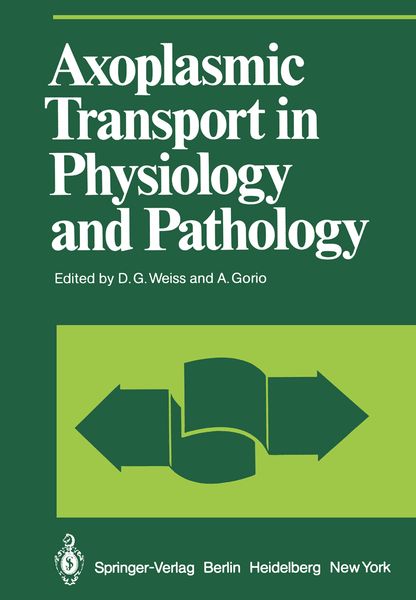
  • Produktbild: Axoplasmic Transport in Physiology and Pathology
  • Produktbild: Axoplasmic Transport in Physiology and Pathology

Axoplasmic Transport in Physiology and Pathology

99,99 €

inkl. gesetzl. MwSt., Versandkostenfrei


Beschreibung

Cajal and contemporary scientists have laid the basis of the modem concepts of the organization of the nervous system: the cir cuits of the brain are made up of individual neurons which transfer information via specialized structures called synapses. Soma and den drites usually receive the inputs, then...

Beschreibung

Cajal and contemporary scientists have laid the basis of the modem concepts of the organization of the nervous system: the cir cuits of the brain are made up of individual neurons which transfer information via specialized structures called synapses. Soma and den drites usually receive the inputs, then the signal is carried all along the axon to the target areas. To fulfIll this task several types of neurons have developed their unique geometry characterized by a large recep tive area (soma and dendrites) and an often very extensive distal branching with the axon terminals. The volume of cytoplasm which constitutes the neuronal periphery is often far larger than the cell body, where the synthetic machinery is located. It is one of the roles ofaxoplasmic transport to supply the periphery with proper material and to sustain the specialized structures necessary for the physiological activity of the neuron. Furthermore, it has become more and more clear that target areas also exert effects on the innervating neurons, and these effects are not only mediated via recurrent fibers. Synapses have been shown to be able to pick up material from the synaptic left which is then intra axon ally transported back to the cell body. This retrograde axoplasmic transport has therefore been recognized as another basic mechanism to convey signals from the periphery to the centre.

Produktdetails

Einband

Taschenbuch

Erscheinungsdatum

10.04.2012

Abbildungen

XI, 192 p. 45 illus., 2 illus. in color.

Herausgeber D. G. Weiss + weitere

Produktdetails

Einband

Taschenbuch

Erscheinungsdatum

10.04.2012

Abbildungen

XI, 192 p. 45 illus., 2 illus. in color.

Herausgeber
Verlag Springer Berlin
Seitenzahl

192

Maße (L/B/H)

24,4/17/1,2 cm

Gewicht

382 g

Sprache

Englisch

ISBN

978-3-642-85716-4

Herstelleradresse

Springer-Verlag KG
Sachsenplatz 4-6
1201 Wien
AT

Email: ProductSafety@springernature.com

Noch keine Bewertungen vorhanden

Verfassen Sie die erste Bewertung zu diesem Artikel

Helfen Sie anderen Kundinnen und Kunden durch Ihre Meinung.

Kundinnen und Kunden meinen

Bewertungen (0)

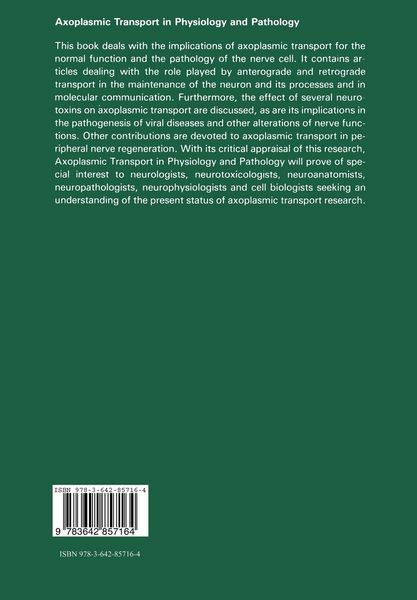
  • Produktbild: Axoplasmic Transport in Physiology and Pathology
  • Produktbild: Axoplasmic Transport in Physiology and Pathology
  • General Properties of Axoplasmic Transport.- General Properties of Axoplasmic Transport.- Section 1. The Physiological Role of Axoplasmic Transport.- Axoplasmic Transport and Synaptic Transmission.- Effect of Physiological Activity in Goldfish Optic Axons on Axonal Transport of Protein and Nucleosides.- Fate of Axonally Transported Proteins in the Nerve Terminal.- Transneuronal Transport: A Way for the Neuron to Communicate with Its Environment.- Axonal Transport, Neurosecretory Vesicles, and the Endocrine Neuron.- Section 2. The Role of Axoplasmic Transport in Growth and Regeneration.- Axonal Transport in the Sprouting Neuron: Transfer of Newly Synthesized Membrane Components to the Cell Surface.- The Role of Axonal Transport in the Growth of the Olfactory Nerve Axons.- Changes in Fast-Transported Protein in Regenerating Axons: Essential or Incidental?.- Recovery of Axonal Transport of Acetylcholinesterase in Regenerating Sciatic Nerve Precedes Muscle Reinnervation.- The Role of Axoplasmic Transport in the Restoration of Synaptic Transmission and in the Process of Sprouting During Nerve Regeneration.- Section 3. Experimental Neuropathies and Axoplasmic Transport.- Disruption of Axoplasmic Transport by Neurotoxic Agents. The 2,5-Hexanedione Model.- Axoplasmic Transport in the Experimental Neuropathy Induced by Acrylamide.- Axonal Transport in ?,?’-Iminodipropionitrile Neuropathy.- Disulfiram-Induced Impairment of Horseradish Peroxidase Retrograde Transport in Rat Sciatic Nerve.- Section 4. Neuronal Pathology and Axoplasmic Transport.- Axonal Transport in Human Nerve Disease and in the Experimental Neuropathy Induced by p-Bromophenylacetylurea.- Disturbances of Axoplasmic Transport in Alzheimer’s Disease.- Axonal Transport of Acetylcholinesterase Molecular Forms inSciatic Nerve of Genetically Diabetic Mice.- Effects of Graded Compression on Axonal Transport in Peripheral Nerves.- Role of Axonal Transport in the Pathophysiology of Retinal and Optic Nerve Disease.- Implications of Axoplasmic Transport for the Spread of Virus Infections in the Nervous System.- Section 5. Axoplasmic Transport as a Tool in Neurophysiology and Neuroanatomy.- Retrograde Migration of Transmitter-Related Molecules.- Intra-Axonal Transport of Horseradish Peroxidase (HRP) and Its Use in Neuroanatomy.- Axonal Transport of Fluorescent Compounds in the Brain and Spinal Cord of Cat and Rat.