Gutscheinbedingungen

**Gültig am 28.06.2026 auf Spielzeug, Schreibwaren, Filme, Geschenke & Trends, Musik, tolino eReader & Zubehör, Hörbücher und Hörbuch-Downloads (außer Abo), nicht preisgebundene Bücher und Kalender online auf thalia.at und in der Thalia App. Einzelne Artikel können ausgeschlossen sein. Aufgrund der Buchpreisbindung sind deutschsprachige Bücher und eBooks ausgenommen. Zusätzlich ausgenommen sind preisgebundene Artikel, Abos & Flatrates, eBooks, Games, Geschenkkarten/-boxen, Shelfies, Software, Zeitschriften sowie einzelne Artikel von tonies®. Pro Einkauf einmal einlösbar. Click & Collect nur bei Onlinevorabzahlung möglich. Keine Barauszahlung. Nicht kombinierbar mit anderen Aktionen und Gutscheinen. Gutschein wird auf max. 500€ Bestellwert angerechnet. Nicht gültig für Versandkosten und Services.

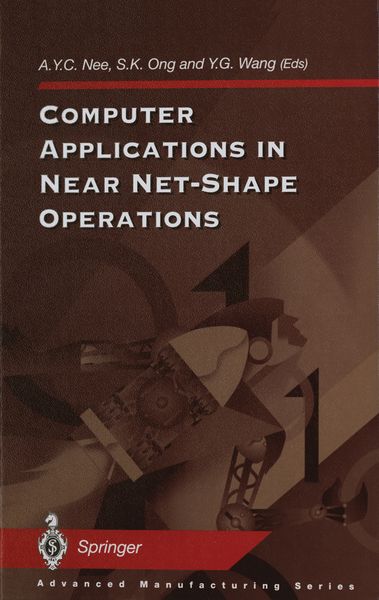
  • Produktbild: Computer Applications in Near Net-Shape Operations
  • Produktbild: Computer Applications in Near Net-Shape Operations

Computer Applications in Near Net-Shape Operations

Aus der Reihe Advanced Manufacturing

49,99 €

inkl. gesetzl. MwSt., Versandkostenfrei


Beschreibung

Produktdetails

Einband

Taschenbuch

Erscheinungsdatum

13.10.2012

Herausgeber

Andrew Y.C. Nee + weitere

Verlag

Springer London

Seitenzahl

322

Maße (L/B/H)

23,5/15,5/1,9 cm

Gewicht

528 g

Auflage

Softcover reprint of the original 1st ed. 1999

Sprache

Englisch

ISBN

978-1-4471-1159-7

Beschreibung

Produktdetails

Einband

Taschenbuch

Erscheinungsdatum

13.10.2012

Herausgeber

Verlag

Springer London

Seitenzahl

322

Maße (L/B/H)

23,5/15,5/1,9 cm

Gewicht

528 g

Auflage

Softcover reprint of the original 1st ed. 1999

Sprache

Englisch

ISBN

978-1-4471-1159-7

Herstelleradresse

Springer-Verlag KG
Sachsenplatz 4-6
1201 Wien
AT

Email: ProductSafety@springernature.com

Kundinnen und Kunden meinen

0 Bewertungen

Informationen zu Bewertungen

Zur Abgabe einer Bewertung ist eine Anmeldung im Konto notwendig. Die Authentizität der Bewertungen wird von uns nicht überprüft. Wir behalten uns vor, Bewertungstexte, die unseren Richtlinien widersprechen, entsprechend zu kürzen oder zu löschen.

Die Bewertungen sind nach Format, Anzahl Sterne und Datum sortiert.

Verfassen Sie die erste Bewertung zu diesem Artikel

Helfen Sie anderen Kund*innen durch Ihre Meinung

Kundinnen und Kunden meinen

0 Bewertungen filtern

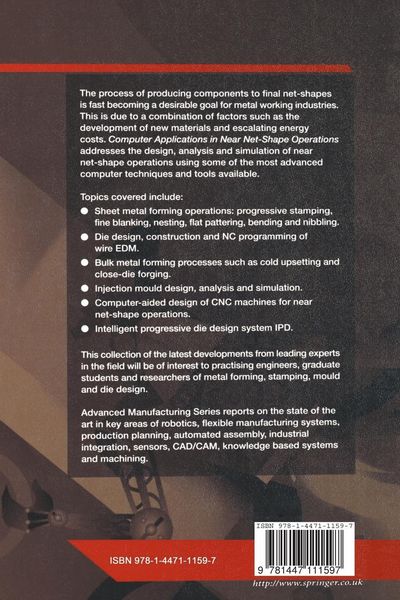
  • Produktbild: Computer Applications in Near Net-Shape Operations
  • Produktbild: Computer Applications in Near Net-Shape Operations
  • 1 Introduction to near net-shape operations.- 1.1 Introduction.- 1.2 Classification of near net-shape operations.- 1.2.1 Sheet metal forming.- 1.2.2 Massive (bulk) metal forming processes.- 1.2.3 Injection moulding.- 1.2.4 Machines for near net-shape operations.- 1.3 Near net-shape operations: past, present and future.- 2 CAD/CAM for sheet metal forming and related processes.- 2.1 Introduction and basic techniques.- 2.1.1 Feature modelling of stampings.- 2.1.2 Application of expert systems to stamping die design.- 2.2 Optimisation of blank layout.- 2.2.1 Mathematical description of blank layout.- 2.2.2 The polygon method.- 2.2.3 The height function method.- 2.3 Fine blanking.- 2.3.1 Characteristics of the fine blanking process.- 2.3.2 Application of the fine blanking process.- 2.3.3 CAD/CAM of fine blanking dies.- 2.4 Progressive stamping.- 2.4.1 Software architecture of the system.- 2.4.2 Strip layout.- 2.4.3 Construction design of progressive dies.- 2.5 An overview of a flat patterning and bending simulation system.- 2.5.1 Design input module.- 2.5.2 Flat pattern development module.- 2.5.3 Bending simulation module.- 2.5.4 System details.- 2.5.5 Implementation of bending simulation module.- 2.6 CNC punching and nibbling.- 2.6.1 Computer-based system for CNC nibbling.- 2.6.2 Punch libraries.- 2.6.3 Profile classification.- 2.6.4 Punch selection and optimisation.- 2.6.5 An approach to automatic tool selection.- 2.6.6 A case study.- 2.7 Die construction design.- 2.7.1 Design of die and punch.- 2.7.2 Layout of ejectors.- 2.8 NC programming of wire EDM.- 2.8.1 Process consideration for NC programming of wire EDM.- 2.8.2 Geometric computation.- 2.8.3 NC programming procedure for wire EDM.- References.- 3 CAD/CAM for massive (bulk) metal forming.- 3.1 Introduction.- 3.2 Cold upsetting.- 3.2.1 Determination of operations and sequences.- 3.2.2 Calculation of process parameters.- 3.2.3 Design of dies cavities, general parts and combined dies.- 3.2.4 The BNC CAD system.- 3.3 Closed-die forging.- 3.3.1 Selection and calculation of bars.- 3.3.2 Determination of operations and sequences.- 3.3.3 Calculation of forging load and stress.- 3.3.4 Design of dies.- 3.3.5 Program flowchart and description.- References.- 4 CAD/CAE/CAM for injection moulding.- 4.1 Introduction.- 4.1.1 Brief history of development.- 4.1.2 Technological characteristics.- 4.2 Graphic input and geometry construction of injection moulded products.- 4.2.1 Wire-frame modelling.- 4.2.2 Surface modelling.- 4.2.3 Solid modelling.- 4.3 CAD for construction design of plastic injection moulds.- 4.3.1 Program flowchart.- 4.3.2 Standard mould base design.- 4.3.3 Cavity and core design.- 4.3.4 Runner bar design.- 4.4 Flow simulation of plastic injection moulding.- 4.4.1 One-dimensional flow analysis.- 4.4.2 Two-dimensional flow analysis.- 4.4.3 Three-dimensional flow analysis.- 4.5 Cooling simulation of plastic injection moulding.- 4.5.1 One-dimensional cooling analysis.- 4.5.2 Two-dimensional cooling analysis.- 4.5.3 Three-dimensional cooling analysis.- 4.6 CAM for plastic injection moulds.- 4.6.1 Integrated CAD/CAM system.- 4.6.2 Information transfer from CAD to CAM.- 4.6.3 Tool path generation in 2-D NC.- 4.6.4 Manufacturing for 3-D core and cavity.- 4.7 CAD/CAE/CAM system for plastic injection moulding.- 4.7.1 System configuration.- 4.7.2 CAD software functions.- 4.7.3 CAE software functions.- 4.7.4 CAM software functions.- 5 FEM applications in near net-shape operations.- 5.1 Introduction.- 5.2 FEM applications and developments in near net-shape operations.- 5.2.1 New algorithms for automatic triangular mesh generation.- 5.2.2 New algorithms for mesh rezoning in FEM simulation.- 5.2.3 Algorithms for generating isogram in FEM.- 5.2.4 Calculation of rigid regions using rigid-plastic FEM.- 5.3 FEM applications in massive (bulk) metal forming processes.- 5.3.1 Simulation of rigid-plastic finite element of radial extrusion process.- 5.3.2 Rigid-plastic finite element simulation of the upsetting-backward extrusion process.- 5.3.3 Simulation of forward extrusion and upsetting-backward extrusion process.- 5.4 FEM application in die design.- 5.4.1 Basic equations for FEM analysis of combined die and mathematical modelling of pre-stressing force.- 5.4.2 FEM solution and program flowchart.- 5.4.3 FEM analysis for combined backward extrusion die.- 5.4.4 FEM analysis for combined forward extrusion die.- 5.4.5 FEM analysis for precision forging die for blades.- 5.4.6 Optimisation design of combined dies.- 5.5 FEM application in analysis of hydraulic presses.- 5.5.1 Finite element analysis of fluid transients.- 5.5.2 Non-symmetrical frontal solution method for fluid FEM 240 References.- 6 CAE/CNC of machines for near net-shape operations.- 6.1 Introduction.- 6.2 Universal CNC systems for near net-shape operations.- 6.2.1 Composition of universal CNC control system.- 6.2.2 Intelligent control module board.- 6.2.3 Module of control software.- 6.2.4 Communication in an integrated-distributed CNC system.- 6.3 CNC for sheet metal forming machines.- 6.3.1 CNC system for shearing machines.- 6.3.2 CNC system for press brakes.- 6.4 FMC for sheet metal bending.- 6.4.1 CNC and automatic generation of system software.- 6.4.2 Bending design based on features.- 6.4.3 Manufacturability criteria for sheet metal bending FMC.- 7 IMOLD®: an intelligent mould design and assembly system.- 7.1 Introduction.- 7.2 Injection moulding.- 7.3 Computer applications in injection mould design.- 7.4 IMOLD®.- 7.4.1 IMOLD® functional modules.- 7.4.2 Design information management in IMOLD®: assembly tree.- 7.5 An example.- 7.6 Conclusions.- References.- 8 Computer applications in intelligent progressive dies design (IPD).- 8.1 Introduction.- 8.2 Overview of the computer architecture.- 8.3 Advanced knowledge-based techniques for the modelling and generation of progressive dies.- 8.3.1 A model-based reasoning (MBR) approach for die design.- 8.3.2 Shape representation and spatial reasoning techniques.- 8.3.3 A function-spatial language for the configuration of a die.- 8.4 An industrial case study.- 8.4.1 Introduction.- 8.4.2 Description of stamping.- 8.4.3 Features of the part.- 8.4.4 Modelling the part.- 8.4.5 The flat pattern.- 8.4.6 The strip layout.- 8.4.7 3-D strip layout.- 8.4.8 Configuration of the progressive die.- 8.4.9 Technical data generated by the system.- 8.5 Conclusions.