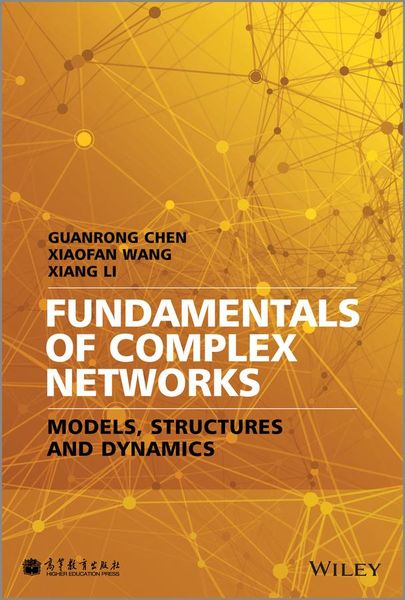
Produktbild: Fundamentals of Complex Networks

Fundamentals of Complex Networks Models, Structures and Dynamics

158,99 €

inkl. gesetzl. MwSt., Versandkostenfrei


Beschreibung

Produktdetails

Einband

Gebundene Ausgabe

Erscheinungsdatum

29.06.2015

Verlag

John Wiley & Sons

Seitenzahl

392

Maße (L/B/H)

24,4/17,3/2,3 cm

Gewicht

748 g

Auflage

1. Auflage

Sprache

Englisch

ISBN

978-1-118-71811-7

Beschreibung

Produktdetails

Einband

Gebundene Ausgabe

Erscheinungsdatum

29.06.2015

Verlag

John Wiley & Sons

Seitenzahl

392

Maße (L/B/H)

24,4/17,3/2,3 cm

Gewicht

748 g

Auflage

1. Auflage

Sprache

Englisch

ISBN

978-1-118-71811-7

Herstelleradresse

Libri GmbH
Europaallee 1
36244 Bad Hersfeld
DE

Email: GPSR Kontakt

Noch keine Bewertungen vorhanden

Verfassen Sie die erste Bewertung zu diesem Artikel

Helfen Sie anderen Kundinnen und Kunden durch Ihre Meinung.

Kundinnen und Kunden meinen

Bewertungen (0)

Die Leseprobe wird geladen.
  • Produktbild: Fundamentals of Complex Networks
  • About the Authors xi
     
    Preface xiii
     
    Acknowledgements xv
     
    Part I FUNDAMENTAL THEORY
     
    1 Introduction 3
     
    1.1 Background and Motivation 3
     
    1.2 A Brief History of Complex Network Research 5
     
    1.2.1 The Königsburg Seven-Bridge Problem 5
     
    1.2.2 Random Graph Theory 7
     
    1.2.3 Small-World Experiments 7
     
    1.2.4 Strengths of Weak Ties 10
     
    1.2.5 Heterogeneity and the WWW 10
     
    1.3 New Era of Complex-Network Studies 11
     
    Exercises 13
     
    References 13
     
    2 Preliminaries 15
     
    2.1 Elementary Graph Theory 15
     
    2.1.1 Background 15
     
    2.1.2 Basic Concepts 15
     
    2.1.3 Adjacency, Incidence and Laplacian Matrices 24
     
    2.1.4 Degree Correlation and Assortativity 26
     
    2.1.5 Some Basic Results on Graphs 31
     
    2.1.6 Eulerian and Hamiltonian Graphs 35
     
    2.1.7 Plane and Planar Graphs 37
     
    2.1.8 Trees and Bipartite Graphs 39
     
    2.1.9 Directed Graphs 41
     
    2.1.10 Weighted Graphs 45
     
    2.1.11 Some Applications 46
     
    2.2 Elementary Probability and Statistics 52
     
    2.2.1 Probability Preliminaries 52
     
    2.2.2 Statistics Preliminaries 58
     
    2.2.3 Law of Large Numbers and Central Limit Theorem 59
     
    2.2.4 Markov Chains 61
     
    2.3 Elementary Dynamical Systems Theory 62
     
    2.3.1 Background and Motivation 62
     
    2.3.2 Some Analytical Tools 70
     
    2.3.3 Chaos in Nonlinear Systems 72
     
    2.3.4 Kolmogorov-Sinai Entropy 77
     
    2.3.5 Some Examples of Chaotic Systems 78
     
    2.3.6 Stabilities of Nonlinear Systems 85
     
    Exercises 90
     
    References 100
     
    3 Network Topologies: Basic Models and Properties 103
     
    3.1 Introduction 103
     
    3.2 Regular Networks 103
     
    3.3 ER Random-Graph Model 105
     
    3.4 Small-World Network Models 108
     
    3.4.1 WS Small-World Network Model 108
     
    3.4.2 NW Small-World Network Model 108
     
    3.4.3 Statistical Properties of Small-World Network Models 109
     
    3.5 Navigable Small-World Network Model 112
     
    3.6 Scale-Free Network Models 114
     
    3.6.1 BA Scale-Free Network Model 114
     
    3.6.2 Robustness versus Fragility 118
     
    3.6.3 Modified BA Models 122
     
    3.6.4 A Simple Model with Power-Law Degree Distribution 126
     
    3.6.5 Local-World and Multi-Local-World Network Models 126
     
    Exercises 133
     
    References 135
     
    Part II APPLICATIONS - SELECTED TOPICS
     
    4 Internet: Topology and Modeling 139
     
    4.1 Introduction 139
     
    4.2 Topological Properties of the Internet 141
     
    4.2.1 Power-Law Node-Degree Distribution 141
     
    4.2.2 Hierarchical Structure 143
     
    4.2.3 Rich-Club Structure 145
     
    4.2.4 Disassortative Property 147
     
    4.2.5 Coreness and Betweenness 148
     
    4.2.6 Growth of the Internet 151
     
    4.2.7 Router-Level Internet Topology 152
     
    4.2.8 Geographic Layout of the Internet 153
     
    4.3 Random-Graph Network Topology Generator 155
     
    4.4 Structural Network Topology Generators 156
     
    4.4.1 Tiers Topology Generator 157
     
    4.4.2 Transit-Stub Topology Generator 158
     
    4.5 Connectivity-Based Network Topology Generators 159
     
    4.5.1 Inet 160
     
    4.5.2 BRITE Model 161
     
    4.5.3 GLP Model 163
     
    4.5.4 PFP Model 165
     
    4.5.5 TANG Model 166
     
    4.6 Multi-Local-World Model 167
     
    4.6.1 Theoretical Considerations 167
     
    4.6.2 Numerical Results with Comparison 169
     
    4.6.3 Performance Comparison 176
     
    4.7 HOT Model 178
    &nb