Minimal Refining of Canola Oil and its Effects on Minor Constituents Minimal Refining for Health
-
- Englisch ausgewählt
43,99 €
UVP
50,40 €
inkl. gesetzl. MwSt.,
Beschreibung
Produktdetails
Einband
Taschenbuch
Erscheinungsdatum
04.03.2013
Verlag
LAP LAMBERT Academic PublishingSeitenzahl
116
Maße (L/B/H)
22/15/0,8 cm
Gewicht
191 g
Sprache
Englisch
ISBN
978-3-659-34291-2
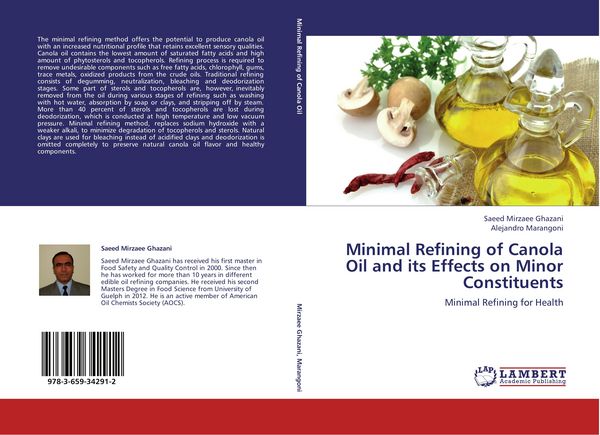
The minimal refining method offers the potential to produce canola oil with an increased nutritional profile that retains excellent sensory qualities. Canola oil contains the lowest amount of saturated fatty acids and high amount of phytosterols and tocopherols. Refining process is required to remove undesirable components such as free fatty acids, chlorophyll, gums, trace metals, oxidized products from the crude oils. Traditional refining consists of degumming, neutralization, bleaching and deodorization stages. Some part of sterols and tocopherols are, however, inevitably removed from the oil during various stages of refining such as washing with hot water, absorption by soap or clays, and stripping off by steam. More than 40 percent of sterols and tocopherols are lost during deodorization, which is conducted at high temperature and low vacuum pressure. Minimal refining method, replaces sodium hydroxide with a weaker alkali, to minimize degradation of tocopherols and sterols. Natural clays are used for bleaching instead of acidified clays and deodorization is omitted completely to preserve natural canola oil flavor and healthy components.
Noch keine Bewertungen vorhanden
Verfassen Sie die erste Bewertung zu diesem Artikel
Helfen Sie anderen Kundinnen und Kunden durch Ihre Meinung.
Kurze Frage zu unserer Seite
Vielen Dank für Ihr Feedback
Wir nutzen Ihr Feedback, um unsere Produktseiten zu verbessern. Bitte haben Sie Verständnis, dass wir Ihnen keine Rückmeldung geben können. Falls Sie Kontakt mit uns aufnehmen möchten, können Sie sich aber gerne an unseren Kund*innenservice wenden.
zum Kundenservice