KI-Beratung Beta

Gutscheinbedingungen

**Gültig bis 30.11.2026 auf Spielzeug, Schreibwaren, Filme, Geschenke & Trends, Musik, tolino eReader & Zubehör, Hörbücher und Hörbuch-Downloads, nicht preisgebundene Bücher und Kalender online auf thalia.at und in der Thalia App. Einzelne Artikel können ausgeschlossen sein. Aufgrund der Buchpreisbindung sind deutschsprachige Bücher und eBooks ausgenommen. Zusätzlich ausgenommen sind Abos & Flatrates, Games, Geschenkkarten/-boxen, Shelfies, Software, Zeitschriften sowie einzelne Artikel von tonies®. Pro Einkauf einmal einlösbar. Nur gültig mit im Onlineshop hinterlegter Bonuscard. Click & Collect nur bei Onlinevorabzahlung möglich. Keine Barauszahlung. Nicht kombinierbar mit anderen Aktionen und Gutscheinen. Gutschein wird auf max. 500€ Bestellwert angerechnet. Nicht gültig für Versandkosten und Services.

  • Produktbild: Algorithms for Random Generation and Counting: A Markov Chain Approach
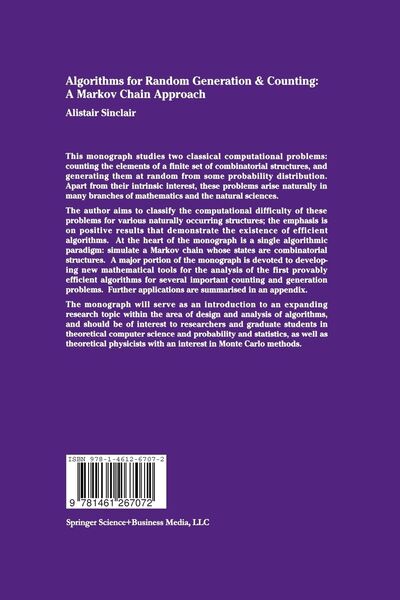
  • Produktbild: Algorithms for Random Generation and Counting: A Markov Chain Approach

Algorithms for Random Generation and Counting: A Markov Chain Approach

99,99 €

inkl. gesetzl. MwSt., Versandkostenfrei


Beschreibung

This monograph is a slightly revised version of my PhD thesis [86], com pleted in the Department of Computer Science at the University of Edin burgh in June 1988, with an additional chapter summarising more recent developments. Some of the material has appeared in the form of papers [50,88]. The underlying...

Beschreibung

This monograph is a slightly revised version of my PhD thesis [86], com pleted in the Department of Computer Science at the University of Edin burgh in June 1988, with an additional chapter summarising more recent developments. Some of the material has appeared in the form of papers [50,88]. The underlying theme of the monograph is the study of two classical problems: counting the elements of a finite set of combinatorial structures, and generating them uniformly at random. In their exact form, these prob lems appear to be intractable for many important structures, so interest has focused on finding efficient randomised algorithms that solve them ap proxim~ly, with a small probability of error. For most natural structures the two problems are intimately connected at this level of approximation, so it is natural to study them together. At the heart of the monograph is a single algorithmic paradigm: sim ulate a Markov chain whose states are combinatorial structures and which converges to a known probability distribution over them. This technique has applications not only in combinatorial counting and generation, but also in several other areas such as statistical physics and combinatorial optimi sation. The efficiency of the technique in any application depends crucially on the rate of convergence of the Markov chain.

Produktdetails

Einband

Taschenbuch

Erscheinungsdatum

01.11.2012

Abbildungen

VIII, 147 p.

Verlag Birkhäuser Boston

Produktdetails

Einband

Taschenbuch

Erscheinungsdatum

01.11.2012

Abbildungen

VIII, 147 p.

Verlag Birkhäuser Boston
Seitenzahl

147

Maße (L/B/H)

23,5/15,5/0,9 cm

Gewicht

254 g

Auflage

Softcover reprint of the original 1st ed. 1993

Sprache

Englisch

ISBN

978-1-4612-6707-2

Herstelleradresse

Springer-Verlag GmbH
Tiergartenstr. 17
69121 Heidelberg
DE

Email: ProductSafety@springernature.com

Noch keine Bewertungen vorhanden

Verfassen Sie die erste Bewertung zu diesem Artikel

Helfen Sie anderen Kundinnen und Kunden durch Ihre Meinung.

Kundinnen und Kunden meinen

Bewertungen (0)

  • Produktbild: Algorithms for Random Generation and Counting: A Markov Chain Approach
  • Produktbild: Algorithms for Random Generation and Counting: A Markov Chain Approach
  • Synopsis.- 1 Preliminaries.- 1.1 Some basic definitions.- 1.2 Notions of tractability.- 1.3 An extended model.- 1.4 Counting, generation and self-reducibility.- 1.5 An interesting class of relations.- 2 Markov chains and rapid mixing.- 2.1 The Markov chain approach to generation problems.- 2.2 Conductance and the rate of convergence.- 2.3 A characterisation of rapid mixing.- 3 Direct Applications.- 3.1 Some simple examples.- 3.2 Approximating the permanent.- 3.3 Monomer-dimer systems.- 3.4 Concluding remarks.- 4 Indirect Applications.- 4.1 A robust notion of approximate counting.- 4.2 Self-embeddable relations.- 4.3 Graphs with specified degrees.- Appendix: Recent developments.