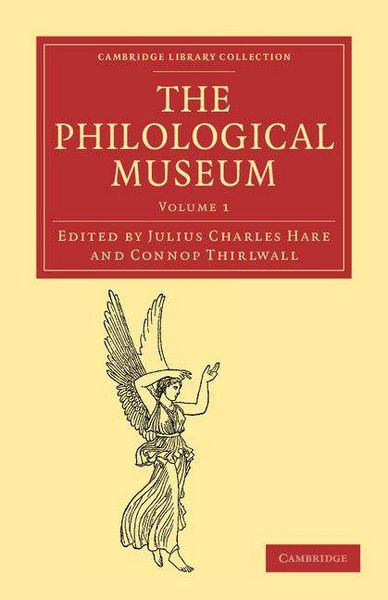
The Philological Museum - Volume 1
-
- Englisch ausgewählt
-
Verlag:Cambridge Academic
89,99 €
inkl. gesetzl. MwSt.,
Beschreibung
Produktdetails
Einband
Taschenbuch
Erscheinungsdatum
23.10.2012
Herausgeber
Julius Charles Hare + weitereVerlag
Cambridge AcademicSeitenzahl
720
Maße (L/B/H)
21,6/14/4,2 cm
Gewicht
999 g
Sprache
Englisch
ISBN
978-1-108-05414-0
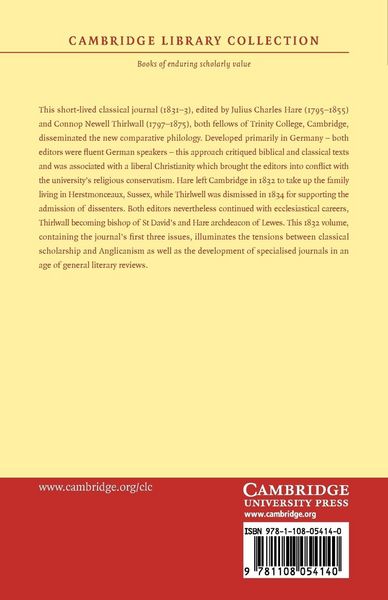
This short-lived classical journal (1831-3), edited by Julius Charles Hare (1795-1855) and Connop Newell Thirlwall (1797-1875), both fellows of Trinity College, Cambridge, disseminated the new comparative philology. Developed primarily in Germany - both editors were fluent German speakers - this approach critiqued biblical and classical texts and was associated with a liberal Christianity which brought the editors into conflict with the university's religious conservatism. Hare left Cambridge in 1832 to take up the family living in Herstmonceaux, Sussex, while Thirlwall was dismissed in 1834 for supporting the admission of dissenters. Both editors nevertheless continued with ecclesiastical careers, Thirlwall becoming bishop of St David's and Hare archdeacon of Lewes. This 1832 volume, containing the journal's first three issues, illuminates the tensions between classical scholarship and Anglicanism as well as the development of specialised journals in an age of general literary reviews.
Noch keine Bewertungen vorhanden
Verfassen Sie die erste Bewertung zu diesem Artikel
Helfen Sie anderen Kundinnen und Kunden durch Ihre Meinung.
Kurze Frage zu unserer Seite
Vielen Dank für Ihr Feedback
Wir nutzen Ihr Feedback, um unsere Produktseiten zu verbessern. Bitte haben Sie Verständnis, dass wir Ihnen keine Rückmeldung geben können. Falls Sie Kontakt mit uns aufnehmen möchten, können Sie sich aber gerne an unseren Kund*innenservice wenden.
zum Kundenservice