Gutscheinbedingungen

**Gültig bis 25.06.2026 auf fremdsprachige Bücher online auf thalia.at und in der Thalia App. Einzelne Artikel können ausgeschlossen sein. Ausgenommen sind preisgebundene Artikel & eBooks. Pro Einkauf einmal einlösbar. Click & Collect nur bei Onlinevorabzahlung möglich. Keine Barauszahlung. Nicht kombinierbar mit anderen Aktionen und Gutscheinen. Gutschein wird auf max. 500€ Bestellwert angerechnet. Nicht gültig für Geschenkkarten, Versandkosten und Services.

  • Produktbild: Patterns, Principles, and Practices of Domain-Driven Design
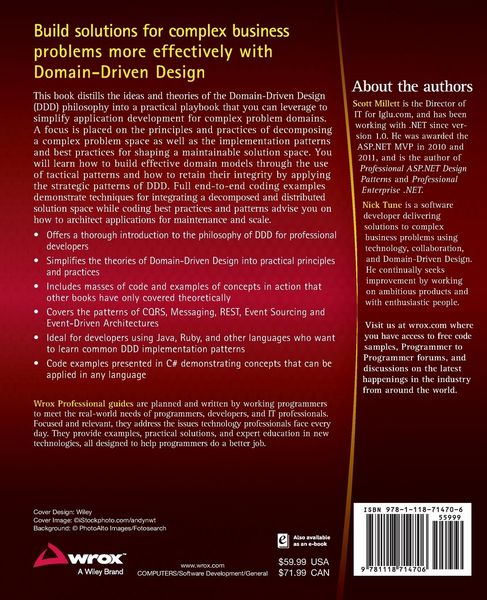
  • Produktbild: Patterns, Principles, and Practices of Domain-Driven Design

Patterns, Principles, and Practices of Domain-Driven Design

58,99 €

inkl. gesetzl. MwSt., Versandkostenfrei


Beschreibung

Produktdetails

Einband

Taschenbuch

Erscheinungsdatum

01.06.2015

Verlag

John Wiley & Sons Inc

Seitenzahl

800

Maße (L/B/H)

23,6/19,2/4,6 cm

Gewicht

1460 g

Auflage

1. Auflage

Sprache

Englisch

ISBN

978-1-118-71470-6

Beschreibung

Produktdetails

Einband

Taschenbuch

Erscheinungsdatum

01.06.2015

Verlag

John Wiley & Sons Inc

Seitenzahl

800

Maße (L/B/H)

23,6/19,2/4,6 cm

Gewicht

1460 g

Auflage

1. Auflage

Sprache

Englisch

ISBN

978-1-118-71470-6

Herstelleradresse

Libri GmbH
Europaallee 1
36244 Bad Hersfeld
DE

Email: gpsr@libri.de

Kundinnen und Kunden meinen

0 Bewertungen

Informationen zu Bewertungen

Zur Abgabe einer Bewertung ist eine Anmeldung im Konto notwendig. Die Authentizität der Bewertungen wird von uns nicht überprüft. Wir behalten uns vor, Bewertungstexte, die unseren Richtlinien widersprechen, entsprechend zu kürzen oder zu löschen.

Die Bewertungen sind nach Format, Anzahl Sterne und Datum sortiert.

Verfassen Sie die erste Bewertung zu diesem Artikel

Helfen Sie anderen Kund*innen durch Ihre Meinung

Kundinnen und Kunden meinen

0 Bewertungen filtern

Die Leseprobe wird geladen.
  • Produktbild: Patterns, Principles, and Practices of Domain-Driven Design
  • Produktbild: Patterns, Principles, and Practices of Domain-Driven Design
  • INTRODUCTION xxxv

    PART I: THE PRINCIPLES AND PRACTICES OF DOMAIN¿DRIVEN DESIGN

    CHAPTER 1: WHAT IS DOMAIN¿DRIVEN DESIGN? 3

    The Challenges of Creating Software for Complex Problem Domains 4

    Code Created Without a Common Language 4

    A Lack of Organization 5

    The Ball of Mud Pattern Stifles Development 5

    A Lack of Focus on the Problem Domain 6

    How the Patterns of Domain¿Driven Design Manage Complexity 6

    The Strategic Patterns of DDD 6

    Distilling the Problem Domain to Reveal What Is Important 7

    Creating a Model to Solve Domain Problems 7

    Using a Shared Language to Enable Modeling Collaboration 7

    Isolate Models from Ambiguity and Corruption 8

    Understanding the Relationships between Contexts 9

    The Tactical Patterns of DDD 9

    The Problem Space and the Solution Space 9

    The Practices and Principles of Domain¿Driven Design 11

    Focusing on the Core Domain 11

    Learning through Collaboration 11

    Creating Models through Exploration and Experimentation 11

    Communication 11

    Understanding the Applicability of a Model 12

    Constantly Evolving the Model 12

    Popular Misconceptions of Domain¿Driven Design 12

    Tactical Patterns Are Key to DDD 12

    DDD Is a Framework 13

    DDD Is a Silver Bullet 13

    The Salient Points 13

    CHAPTER 2: DISTILLING THE PROBLEM DOMAIN 15

    Knowledge Crunching and Collaboration 15

    Reaching a Shared Understanding through a Shared Language 16

    The Importance of Domain Knowledge 17

    The Role of Business Analysts 17

    An Ongoing Process 17

    Gaining Domain Insight with Domain Experts 18

    Domain Experts vs Stakeholders 18

    Deeper Understanding for the Business 19

    Engaging with Your Domain Experts 19

    Patterns for Effective Knowledge Crunching 19

    Focus on the Most Interesting Conversations 19

    Start from the Use Cases 20

    Ask Powerful Questions 20

    Sketching 20

    Class Responsibility Collaboration Cards 21

    Defer the Naming of Concepts in Your Model 21

    Behavior¿Driven Development 22

    Rapid Prototyping 23

    Look at Paper¿Based Systems 24

    Look For Existing Models 24

    Understanding Intent 24

    Event Storming 25

    Impact Mapping 25

    Understanding the Business Model 27

    Deliberate Discovery 28

    Model Exploration Whirlpool 29

    The Salient Points 29

    CHAPTER 3: FOCUSING ON THE CORE DOMAIN 31

    Why Decompose a Problem Domain? 31

    How to Capture the Essence of the Problem 32

    Look Beyond Requirements 32

    Capture the Domain Vision for a Shared Understanding of What Is Core 32

    How to Focus on the Core Problem 33

    Distilling a Problem Domain 34

    Core Domains 35

    Treat Your Core Domain as a Product Rather than a Project 36

    Generic Domains 37

    Supporting Domains 37

    How Subdomains Shape a Solution 37

    Not All Parts of a System will be Well Designed 37

    Focus on Clean Boundaries over Perfect Models 38

    The Core Domain Doesn't Always Have to Be Perfect the First Time 39

    Build Subdomains for Replacement Rather than Reuse 39

    What if You Have no Core Domain? 39

    The Salient Points 40

    CHAPTER 4: MODEL¿DRIVEN DESIGN 41

    What Is a Domain Model? 42

    The Domain versus the Domain Model 42

    The Analysis Model 43

    The Code Model 43

    The Code Model Is the Primary Expression of the Domain Model 44

    Model¿Driven Design 44

    The Challenges with Upfront Design 44

    Team Modeling 45

    Using a Ubiquitous Language to Bind the Analysis to the Code Model 47

    A Language Will Outlive Your Software 47

    The Language of the Business 48

    Translation between the Developers and the Business 48

    Collaborating on a Ubiquitous Language 48

    Carving Out a Language by Working with Concrete Examples 49

    Teach Your Domain Experts to Focus on the Problem and Not Jump to a Solution 50

    Best Practices for Shaping the Language 51

    How to Create Effective Domain Models 52

    Don't Let the Truth Get in the Way of a Good Model 52

    Model Only What Is Relevant 54

    Domain Models Are Temporarily Useful 54

    Be Explicit with Terminology 54

    Limit Your Abstractions 54

    Focus Your Code at the Right Level of Abstraction 55

    Abstract Behavior Not Implementations 55

    Implement the Model in Code Early and Often 56

    Don't Stop at the First Good Idea 56

    When to Apply Model¿Driven Design 56

    If It's Not Worth the Effort Don't Try and Model It 56

    Focus on the Core Domain 57

    The Salient Points 57

    CHAPTER 5: DOMAIN MODEL IMPLEMENTATION PATTERNS 59

    The Domain Layer 60

    Domain Model Implementation Patterns 60

    Domain Model 62

    Transaction Script 65

    Table Module 67

    Active Record 67

    Anemic Domain Model 67

    Anemic Domain Model and Functional Programming 68

    The Salient Points 71

    CHAPTER 6: MAINTAINING THE INTEGRITY OF DOMAIN MODELS WITH BOUNDED CONTEXTS 73

    The Challenges of a Single Model 74

    A Model Can Grow in Complexity 74

    Multiple Teams Working on a Single Model 74

    Ambiguity in the Language of the Model 75

    The Applicability of a Domain Concept 76

    Integration with Legacy Code or Third Party Code 78

    Your Domain Model Is not Your Enterprise Model 79

    Use Bounded Contexts to Divide and Conquer a Large Model 79

    Defining a Model's Boundary 82

    Define Boundaries around Language 82

    Align to Business Capabilities 83

    Create Contexts around Teams 83

    Try to Retain Some Communication between Teams 84

    Context Game 85

    The Difference between a Subdomain and a Bounded Context 85

    Implementing Bounded Contexts 85

    The Salient Points 89

    CHAPTER 7: CONTEXT MAPPING 91

    A Reality Map 92

    The Technical Reality 92

    The Organizational Reality 93

    Mapping a Relevant Reality 94

    X Marks the Spot of the Core Domain 94

    Recognising the Relationships between Bounded Contexts 95

    Anticorruption Layer 95

    Shared Kernel 96

    Open Host Service 97

    Separate Ways 97

    Partnership 98

    An Upstream/Downstream Relationship 98

    Customer¿Supplier 99

    Conformist 100

    Communicating the Context Map 100

    The Strategic Importance of Context Maps 101

    Retaining Integrity 101

    The Basis for a Plan of Attack 101

    Understanding Ownership and Responsibility 101

    Revealing Areas of Confusion in Business Work Flow 102

    Identifying Nontechnical Obstacles 102

    Encourages Good Communication 102

    Helps On¿Board New Starters 102

    The Salient Points 103

    CHAPTER 8: APPLICATION ARCHITECTURE 105

    Application Architecture 105

    Separating the Concerns of Your Application 106

    Abstraction from the Complexities of the Domain 106

    A Layered Architecture 106

    Dependency Inversion 107

    The Domain Layer 107

    The Application Service Layer 108

    The Infrastructural Layers 108

    Communication Across Layers 108

    Testing in Isolation 109

    Don t Share Data Schema between Bounded Contexts 109

    Application Architectures versus Architectures for Bounded Contexts 111

    Application Services 112

    Application Logic versus Domain Logic 114

    Defining and Exposing Capabilities 114

    Business Use Case Coordination 115

    Application Services Represent Use Cases, Not Create, Read, Update, and Delete 115

    Domain Layer As an Implementation Detail 115

    Domain Reporting 116

    Read Models versus Transactional Models 116

    Application Clients 117

    The Salient Points 120

    CHAPTER 9: COMMON PROBLEMS FOR TEAMS STARTING OUT WITH DOMAIN¿DRIVEN DESIGN 121

    Overemphasizing the Importance of Tactical Patterns 122

    Using the Same Architecture for All Bounded Contexts 122

    Striving for Tactical Pattern Perfection 122

    Mistaking the Building Blocks for the Value of DDD 123

    Focusing on Code Rather Than the Principles of DDD 123

    Missing the Real Value of DDD: Collaboration, Communication, and Context 124

    Producing a Big Ball of Mud Due to Underestimating the Importance of Context 124

    Causing Ambiguity and Misinterpretations by Failing to Create a UL 125

    Designing Technical¿Focused Solutions Due to a Lack of Collaboration 125

    Spending Too Much Time on What's Not Important 126

    Making Simple Problems Complex 126

    Applying DDD Principles to a Trivial Domain with Little Business Expectation 126

    Disregarding CRUD as an Antipattern 127

    Using the Domain Model Pattern for Every Bounded Context 127

    Ask Yourself: Is It Worth This Extra Complexity? 127

    Underestimating the Cost of Applying DDD 127

    Trying to Succeed Without a Motivated and Focused Team 128

    Attempting Collaboration When a Domain Expert Is Not Behind the Project 128

    Learning in a Noniterative Development Methodology 128

    Applying DDD to Every Problem 129

    Sacrificing Pragmatism for Needless Purity 129

    Wasted Effort by Seeking Validation 129

    Always Striving for Beautiful Code 130

    DDD Is About Providing Value 130

    The Salient Points 130

    CHAPTER 10: APPLYING THE PRINCIPLES, PRACTICES, AND PATTERNS OF DDD 131

    Selling DDD 132

    Educating Your Team 132

    Speaking to Your Business 132

    Applying the Principles of DDD 133

    Understand the Vision 133

    Capture the Required Behaviors 134

    Distilling the Problem Space 134

    Focus on What Is Important 134

    Understand the Reality of the Landscape 135

    Modeling a Solution 135

    All Problems Are Not Created Equal 136

    Engaging with an Expert 136

    Select a Behavior and Model Around a Concrete Scenario 137

    Collaborate with the Domain Expert on the Most Interesting Parts 137

    Evolve UL to Remove Ambiguity 138

    Throw Away Your First Model, and Your Second 138

    Implement the Model in Code 139

    Creating a Domain Model 139

    Keep the Solution Simple and Your Code Boring 139

    Carve Out an Area of Safety 140

    Integrate the Model Early and Often 140

    Nontechnical Refactoring 140

    Decompose Your Solution Space 140

    Rinse and Repeat 141

    Exploration and Experimentation 142

    Challenge Your Assumptions 142

    Modeling Is a Continuous Activity 142

    There Are No Wrong Models 142

    Supple Code Aids Discovery 143

    Making the Implicit Explicit 143

    Tackling Ambiguity 144

    Give Things a Name 145

    A Problem Solver First, A Technologist Second 146

    Don't Solve All the Problems 146

    How Do I Know That I Am Doing It Right? 146

    Good Is Good Enough 147

    Practice, Practice, Practice 147

    The Salient Points 147

    PART II: STRATEGIC PATTERNS: COMMUNICATING BETWEEN BOUNDED CONTEXTS

    CHAPTER 11: INTRODUCTION TO BOUNDED CONTEXT INTEGRATION 151

    How to Integrate Bounded Contexts 152

    Bounded Contexts Are Autonomous 153

    The Challenges of Integrating Bounded Contexts at the Code Level 153

    Multiple Bounded Contexts Exist within a Solution 153

    Namespaces or Projects to Keep Bounded Contexts Separate 154

    Integrating via the Database 155

    Multiple Teams Working in a Single Codebase 156

    Models Blur 156

    Use Physical Boundaries to Enforce Clean Models 157

    Integrating with Legacy Systems 158

    Bubble Context 158

    Autonomous Bubble Context 158

    Exposing Legacy Systems as Services 160

    Integrating Distributed Bounded Contexts 161

    Integration Strategies for Distributed Bounded Contexts 161

    Database Integration 162

    Flat File Integration 163

    RPC 164

    Messaging 165

    REST 165

    The Challenges of DDD with Distributed Systems 165

    The Problem with RPC 166

    RPC Is Harder to Make Resilient 167

    RPC Costs More to Scale 167

    RPC Involves Tight Coupling 168

    Distributed Transactions Hurt Scalability and Reliability 169

    Bounded Contexts Don't Have to Be Consistent with Each Other 169

    Eventual Consistency 169

    Event¿Driven Reactive DDD 170

    Demonstrating the Resilience and Scalability of Reactive Solutions 171

    Challenges and Trade¿Offs of Asynchronous Messaging 173

    Is RPC Still Relevant? 173

    SOA and Reactive DDD 174

    View Your Bounded Contexts as SOA Services 175

    Decompose Bounded Contexts into Business Components 175

    Decompose Business Components into Components 176

    Going Even Further with Micro Service Architecture 178

    The Salient Points 180

    CHAPTER 12: INTEGRATING VIA MESSAGING 181

    Messaging Fundamentals 182

    Message Bus 182

    Reliable Messaging 184

    Store¿and¿Forward 184

    Commands and Events 185

    Eventual Consistency 186

    Building an E¿Commerce Application with NServiceBus 186

    Designing the System 187

    Domain¿Driven Design 187

    Containers Diagrams 188

    Evolutionary Architecture 191

    Sending Commands from a Web Application 192

    Creating a Web Application to Send Messages with NServiceBus 192

    Sending Commands 197

    Handling Commands and Publishing Events 200

    Creating an NServiceBus Server to Handle Commands 200

    Configuring the Solution for Testing and Debugging 201

    Publishing Events 204

    Subscribing to Events 206

    Making External HTTP Calls Reliable with Messaging Gateways 208

    Messaging Gateways Improve Fault Tolerance 208

    Implementing a Messaging Gateway 209

    Controlling Message Retries 212

    Eventual Consistency in Practice 215

    Dealing with Inconsistency 215

    Rolling Forward into New States 215

    Bounded Contexts Store All the Data They Need Locally 216

    Storage Is Cheap-Keep a Local Copy 217

    Common Data Duplication Concerns 223

    Pulling It All Together in the UI 224

    Business Components Need Their Own APIs 225

    Be Wary of Server¿Side Orchestration 226

    UI Composition with AJAX Data 226

    UI Composition with AJAX HTML 226

    Sharing Your APIs with the Outside World 227

    Maintaining a Messaging Application 227

    Message Versioning 228

    Backward¿Compatible Message Versioning 228

    Handling Versioning with NServiceBus's Polymorphic Handlers 229

    Monitoring and Scaling 233

    Monitoring Errors 233

    Monitoring SLAs 234

    Scaling Out 235

    Integrating a Bounded Context with Mass Transit 235

    Messaging Bridge 236

    Mass Transit 236

    Installing and Configuring Mass Transit 236

    Declaring Messages for Use by Mass Transit 238

    Creating a Message Handler 239

    Subscribing to Events 239

    Linking the Systems with a Messaging Bridge 240

    Publishing Events 242

    Testing It Out 243

    Where to Learn More about Mass Transit 243

    The Salient Points 243

    CHAPTER 13: INTEGRATING VIA HTTP WITH RPC AND REST 245

    Why Prefer HTTP? 247

    No Platform Coupling 247

    Everyone Understands HTTP 247

    Lots of Mature Tooling and Libraries 247

    Dogfooding Your APIs 247

    RPC 248

    Implementing RPC over HTTP 248

    SOAP 249

    Plain XML or JSON: The Modern Approach to RPC 259

    Choosing a Flavor of RPC 263

    REST 264

    Demystifying REST 264

    Resources 264

    Hypermedia 265

    Statelessness 265

    REST Fully Embraces HTTP 266

    What REST Is Not 267

    REST for Bounded Context Integration 268

    Designing for REST 268

    Building Event¿Driven REST Systems with ASP.NET Web API 273

    Maintaining REST Applications 303

    Versioning 303

    Monitoring and Metrics 303

    Drawbacks with REST for Bounded Context Integration 304

    Less Fault Tolerance Out of the Box 304

    Eventual Consistency 304

    The Salient Points 305

    PART III: TACTICAL PATTERNS: CREATING EFFECTIVE DOMAIN MODELS

    CHAPTER 14: INTRODUCING THE DOMAIN MODELING BUILDING BLOCKS 309

    Tactical Patterns 310

    Patterns to Model Your Domain 310

    Entities 310

    Value Objects 314

    Domain Services 317

    Modules 318

    Lifecycle Patterns 318

    Aggregates 318

    Factories 322

    Repositories 323

    Emerging Patterns 324

    Domain Events 324

    Event Sourcing 326

    The Salient Points 327

    CHAPTER 15: VALUE OBJECTS 329

    When to Use a Value Object 330

    Representing a Descriptive, Identity¿Less Concept 330

    Enhancing Explicitness 331

    Defining Characteristics 333

    Identity¿Less 333

    Attribute¿Based Equality 333

    Behavior¿Rich 337

    Cohesive 337

    Immutable 337

    Combinable 339

    Self¿Validating 341

    Testable 344

    Common Modeling Patterns 345

    Static Factory Methods 345

    Micro Types (Also Known as Tiny Types) 347

    Collection Aversion 349

    Persistence 35

    NoSQL 352

    SQL 353

    Flat Denormalization 353

    Normalizing into Separate Tables 357

    The Salient Points 359

    CHAPTER 16: ENTITIES 36

    Understanding Entities 362

    Domain Concepts with Identity and Continuity 362

    Context¿Dependent 363

    Implementing Entities 363

    Assigning Identifiers 363

    Natural Keys 363

    Arbitrarily Generated IDs 364

    Datastore¿Generated IDs 368

    Pushing Behavior into Value Objects and Domain Services 369

    Validating and Enforcing Invariants 371

    Focusing on Behavior, Not Data 374

    Avoiding the "Model the Real¿World" Fallacy 377

    Designing for Distribution 378

    Common Entity Modeling Principles and Patterns 380

    Implementing Validation and Invariants with Specifications 380

    Avoid the State Pattern; Use Explicit Modeling 382

    Avoiding Getters and Setters with the Memento Pattern 385

    Favor Hidden¿Side¿Effect¿Free Functions 386

    The Salient Points 388

    CHAPTER 17: DOMAIN SERVICES 389

    Understanding Domain Services 390

    When to Use a Domain Service 390

    Encapsulating Business Policies and Processes 390

    Representing Contracts 394

    Anatomy of a Domain Service 395

    Avoiding Anemic Domain Models 395

    Contrasting with Application Services 396

    Utilizing Domain Services 397

    In the Service Layer 397

    In the Domain 398

    Manually Wiring Up 399

    Using Dependency Injection 400

    Using a Service Locator 400

    Applying Double Dispatch 401

    Decoupling with Domain Events 402

    Should Entities Even Know About Domain Services? 403

    The Salient Points 403

    CHAPTER 18: DOMAIN EVENTS 405

    Essence of the Domain Events Pattern 406

    Important Domain Occurrences That Have Already Happened 406

    Reacting to Events 407

    Optional Asynchrony 407

    Internal vs External Events 408

    Event Handling Actions 409

    Invoke Domain Logic 409

    Invoke Application Logic 410

    Domain Events' Implementation Patterns 410

    Use the .Net Framework's Events Model 410

    Use an In¿Memory Bus 412

    Udi Dahan's Static DomainEvents Class 415

    Handling Threading Issues 417

    Avoid a Static Class by Using Method Injection 418

    Return Domain Events 419

    Use an IoC Container as an Event Dispatcher 421

    Testing Domain Events 422

    Unit Testing 422

    Application Service Layer Testing 424

    The Salient Points 425

    CHAPTER 19: AGGREGATES 427

    Managing Complex Object Graphs 428

    Favoring a Single Traversal Direction 428

    Qualifying Associations 430

    Preferring IDs Over Object References 431

    Aggregates 434

    Design Around Domain Invariants 435

    Higher Level of Domain Abstraction 435

    Consistency Boundaries 435

    Transactional Consistency Internally 436

    Eventual Consistency Externally 439

    Special Cases 440

    Favor Smaller Aggregates 441

    Large Aggregates Can Degrade Performance 441

    Large Aggregates Are More Susceptible to Concurrency Conflicts 442

    Large Aggregates May Not Scale Well 442

    Defining Aggregate Boundaries 442

    eBidder: The Online Auction Case Study 443

    Aligning with Invariants 444

    Aligning with Transactions and Consistency 446

    Ignoring User Interface Influences 448

    Avoiding Dumb Collections and Containers 448

    Don't Focus on HAS¿A Relationships 449

    Refactoring to Aggregates 449

    Satisfying Business Use Cases-Not Real Life 449

    Implementing Aggregates 450

    Selecting an Aggregate Root 450

    Exposing Behavioral Interfaces 452

    Protecting Internal State 453

    Allowing Only Roots to Have Global Identity 454

    Referencing Other Aggregates 454

    Nothing Outside An Aggregate's Boundary May Hold a Reference to Anything Inside 455

    The Aggregate Root Can Hand Out Transient References to the Internal Domain Objects 456

    Objects within the Aggregate Can Hold References to Other Aggregate Roots 456

    Implementing Persistence 458

    Access to Domain Objects for Reading Can Be at the Database Level 460

    A Delete Operation Must Remove Everything within the Aggregate Boundary at Once 461

    Avoiding Lazy Loading 461

    Implementing Transactional Consistency 462

    Implementing Eventual Consistency 463

    Rules That Span Multiple Aggregates 463

    Asynchronous Eventual Consistency 464

    Implementing Concurrency 465

    The Salient Points 468

    CHAPTER 20: FACTORIES 469

    The Role of a Factory 469

    Separating Use from Construction 470

    Encapsulating Internals 470

    Hiding Decisions on Creation Type 472

    Factory Methods on Aggregates 474

    Factories for Reconstitution 475

    Use Factories Pragmatically 477

    The Salient Points 477

    CHAPTER 21: REPOSITORIES 479

    Repositories 479

    A Misunderstood Pattern 481

    Is the Repository an Antipattern? 481

    The Difference between a Domain Model and a Persistence Model 482

    The Generic Repository 483

    Aggregate Persistence Strategies 486

    Using a Persistence Framework That Can Map the Domain Model to the Data Model without Compromise 486

    Using a Persistence Framework That Cannot Map the Domain Model Directly without Compromise 487

    Public Getters and Setters 487

    Using the Memento Pattern 488

    Event Streams 49

    Be Pragmatic 491

    A Repository Is an Explicit Contract 492

    Transaction Management and Units of Work 493

    To Save or Not To Save 497

    Persistence Frameworks That Track Domain Object Changes 497

    Having to Explicitly Save Changes to Aggregates 498

    The Repository as an Anticorruption Layer 499

    Other Responsibilities of a Repository 500

    Entity ID Generation 500

    Collection Summaries 502

    Concurrency 503

    Audit Trails 506

    Repository Antipatterns 506

    Antipatterns: Don't Support Ad Hoc Queries 506

    Antipatterns: Lazy Loading Is Design Smell 507

    Antipatterns: Don't Use Repositories for Reporting Needs 507

    Repository Implementations 508

    Persistence Framework Can Map Domain Model to Data Model without Compromise 509

    NHibernate Example 509

    RavenDB Example 543

    Persistence Framework Cannot Map Domain Model Directly without Compromise 557

    Entity Framework Example 558

    Micro ORM Example 577

    The Salient Points 593

    CHAPTER 22: EVENT SOURCING 595

    The Limitations of Storing State as a Snapshot 596

    Gaining Competitive Advantage by Storing State as a Stream of Events 597

    Temporal Queries 597

    Projections 599

    Snapshots 599

    Event¿Sourced Aggregates 600

    Structuring 600

    Adding Event¿Sourcing Capabilities 601

    Exposing Expressive Domain¿Focused APIs 602

    Adding Snapshot Support 604

    Persisting and Rehydrating 605

    Creating an Event-Sourcing Repository 605

    Adding Snapshot Persistence and Reloading 607

    Handling Concurrency 609

    Testing 610

    Building an Event Store 611

    Designing a Storage Format 612

    Creating Event Streams 614

    Appending to Event Streams 614

    Querying Event Streams 615

    Adding Snapshot Support 616

    Managing Concurrency 618

    A SQL Server¿Based Event Store 621

    Choosing a Schema 621

    Creating a Stream 622

    Saving Events 623

    Loading Events from a Stream 624

    Snapshots 625

    Is Building Your Own Event Store a Good Idea? 627

    Using the Purpose¿Built Event Store 627

    Installing Greg Young's Event Store 628

    Using the C# Client Library 627

    Running Temporal Queries 632

    Querying a Single Stream 632

    Querying Multiple Streams 634

    Creating Projections 635

    CQRS with Event Sourcing 637

    Using Projections to Create View Caches 638

    CQRS and Event Sourcing Synergy 638

    Event Streams as Queues 639

    No TwöPhase Commits 639

    Recapping the Benefits of Event Sourcing 639

    Competitive Business Advantage 639

    Expressive Behavior¿Focused Aggregates 639

    Simplified Persistence 640

    Superior Debugging 640

    Weighing the Costs of Event Sourcing 640

    Versioning 640

    New Concepts to Learn and Skills to Hone 640

    New Technologies to Learn and Master 641

    Greater Data Storage Requirements 641

    Additional Learning Resources 641

    The Salient Points 641

    PART IV: DESIGN PATTERNS FOR EFFECTIVE APPLICATIONS

    CHAPTER 23: ARCHITECTING APPLICATION USER INTERFACES 645

    Design Considerations 646

    Owned UIs versus Composed UIs 646

    Autonomous 646

    Authoritative 647

    Some Help Deciding 648

    HTML APIs versus Data APIs 649

    Client versus Server¿Side Aggregation/Coordination 649

    Example 1: An HTML API¿Based, Server¿Side UI for Nondistributed Bounded Contexts 651

    Example 2: A Data API¿Based, Client¿Side UI for Distributed Bounded Contexts 658

    The Salient Points 667

    CHAPTER 24: CQRS: AN ARCHITECTURE OF A BOUNDED CONTEXT 669

    The Challenges of Maintaining a Single Model for Two Contexts 670

    A Better Architecture for Complex Bounded Contexts 670

    The Command Side: Business Tasks 672

    Explicitly Modeling Intent 672

    A Model Free from Presentational Distractions 674

    Handling a Business Request 675

    The Query Side: Domain Reporting 676

    Reports Mapped Directly to the Data Model 676

    Materialized Views Built from Domain Events 678

    The Misconceptions of CQRS 679

    CQRS Is Hard 679

    CQRS Is Eventually Consistent 679

    Your Models Need to Be Event Sourced 680

    Commands Should Be Asynchronous 680

    CQRS Only Works with Messaging Systems 680

    You Need to Use Do