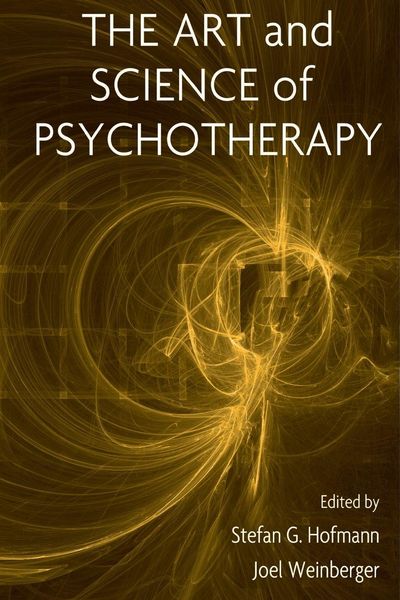
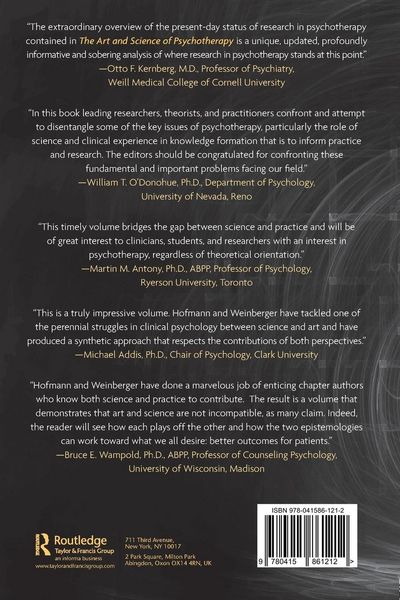
"The extraordinary overview of the present day status of research in psychotherapy contained in The Art and Science of Psychotherapy, edited by Stefan G. Hofmann and Joel Weinberger is a unique, updated, profoundly informative and sobering analysis of where research in psychotherapy stands at this point. In a collection of thirteen chapters by outstanding researchers and clinicians involved in the research and clinical practice of a broad spectrum of psychotherapies, the main findings, present trends, political and financial pressures, and social realities influencing research and reflecting dominant biases in research as well as in clinical practice are summarized and critically examined. The present day dominant move into the direction of "evidence supported treatment" is critically explored in the light of the accumulated experiences with this approach, and advantages and shortcomings are clearly spelled out. The importance of what is called "non-specific" or common factors of psychotherapy, that is the patient variables of prognostic relevance, the nature of the patient's expectations and their relation to the nature of the treatment approach, the therapeutic alliance, the nature of the therapeutic interaction, the personality of the therapist, and the psychosocial context in which treatment is carried out, all are highlighted as important modifiers of the therapeutic encounter that tend to be neglected in randomized controlled trials, together with the importance of particular events in psychotherapeutic treatments that require an emphasis on process research and on the research of mechanisms of change. In unmistakable ways, a majority of authors criticizes the relative isolation of much research from ordinary clinical practice, and the related discrepancy between the efficacy of highly controlled trials, on the one hand, and the effectiveness of a determined treatment model in the community, on the other.
A fair and objective focus on both cognitive behavioral and psychodynamic psychotherapies, both of which orientations are explored with a highly sophisticated focus from the viewpoint of the research questions raised in this volume should assure the interest of this book for the broadest spectrum of psychotherapists from all orientations. Both for the psychotherapy researcher and the practicing clinician, this volume provides a refreshingly clear, concise, and comprehensive review of the problems that the field of psychotherapy struggles with today, and an honest exploration of social pressures, such as the biases of funding agencies and managed care interests in shaping and at times distorting the nature of the requirements for scientific progress. For all these reasons, it stands out as a unique, clear and fair platform from which new directions of research presently necessary to foster progress in the field of psychotherapy may be derived."
- Otto F. Kernberg, M.D., Professor of Psychiatry, Weill Medical College of Cornell University
"In this book leading researchers, theorists, and practitioners confront and attempt to disentangle some of the key issues of psychotherapy, particularly the role of science and clinical experience in knowledge formation that is to inform practice and research. The editors should be congratulated for confronting these fundamental and important problems facing our field."
- William T. O'Donohue, Ph.D., Department of Psychology, University of Nevada, Reno
"This timely volume bridges the gap between science and practice, and will be of great interest to clinicians, students, and researchers with an interest in psychotherapy, regardless of theoretical orientation."
- Martin M. Antony, Ph.D., ABPP, Professor of Psychology at Ryerson University in Toronto, USA
"This is a truly impressive volume. Hoffman and Weinberger have tackled one of the perennial struggles in clinical psychology between science and art, and have produced a synthetic approach that respects the contributions of both perspectives."
- Michael Addis, Ph.D., Chair of Psychology, Clark University, USA
"Hofmann and Weinberger have done a marvelous job of enticing chapter authors who know both science and practice to contribute. The result is a volume that demonstrates that art and science are not incompatible, as many claim. Indeed, the reader will see how each plays off the other and how the two epistemologies can work toward what we all desire: better outcomes for patients."
- Bruce E. Wampold, Ph.D., ABPP, Professor of Counseling Psychology, University of Wisconsin, Madison, USA