
Gutscheinbedingungen

**Gültig am 28.06.2026 auf Spielzeug, Schreibwaren, Filme, Geschenke & Trends, Musik, tolino eReader & Zubehör, Hörbücher und Hörbuch-Downloads (außer Abo), nicht preisgebundene Bücher und Kalender online auf thalia.at und in der Thalia App. Einzelne Artikel können ausgeschlossen sein. Aufgrund der Buchpreisbindung sind deutschsprachige Bücher und eBooks ausgenommen. Zusätzlich ausgenommen sind preisgebundene Artikel, Abos & Flatrates, eBooks, Games, Geschenkkarten/-boxen, Shelfies, Software, Zeitschriften sowie einzelne Artikel von tonies®. Pro Einkauf einmal einlösbar. Click & Collect nur bei Onlinevorabzahlung möglich. Keine Barauszahlung. Nicht kombinierbar mit anderen Aktionen und Gutscheinen. Gutschein wird auf max. 500€ Bestellwert angerechnet. Nicht gültig für Versandkosten und Services.

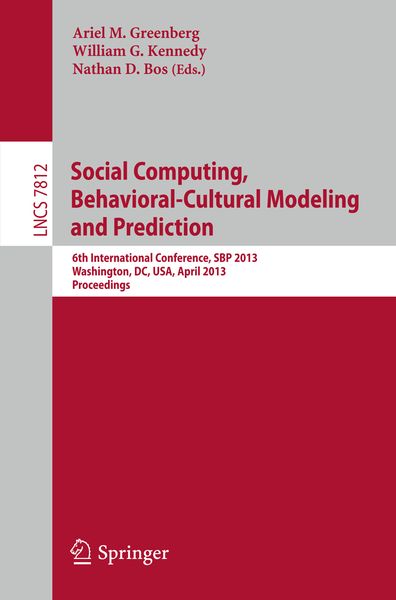
  • Produktbild: Social Computing, Behavioral-Cultural Modeling and Prediction
  • Produktbild: Social Computing, Behavioral-Cultural Modeling and Prediction
Band 6589

Social Computing, Behavioral-Cultural Modeling and Prediction 6th International Conference, SBP 2013, Washington, DC, USA, April 2-5, 2013, Proceedings

51,99 €

inkl. gesetzl. MwSt., Versandkostenfrei


Beschreibung

Produktdetails

Einband

Taschenbuch

Erscheinungsdatum

21.03.2013

Herausgeber

Ariel M. Greenberg + weitere

Verlag

Springer Berlin

Seitenzahl

535

Maße (L/B/H)

23,5/15,5/3 cm

Gewicht

826 g

Auflage

2013

Sprache

Englisch

ISBN

978-3-642-37209-4

Beschreibung

Produktdetails

Einband

Taschenbuch

Erscheinungsdatum

21.03.2013

Herausgeber

Verlag

Springer Berlin

Seitenzahl

535

Maße (L/B/H)

23,5/15,5/3 cm

Gewicht

826 g

Auflage

2013

Sprache

Englisch

ISBN

978-3-642-37209-4

Herstelleradresse

Springer-Verlag GmbH
Tiergartenstr. 17
69121 Heidelberg
DE

Email: ProductSafety@springernature.com

Kundinnen und Kunden meinen

0 Bewertungen

Informationen zu Bewertungen

Zur Abgabe einer Bewertung ist eine Anmeldung im Konto notwendig. Die Authentizität der Bewertungen wird von uns nicht überprüft. Wir behalten uns vor, Bewertungstexte, die unseren Richtlinien widersprechen, entsprechend zu kürzen oder zu löschen.

Die Bewertungen sind nach Format, Anzahl Sterne und Datum sortiert.

Verfassen Sie die erste Bewertung zu diesem Artikel

Helfen Sie anderen Kund*innen durch Ihre Meinung

Kundinnen und Kunden meinen

0 Bewertungen filtern

  • Produktbild: Social Computing, Behavioral-Cultural Modeling and Prediction
  • Produktbild: Social Computing, Behavioral-Cultural Modeling and Prediction
  • Behavioral Science.- The Evolution of Paternal Care.- Parent Training Resource Allocation Optimization Using an Agent-Based Model of Child Maltreatment.- Influence and Power in Group Interactions.- The Marketcast Method for Aggregating Prediction Market Forecasts.- Peer Nominations and Its Relation to Interactions in a Computer Game.- Predicting People Personality Using Novel Mobile Phone-Based Metrics.- Moral Values from Simple Game Play.- An Agent-Based Model for Simultaneous Phone and SMS Traffic over Time.- Reconstructing Online Behaviors by Effort Minimization.- “Copping” in Heroin Markets: The Hidden Information Costs of Indirect Sales and Why They Matter.- Cultural Polarization and the Role of Extremist Agents: A Simple Simulation Model.- Using Imageability and Topic Chaining to Locate Metaphors in Linguistic Corpora.- Automated Trading in Prediction Markets.- Health Sciences.- Social Network Analysis of Peer Effects on Binge Drinking among U.S.
    Adolescents.- Feedback Dynamic between Emotional Reinforcement and Healthy Eating: An Application of the Reciprocal Markov Model.- Testing the Foundations of Quantal Response Equilibrium.- Discovering Consumer Health Expressions from Consumer-Contributed Content.- Patient-Centered Information Extraction for Effective Search on Healthcare Forum.- Controlling for Population Variances in Health and Exposure Risk
    Using Randomized Matrix Based Mathematical Modeling.- How Do E-Patients Connect Online? A Study of Social Support Roles in Health Social Networking.- Information Science.- Dynamic Stochastic Blockmodels: Statistical Models for Time-Evolving Networks.- LA-LDA: A Limited Attention Topic Model for Social Recommendation.- Graph Formation Effects on Social Welfare and Inequality in a Networked Resource Game.- Recommendation in Reciprocal and Bipartite Social Networks–A Case
    Study of Online Dating.- In You We Follow: Determining the Group Leader in Dialogue.- Pareto Distance for Multi-layer Network Analysis.- Formation of Multiple Networks.- A Flexible Framework for Probabilistic Models of Social Trust.- Coauthor Prediction for Junior Researchers.- Massive Media Event Data Analysis to Assess World-Wide Political Conflict and Instability.- Sparsification and Sampling of Networks for Collective Classification.- A Comparative Study of Social Media and Traditional Polling in the Egyptian Uprising of 2011.- Hashtag Lifespan and Social Networks during the London Riots.- A Text Cube Approach to Human, Social and Cultural Behavior in the Twitter Stream.- Mapping Cyber-Collective Action among Female Muslim Bloggers for the Women to Drive Movement.- Discovering Patterns in Social Networks with Graph Matching Algorithms.- Critiquing Text Analysis in Social Modeling: Best Practices, Limitations, and New Frontiers.- Which Targets to Contact First to Maximize Influence over Social Network.- Intruder or Welcome Friend: Inferring Group Membership in Online Social Networks.- Identifying Influential Twitter Users in the 2011 Egyptian Revolution.- Socio-Cultural Opinion Evolution.- Who Shall We Follow in Twitter for Cyber Vulnerability?.- Respondent-Driven Sampling in Online Social Networks.- Trade-Offs in Social and Behavioral Modeling in Mobile Networks.- Privacy Protection in Personalized Web Search: A Peer Group-Based Approach.- Detecting Anomalous Behaviors Using Structural Properties of Social Networks.- Measuring User Credibility in Social Media.- Financial Crisis, Omori’s Law, and Negative Entropy Flow.- Trust Metrics and Results for Social Media Analysis.- Methodology.- Predicting Mobile Call Behavior via Subspace Methods.- Modeling the Interaction between Emergency Communications and Behavior in the Aftermath of a Disaster.- Modeling the Dynamics of Dengue Fever.- Improving Markov Chain Monte Carlo Estimation with Agent-Based Models.- Military Science.- Geographic Profiling of Criminal Groups for Military Cordon and Search.- Exploiting User Model Diversity in Forecast Aggregation.- Risk-Based Models of Attacker Behavior in Cybersecurity.