KI-Beratung Beta

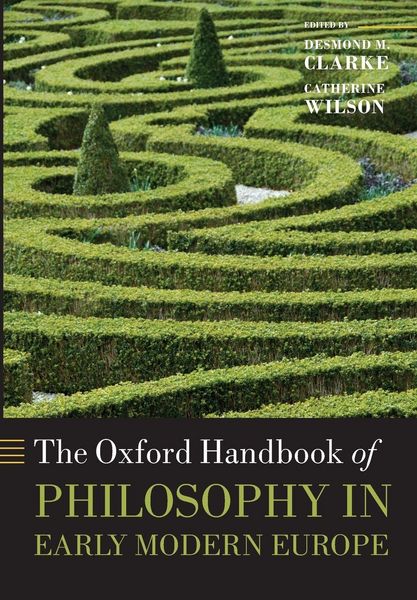
  • Produktbild: The Oxford Handbook of Philosophy in Early Modern Europe
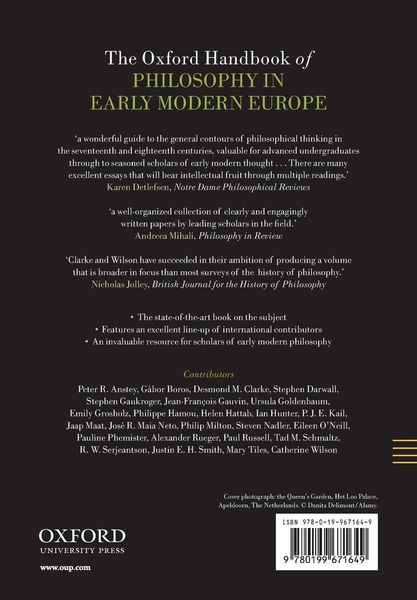
  • Produktbild: The Oxford Handbook of Philosophy in Early Modern Europe

The Oxford Handbook of Philosophy in Early Modern Europe

86,99 €

inkl. gesetzl. MwSt., Versandkostenfrei


Beschreibung

In this Handbook twenty-six leading scholars survey the development of philosophy between the middle of the sixteenth century and the early eighteenth century. The five parts of the book cover metaphysics and natural philosophy; the mind, the passions, and aesthetics; epistemology, logic, mathematics,...

Beschreibung

In this Handbook twenty-six leading scholars survey the development of philosophy between the middle of the sixteenth century and the early eighteenth century. The five parts of the book cover metaphysics and natural philosophy; the mind, the passions, and aesthetics; epistemology, logic, mathematics, and language; ethics and political philosophy; and religion. The period between the publication of Copernicus's De Revolutionibus and Berkeley's reflections on Newton and Locke saw one of the most fundamental changes in the history of our way of thinking about the universe. This radical transformation of worldview was partly a response to what we now call the Scientific Revolution; it was equally a reflection of political changes that were no less fundamental, which included the establishment of nation-states and some of the first attempts to formulate a theory of international rights and justice. Finally, the Reformation and its aftermath undermined the apparent unity of the Christian church in Europe and challenged both religious beliefs that had been accepted for centuries and the interpretation of the Bible on which they had been based. The Handbook surveys a number of the most important developments in the philosophy of the period, as these are expounded both in texts that have since become very familiar and in other philosophical texts that are undeservedly less well-known. It also reaches beyond the philosophy to make evident the fluidity of the boundary with science, and to consider the impact on philosophy of historical and political events--explorations, revolutions and reforms, inventions and discoveries. Thus it not only offers a guide to the most important areas of recent research, but also offers some new questions for historians of philosophy to pursue and to have indicated areas that are ripe for further exploration.

Produktdetails

Einband

Taschenbuch

Erscheinungsdatum

23.05.2013

Herausgeber Clarke Desmond M. + weitere
Verlag Oxford University Press

Produktdetails

Einband

Taschenbuch

Erscheinungsdatum

23.05.2013

Herausgeber
Verlag Oxford University Press
Seitenzahl

610

Maße (L/B/H)

24,4/17/3,3 cm

Gewicht

1037 g

Sprache

Englisch

ISBN

978-0-19-967164-9

Herstelleradresse

Libri GmbH
Europaallee 1
36244 Bad Hersfeld
DE

Email: gpsr@libri.de

Noch keine Bewertungen vorhanden

Verfassen Sie die erste Bewertung zu diesem Artikel

Helfen Sie anderen Kundinnen und Kunden durch Ihre Meinung.

Kundinnen und Kunden meinen

Bewertungen (0)

Die Leseprobe wird geladen.
  • Produktbild: The Oxford Handbook of Philosophy in Early Modern Europe
  • Produktbild: The Oxford Handbook of Philosophy in Early Modern Europe
    • Notes on the Contributors
    • Abbreviations
    • Introduction
    • Part I: Metaphysics and Natural Philosophy
    • 1: Peter R. Anstey: Essences and Kinds
    • 2: Tad M. Schmaltz: From Causes to Laws
    • 3: Emily Grosholz: Space and Time
    • 4: Helen Hattab: The Mechanical Philosophy
    • 5: Justin E. H. Smith: Machines, Souls, and Vital Principles
    • Part II: The Mind, the Passions, and Aesthetics
    • 6: R. W. Serjeantson: The Soul
    • 7: Pauline Phemister: Ideas
    • 8: Philippe Hamou: Qualities and Sensory Perception
    • 9: Gabor Boros: The Passions
    • 10: Alexander Rueger: Aesthetics
    • Part III: Epistemology, Logic, Mathematics and Language
    • 11: José R. Maia Neto: Sceptisism
    • 12: Desmond M. Clarke: Hypotheses
    • 13: Jaap Maat: Language and Semiotics
    • 14: Mary Tiles: Form, Reason, and Method
    • 15: Jean-François Gauvin: Instruments of Knowledge
    • 16: Stephen Gaukroger: Picturability and Mathematical Ideals of Knowledge
    • Part IV: Ethics and Political Philosophy
    • 17: P. J. E. Kail: Virtue and Vice
    • 18: Stephen Darwall: Egoism and Morality
    • 19: Catherine Wilson: Realism and Relativism in Ethics
    • 20: Paul Russell: The Free Will Problem
    • 21: Eileen O'Neill: The Equality of Men and Women
    • 22: Ian Hunter: Natural Law as Political Philosophy
    • 23: Ursula Goldenbaum: Sovereignty and Obedience
    • Part V: Religion
    • 24: Steven Nadler: Conceptions of God
    • 25: Desmond M. Clarke: The Epistemology of Religious Belief
    • 26: Philip Milton: Religious Toleration