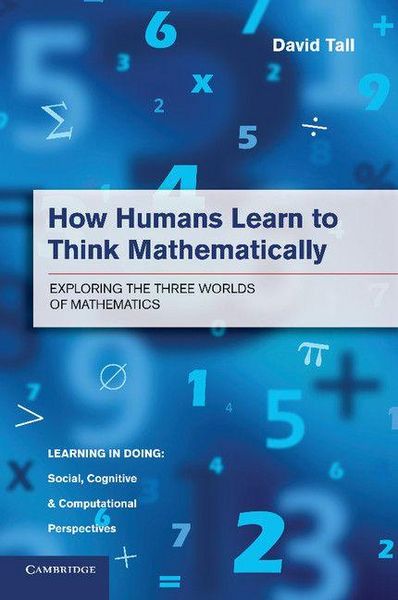
How Humans Learn to Think Mathematically Exploring the Three Worlds of Mathematics, Nominiert: PROSE Award for Psychology 2013
-
- Hardcover
- Taschenbuch ausgewählt
- eBook
-
Sprache:Englisch
61,99 €
inkl. gesetzl. MwSt.,
Beschreibung
Produktdetails
Einband
Taschenbuch
Erscheinungsdatum
30.07.2014
Verlag
Cambridge University PressSeitenzahl
484
Maße (L/B/H)
22,9/15,2/2,7 cm
Gewicht
640 g
Sprache
Englisch
ISBN
978-1-107-66854-6
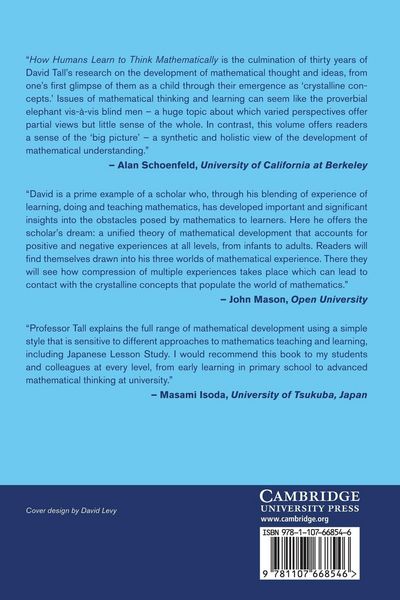
How Humans Learn to Think Mathematically describes the development of mathematical thinking from the young child to the sophisticated adult. Professor David Tall reveals the reasons why mathematical concepts that make sense in one context may become problematic in another. For example, a child's experience of whole number arithmetic successively affects subsequent understanding of fractions, negative numbers, algebra, and the introduction of definitions and proof. Tall's explanations for these developments are accessible to a general audience while encouraging specialists to relate their areas of expertise to the full range of mathematical thinking. The book offers a comprehensive framework for understanding mathematical growth, from practical beginnings through theoretical developments, to the continuing evolution of mathematical thinking at the highest level.
Noch keine Bewertungen vorhanden
Verfassen Sie die erste Bewertung zu diesem Artikel
Helfen Sie anderen Kundinnen und Kunden durch Ihre Meinung.
Kurze Frage zu unserer Seite
Vielen Dank für Ihr Feedback
Wir nutzen Ihr Feedback, um unsere Produktseiten zu verbessern. Bitte haben Sie Verständnis, dass wir Ihnen keine Rückmeldung geben können. Falls Sie Kontakt mit uns aufnehmen möchten, können Sie sich aber gerne an unseren Kund*innenservice wenden.
zum Kundenservice