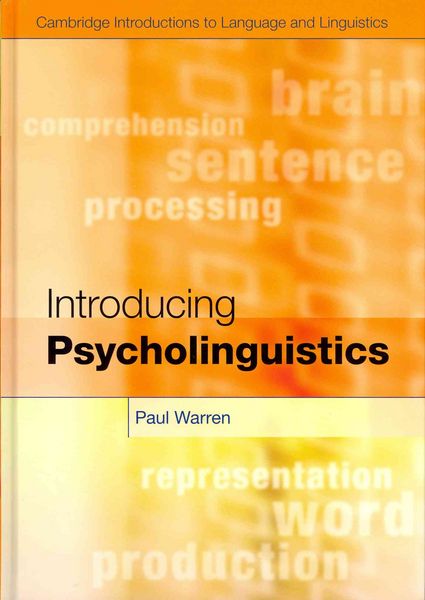
Introducing Psycholinguistics
-
- Hardcover ausgewählt
- Taschenbuch
- eBook
-
Sprache:Englisch
159,99 €
inkl. gesetzl. MwSt.,
Beschreibung
Produktdetails
Einband
Gebundene Ausgabe
Erscheinungsdatum
11.10.2012
Verlag
Cambridge AcademicSeitenzahl
288
Maße (L/B/H)
25/17,5/2 cm
Gewicht
720 g
Sprache
Englisch
ISBN
978-0-521-11363-2
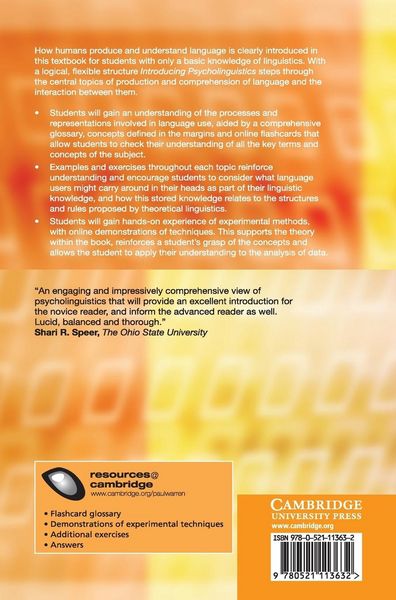
How humans produce and understand language is clearly introduced in this textbook for students with only a basic knowledge of linguistics. With a logical, flexible structure Introducing Psycholinguistics steps through the central topics of production and comprehension of language and the interaction between them. Students will gain an understanding of the processes and representations involved in language use, aided by a comprehensive glossary, concepts defined in the margins and online flashcards that allow students to check their understanding of all the key terms and concepts of the subject. Examples and exercises throughout each topic reinforce understanding and encourage students to consider what language users might carry around in their heads as part of their linguistic knowledge, and how this stored knowledge relates to the structures and rules proposed by theoretical linguistics. Students will gain hands-on experience of experimental methods, with online demonstrations of techniques. This supports the theory within the book, reinforces a student's grasp of the concepts and allows the student to apply their understanding to the analysis of data.
Noch keine Bewertungen vorhanden
Verfassen Sie die erste Bewertung zu diesem Artikel
Helfen Sie anderen Kundinnen und Kunden durch Ihre Meinung.
Kurze Frage zu unserer Seite
Vielen Dank für Ihr Feedback
Wir nutzen Ihr Feedback, um unsere Produktseiten zu verbessern. Bitte haben Sie Verständnis, dass wir Ihnen keine Rückmeldung geben können. Falls Sie Kontakt mit uns aufnehmen möchten, können Sie sich aber gerne an unseren Kund*innenservice wenden.
zum Kundenservice