Produktbild: A Perfect Moral Storm

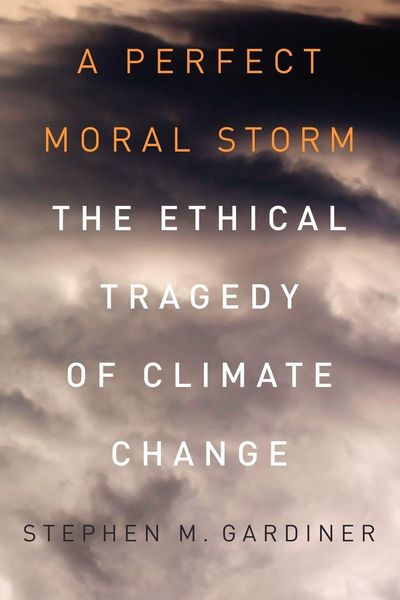
A Perfect Moral Storm The Ethical Tragedy of Climate Change

45,99 €

inkl. gesetzl. MwSt., Versandkostenfrei


Beschreibung

Produktdetails

Einband

Taschenbuch

Erscheinungsdatum

01.03.2013

Verlag

Oxford Academic

Seitenzahl

518

Maße (L/B/H)

23,4/15,6/2,8 cm

Gewicht

748 g

Sprache

Englisch

ISBN

978-0-19-998514-2

Beschreibung

Zitat

"Gardiner has expertly explored some very instinctual and vitally important considerations which cannot realistically be ignored. --Required reading." --Robin Whitlock, Green Prophet"Gardiner makes a strong case for highlighting and insisting on the ethical dimensions of the climate problem, and his warnings about buck-passing and the dangerous appeal of moral corruptions hit home." --Steve Yearley, Times Higher Education"Stephen Gardiner takes to a new level our understanding of the moral dimensions of climate change. A Perfect Moral Storm argues convincingly that climate change is the greatest moral challenge our species has ever faced -- and that the problem goes even deeper than we think." --Peter Singer, Princeton University "This is a radical book, both in the sense that it faces extremes and in the sense that it goes to the roots." -- Holmes Rolston, III, Notre Dame Philosophical Reviews"Everyone who is interested in ethics, the future of her children, or the welfare of the planet, should read this book. Clear, analytically precise, and superbly written, Gardiner does practical philosophy at its very best. In analyzing the ethics of climate change, no moral philosopher anywhere does a better job than Gardiner. He sets the standard for work in this area." --Kristin Shrader-Frechette, Philosophy and Biological Sciences, University of Notre Dame "Gardiner's A Perfect Moral Storm sets a new standard in erudition, philosophical rigor, and interdisciplinary breadth in discussions of climate ethics. This book should be read by any philosopher, scientist, or policy-maker who is serious about addressing the moral challenge with which climate change confronts us." --Dale Jamieson, Environmental Studies and Philosophy, New York University "Written with great authority and lucidity, A Perfect Moral Storm identifies exactly why our ethical theories and intuitions have been found wanting in relation to climate chang

Produktdetails

Einband

Taschenbuch

Erscheinungsdatum

01.03.2013

Verlag

Oxford Academic

Seitenzahl

518

Maße (L/B/H)

23,4/15,6/2,8 cm

Gewicht

748 g

Sprache

Englisch

ISBN

978-0-19-998514-2

Herstelleradresse

Libri GmbH
Europaallee 1
36244 Bad Hersfeld
DE

Email: gpsr@libri.de

Noch keine Bewertungen vorhanden

Verfassen Sie die erste Bewertung zu diesem Artikel

Helfen Sie anderen Kundinnen und Kunden durch Ihre Meinung.

Kundinnen und Kunden meinen

Bewertungen (0)

Die Leseprobe wird geladen.
  • Produktbild: A Perfect Moral Storm
    • Contents

    • Preface

    • Acknowledgements

    • Introduction: A Global Environmental Tragedy

    • I. Some Assumptions

    • II. Introducing the Perfect Storm Metaphor

    • III. Climate Change

    • IV. The Wider Relevance of the Model

    • V. Outline of the Book

    • Part A: Overview

    • Chapter 1: A Perfect Moral Storm

    • I. Why Ethics?

    • II. The Global Storm

    • III. The Intergenerational Storm

    • IV. The Theoretical Storm

    • V. The Problem of Moral Corruption

    • Chapter 2: A Consumption Tragedy

    • I. What is the Point of Game Theory?

    • II. Motivating the Models

    • III. A Green Energy Revolution?

    • IV. Consumption and Happiness

    • Part B: The Global Storm

    • Chapter 3: Somebody Else's Problem

    • I. Past Climate Policy

    • II. Somebody Else's Burden

    • III. Against Optimism

    • IV. Conclusion

    • Chapter 4: In the Shadow of a Common Tragedy

    • I. Climate Prisoners?

    • II. An Evolving Tragedy

    • III. Beyond Pessimism

    • IV. Lingering Tragedy

    • V. Climate Policy in the Shadows

    • VI. Conclusion

    • Part C: The Intergenerational Storm

    • Chapter 5: The Tyranny of the Contemporary

    • I. Problems with 'Generations'

    • II. Intergenerational Buck-Passing

    • III. Intergenerational Buck-Passing vs. The Prisoners' Dilemma

    • IV. The Features of the Pure Intergenerational Problem

    • V. Applications and Complications

    • VI. Mitigating Factors

    • VII. The Non-Identity Problem: A Quick Aside

    • VIII. Conclusion

    • Chapter 6: An Intergenerational Arms Race?

    • I. Abrupt Climate Change

    • II. Three Causes of Political Inertia

    • III. Against Undermining

    • IV. Conclusion

    • Part D: The Theoretical Storm

    • Chapter 7: A Global Test for Political Institutions and Theories

    • I. The Global Test

    • II. Scenarios

    • III. A Conjecture

    • IV. Theoretical Vices

    • V. An Illustration: Utilitarianism

    • VI. Understanding the Complaint

    • VII. Conclusion

    • Chapter 8: Cost-Benefit Paralysis

    • I. Cost-Benefit Analysis in Normal Contexts

    • II. CBA for Climate Change

    • III. The Presumption Against Discounting

    • IV. The Basic Economics of the Discount Rate

    • V. Discounting the Rich?

    • VI. Declining Discount Rates

    • VII. Two Objections to "Not Discounting"

    • VIII. The "Devil's in the Details" Argument

    • IX. Conclusions

    • Part E: Moral Corruption

    • Chapter 9: Jane Austen vs. Climate Economics

    • I. Corruption

    • II. The Dubious Dashwoods: Initial Parallels

    • III. The Opening Assault on the Status of the Moral Claim

    • IV. The Assault on Content

    • V. Indirect Attacks

    • VI. The Moral of the Story

    • Chapter 10: Geoengineering in an Atmosphere of Evil

    • I. An Idea that is Changing the World

    • II. The Problem of Political Inertia Revisited

    • III. Two Preliminary Arguments: Cost and "Research First"?

    • IV. Arming the Future

    • V. Arm the Present?

    • VI. Evolving Shadows

    • VII. Underestimating 'Evil'

    • VIII. An Atmosphere of Evil?

    • IX. "But... Should We Do It?"

    • Part F: What Now?

    • Conclusion: The Immediate Future

    • Postscript: Some Initial Ethics of the Transition

    • I. Introduction

    • II. The Ethics of Skepticism

    • III. Past Emissions

    • IV. Future Emissions

    • V. Responsibility

    • VI. Ideal Theory

    • VII. Conclusion

    • Appendices

    • Appendix 1: The Population Tragedy

    • I. Hardin's Analysis

    • II. Population as a Tragedy of the Commons

    • III. Total Environmental Impact

    • IV. Conclusion

    • Appendix 2: Epistemic Corruption and Scientific Uncertainty in

    • Michael Crichton's State of Fear

    • I. What the Scientists Know

    • II. Certainty, Guesswork and the Missing Middle

    • III. Conclusion