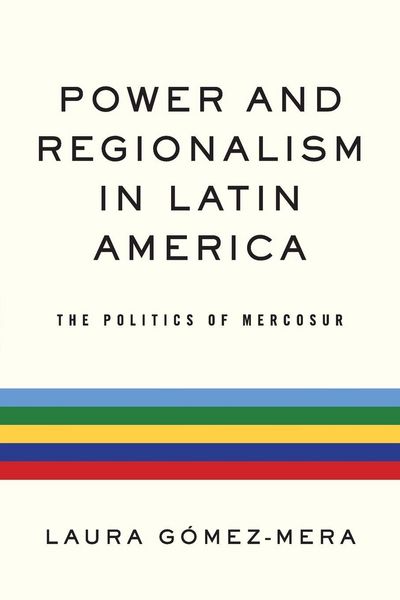
Power and Regionalism in Latin America The Politics of MERCOSUR
-
- Hardcover
- Taschenbuch ausgewählt
- eBook
-
Sprache:Englisch
-
Verlag:University Of Notre Dame Press
43,99 €
inkl. gesetzl. MwSt.,
Beschreibung
Produktdetails
Einband
Taschenbuch
Erscheinungsdatum
15.04.2013
Verlag
University Of Notre Dame PressSeitenzahl
306
Maße (L/B/H)
22,9/15,2/1,8 cm
Gewicht
500 g
Sprache
Englisch
ISBN
978-0-268-02985-2
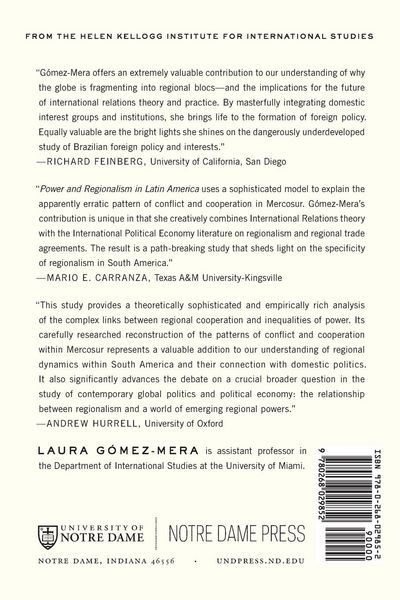
In Power and Regionalism in Latin America: The Politics of MERCOSUR, Laura Gómez-Mera examines the erratic patterns of regional economic cooperation in the Southern Common Market (MERCOSUR), a political-economic agreement among Argentina, Brazil, Paraguay, Uruguay, and, recently, Venezuela that comprises the world's fourth-largest regional trade bloc. Despite a promising start in the early 1990s, MERCOSUR has had a tumultuous and conflict-ridden history. Yet it has survived, expanding in membership and institutional scope. What explains its survival, given a seemingly contradictory mix of conflict and cooperation? Through detailed empirical analyses of several key trade disputes between the bloc's two main partners, Argentina and Brazil, Gómez-Mera proposes an explanation that emphasizes the tension between and interplay of two sets of factors: power asymmetries within and beyond the region, and domestic-level politics. Member states share a common interest in preserving MERCOSUR as a vehicle for increasing the region's leverage in external negotiations. Gómez-Mera argues that while external vulnerability and overlapping power asymmetries have provided strong and consistent incentives for regional cooperation in the Southern Cone, the impact of these systemic forces on regional outcomes also has been crucially mediated by domestic political dynamics in the bloc's two main partners, Argentina and Brazil. Contrary to conventional wisdom, however, the unequal distribution of power within the bloc has had a positive effect on the sustainability of cooperation. Despite Brazil's reluctance to adopt a more active leadership role in the process of integration, its offensive strategic interests in the region have contributed to the durability of institutionalized collaboration. However, as Gómez-Mera demonstrates, the tension between Brazil's global and regional power aspirations has also added significantly to the bloc's ineffectiveness.
Noch keine Bewertungen vorhanden
Verfassen Sie die erste Bewertung zu diesem Artikel
Helfen Sie anderen Kundinnen und Kunden durch Ihre Meinung.
Kurze Frage zu unserer Seite
Vielen Dank für Ihr Feedback
Wir nutzen Ihr Feedback, um unsere Produktseiten zu verbessern. Bitte haben Sie Verständnis, dass wir Ihnen keine Rückmeldung geben können. Falls Sie Kontakt mit uns aufnehmen möchten, können Sie sich aber gerne an unseren Kund*innenservice wenden.
zum Kundenservice