Gutscheinbedingungen

**Gültig bis 06.07.2026 auf fremdsprachige Bücher online auf thalia.at, in der Thalia App ab einem Mindestbestellwert von 30€ und in allen Thalia Buchhandlungen in Österreich. In den Buchhandlungen nur gültig auf lagernde Ware. Einzelne Artikel können ausgeschlossen sein. Ausgenommen sind preisgebundene Artikel & eBooks. Pro Einkauf einmal einlösbar. Nur gültig gegen Vorlage oder im Onlineshop hinterlegter Bonuscard. Infos zur Einlösung in der Buchhandlung sind auf der Bonuscard-Vorteilspreisseite zu finden. Click & Collect nur bei Onlinevorabzahlung möglich. Keine Einlösung bei Scan & Go-Bezahlung. Keine Barauszahlung. Nicht kombinierbar mit anderen Aktionen und Gutscheinen. Gutschein wird auf max. 500€ Bestellwert angerechnet. Nicht gültig für Versandkosten und Services.

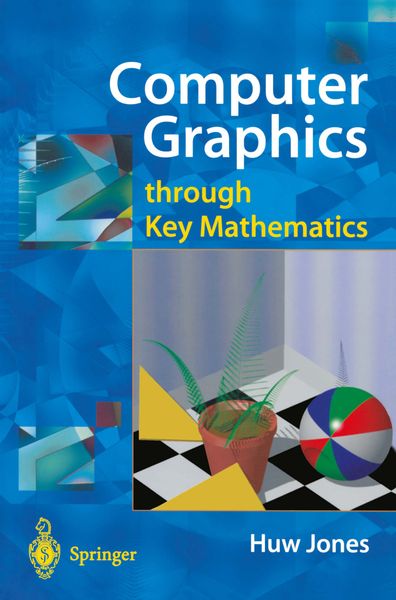
  • Produktbild: Computer Graphics through Key Mathematics
  • Produktbild: Computer Graphics through Key Mathematics
- 11%

Computer Graphics through Key Mathematics

11% sparen

82,99 € UVP 93,49 €

inkl. gesetzl. MwSt., Versandkostenfrei


Beschreibung

Produktdetails

Einband

Taschenbuch

Erscheinungsdatum

27.04.2001

Abbildungen

XIV, 10 illus., schwarz-weiss Illustrationen

Verlag

Springer London

Seitenzahl

343

Maße (L/B/H)

23,5/15,5/2 cm

Gewicht

557 g

Auflage

Softcover reprint of the original 1st ed. 2001

Sprache

Englisch

ISBN

978-1-85233-422-2

Beschreibung

Produktdetails

Einband

Taschenbuch

Erscheinungsdatum

27.04.2001

Abbildungen

XIV, 10 illus., schwarz-weiss Illustrationen

Verlag

Springer London

Seitenzahl

343

Maße (L/B/H)

23,5/15,5/2 cm

Gewicht

557 g

Auflage

Softcover reprint of the original 1st ed. 2001

Sprache

Englisch

ISBN

978-1-85233-422-2

Herstelleradresse

Springer-Verlag KG
Sachsenplatz 4-6
1201 Wien
AT

Email: GPSR Kontakt

Noch keine Bewertungen vorhanden

Verfassen Sie die erste Bewertung zu diesem Artikel

Helfen Sie anderen Kundinnen und Kunden durch Ihre Meinung.

Kundinnen und Kunden meinen

Bewertungen (0)

  • Produktbild: Computer Graphics through Key Mathematics
  • Produktbild: Computer Graphics through Key Mathematics
  • 1 The Processes of Computer Graphics.- Object Model Building.- Depiction of Models.- Conclusion.- 2 Numbers, Counting and Measuring.- Natural Numbers.- Integers.- Rational Numbers.- Real Numbers.- Complex Numbers.- Representations of Number.- The Computer Representation of Number.- Boolean Algebra.- Summary.- 3 Coordinates and Dimension: Representations of Space and Colour.- Cartesian Coordinates.- Defining Space by Equations and Inequalities.- Angles.- Trigonometry and Polar Coordinates.- Dimension.- Coordinate Systems in Three Dimensions.- Colour and its Representation.- Summary.- 4 Functions and Transformations: Ways of Manipulating Space.- Functions as Mappings.- Graphs of Functions.- Transformations in 2D.- Transformations in 3D.- Combining Affine Transformations.- Inversion of Affine Transformations.- Inversion of Functions.- Shape Transformation by Function Change.- Conclusions.- 5 Form from Function: Analysis of Shapes.- The Straight Line.- Drawing General Function Graphs.- Graphs of Polynomials.- Calculus: Differentiation.- Calculus: Integration.- Series Expansions.- Calculus and Animation.- The Exponential Function.- The Conic Sections.- Some Standard 3D Forms and their Equations.- Summary.- 6 Matrices: Tools for Manipulating Space.- Matrices in Computer Graphics.- Definition and Notation.- Forms of Matrices.- Operations on Matrices: Addition.- Operations on Matrices: Multiplication.- The Identity Matrix.- Matrices and Equations.- The Inverse of a Square Matrix.- Matrices, Transformations and Homogeneous Coordinates: Two Dimensions.- Matrices, Transformations and Homogeneous Coordinates: Three Dimensions.- Inverse of a Transformation Matrix.- Perspective Projection.- Computer Implementation of Matrix Methods.- Summary.- 7 Vectors: Descriptions of Spatial Relationships.- Definition of a Vector.- Notation.- Addition of Vectors: The Parallelogram and Triangle Laws.- Multiplication of a Vector by a Scalar.- Examples of Vector Quantities.- Vectors in 2D Cartesian Spaces.- Vectors in 3D Cartesian Spaces.- Multiplication of Vectors: The Scalar or Dot Product.- Multiplication of Vectors: The Vector or Cross Product.- Representation of Lines Using Vectors.- Classification of Points against Planes Using Vectors.- Representation of Planes in Standard Form.- Intersection of a Line with a Plane.- Inclusion of a Point in a Triangle.- Reflected and Refracted Rays.- Distance between Two Skew Lines.- Intersection of Two Planes.- Summary.- 8 Geometric Modelling and Fractals: Building Descriptions of Objects.- Data Structures.- Geometric Modelling Systems.- Voxel Modelling Methods.- Constructive Solid Geometry (CSG).- Boundary Representation (B-Rep).- Isosurface Modelling.- Fractals.- Fractal Dimension.- Fractals Based in the Complex Plane: Julia and Mandelbrot Sets.- Fractals in Simulation of Natural Phenomena.- Summary.- 9 Splines: Generation of Curves and Surfaces.- Reasons for Splines.- Interpolation.- Bézier Splines for Curve Drawing.- Animation Control Using Cubic Bézier Curves.- Drawing Bézier Curves.- Interpolating Splines for Curve Generation.- Animation Control Using Interpolating Splines.- B-Splines.- Non-Uniform Rational B-Splines: NURBS.- Circles and Other Conic Sections.- Surface Construction Using Bézier Patches.- Surface Generation Based on Other Forms of Curve.- Depiction of Surface Patches.- Summary.- 10 Drawing and Rendering: How to Create Pictures.- What is a 3D Drawing?.- Methods for Rendering.- Hidden Surface Removal.- Flat or Lambert Shading.- Scan Line Methods.- Gouraud Shading.- Phong Shading.- Exact Object Rendering.- Shadows.- Specular Highlights.- Textures.- Ray Tracing.- Radiosity.- Anti-Aliasing.- Summary.- Suggestions for Further Reading.- Mathematical and Scientific Minds.- Understanding of Mathematics.- Computer Graphics in General.- Geometric Modelling.- Fractals and Related Issues.- Journals.- Names.