KI-Beratung Beta

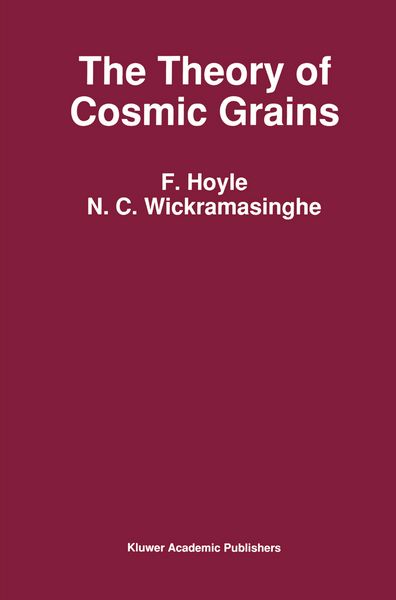
  • Produktbild: The Theory of Cosmic Grains
  • Produktbild: The Theory of Cosmic Grains
Band 168

The Theory of Cosmic Grains

148,99 €

inkl. gesetzl. MwSt., Versandkostenfrei


Beschreibung

Produktdetails

Einband

Taschenbuch

Erscheinungsdatum

24.09.2012

Abbildungen

IX, 307 p.

Verlag

Springer Netherland

Seitenzahl

307

Maße (L/B/H)

23,5/15,5/1,8 cm

Gewicht

487 g

Auflage

1. Auflage

Sprache

Englisch

ISBN

978-94-010-5505-5

Beschreibung

Produktdetails

Einband

Taschenbuch

Erscheinungsdatum

24.09.2012

Abbildungen

IX, 307 p.

Verlag

Springer Netherland

Seitenzahl

307

Maße (L/B/H)

23,5/15,5/1,8 cm

Gewicht

487 g

Auflage

1. Auflage

Sprache

Englisch

ISBN

978-94-010-5505-5

Herstelleradresse

Springer-Verlag GmbH
Europaplatz 3
69115 Heidelberg
DE

Email: ProductSafety@springernature.com

Noch keine Bewertungen vorhanden

Verfassen Sie die erste Bewertung zu diesem Artikel

Helfen Sie anderen Kundinnen und Kunden durch Ihre Meinung.

Kundinnen und Kunden meinen

Bewertungen (0)

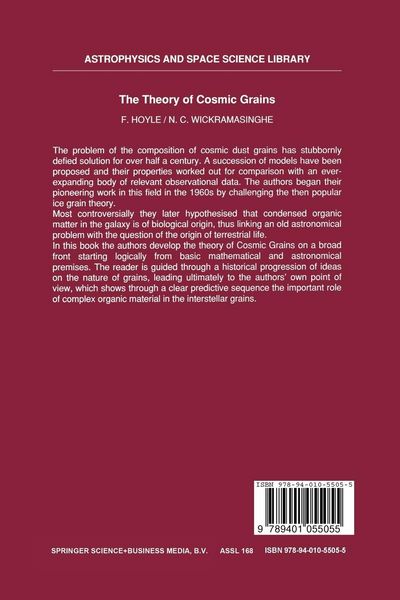
  • Produktbild: The Theory of Cosmic Grains
  • Produktbild: The Theory of Cosmic Grains
  • 1. Introduction.- 1.1. Early Ideas.- 1.2. Trumpler’s Method of Estimating Interstellar Extinction.- 1.3. The First Colour Measurements.- 1.4. The Oort Limit.- 1.5. Data Relating to Interstellar Clouds.- 1.6. Correlation Between Gas and Dust Clouds.- 1.7. Composition of Grains.- 2. Electromagnetic Properties of Small Particles.- 2.1. Homogeneous Spherical Particles.- 2.2. Composite Spheres.- 2.3. Infinite Cylinders.- 2.4. Rayleigh Scattering by Ellipsiods.- 2.5. Heterogeneous or Porous Grains.- 2.6. Absorption Cross—sections, Bulk Absorption Coefficient and Emissivity.- 2.7. Two Special Cases.- 3. Interstellar Extinction and Polarisation.- 3.1. Equation of Transfer.- 3.2. Observations of Interstellar Extinction, Definition of Colour Indices and Colour Excesses.- 3.3. Observations of Interstellar Polarisation.- 3.4. Diffuse Interstellar Bands.- 4. Reflection Nebulae and the Diffuse Galactic Light.- 4.1. Introductory Remarks.- 4.2. Apparent Size of Reflection Nebulae.- 4.3. Observations of NGC 7023.- 4.4. Observations of Reflection Nebula Around Merope.- 4.5. Multiple Scattering Models of Reflection Nebulae.- 4.6. Diffuse Galactic Light.- 5 Interactions between Dust, Gas and Radiation.- 5.1.Introductory Remarks.- 5.2. Grain Temperatures for Sandard Grains.- 5.3.Temperature Spikes in Very Small Grains.- 5.4.Electrostatic Gharge on Grains.- 5.5.Rotation of Grains.- 5.6.Radio Waves from Grains.- 5.7.Molecule Formation.- 5.8. Growth and Destruction of Grains.- 5.9. Effects of Radiation Pressure.- 5.10. Gyration About the Magnetic Field.- 5.11. Alignment of Grains.- 5.12. Depletion of Elements from the Gas Phase.- 6. Inorganic Theories of Grain Formation.- 6.1. Interstellar Condensation.- 6.2. Condensation of Graphite Grains.- 6.3. Condensation of Grains in CoolOxygen—rich Giant Stars.- 6.4. Core—mantle Grains.- 7. The Organic Grain Model.- 7.1. Introductory Remarks.- 7.2. Polymerisation of Formaldehyde.- 7.3. From Formaldehyde to Polysacharides.- 7.4. Polysacharide Formation in Stellar Mass Flows.- 7.5. HAC, PAH and QCC Models.- 7.6. Fischer Tropsch Reactions in the Gas Phase.- 7.7. The Biological Grain Model.- 8. Models of the Extinction and Polarisation of Starlight.- 8.1. Introduction.- 8.2. The Visual Extinction Curve.- 8.3. The Ultraviolet Extinction Curve: Extinction Curves for Graphite Grains.- 8.4. Polarisation Constraints.- 8.5. An Organic/Biologic Grain Model.- 8.6. Analysis of a Biological Grain Model.- 8.7. Refinements to Biological Extinction Model.- 9. Spectroscopic Identifications.- 9.1. Introduction.- 9.2. The 8 – 13µm Features in Astronomy.- 9.3. The 8 – 40µm Flux from the Trapezium Nebula.- 9.4. The 3.4µm Band: Proof that Grains are Mainly Organic.- 9.5. Modelling the 2.9 – 4µm IR Data for GC-IRS7.- 9.6. How Much Water — Ice?.- 9.7. Sources with Spectra in the 2 – 14µm Waveband.- 9.8. Evidence for PAH.- 9.9. Aromatic Molecules and the Diffuse Optical Bands.- 10. Dust in External Galaxies.- 10.1. Introduction.- 10.2. The Magellanic Clouds: LMC and SMC.- 10.3. M82 and Other Galaxies.- 10.4. Particles of High Infrared Emissivity.- 10.5. The Ejection of Iron Whiskers from Galaxies.- 10.6. The Microwave Background.